The Proverbial Messenger
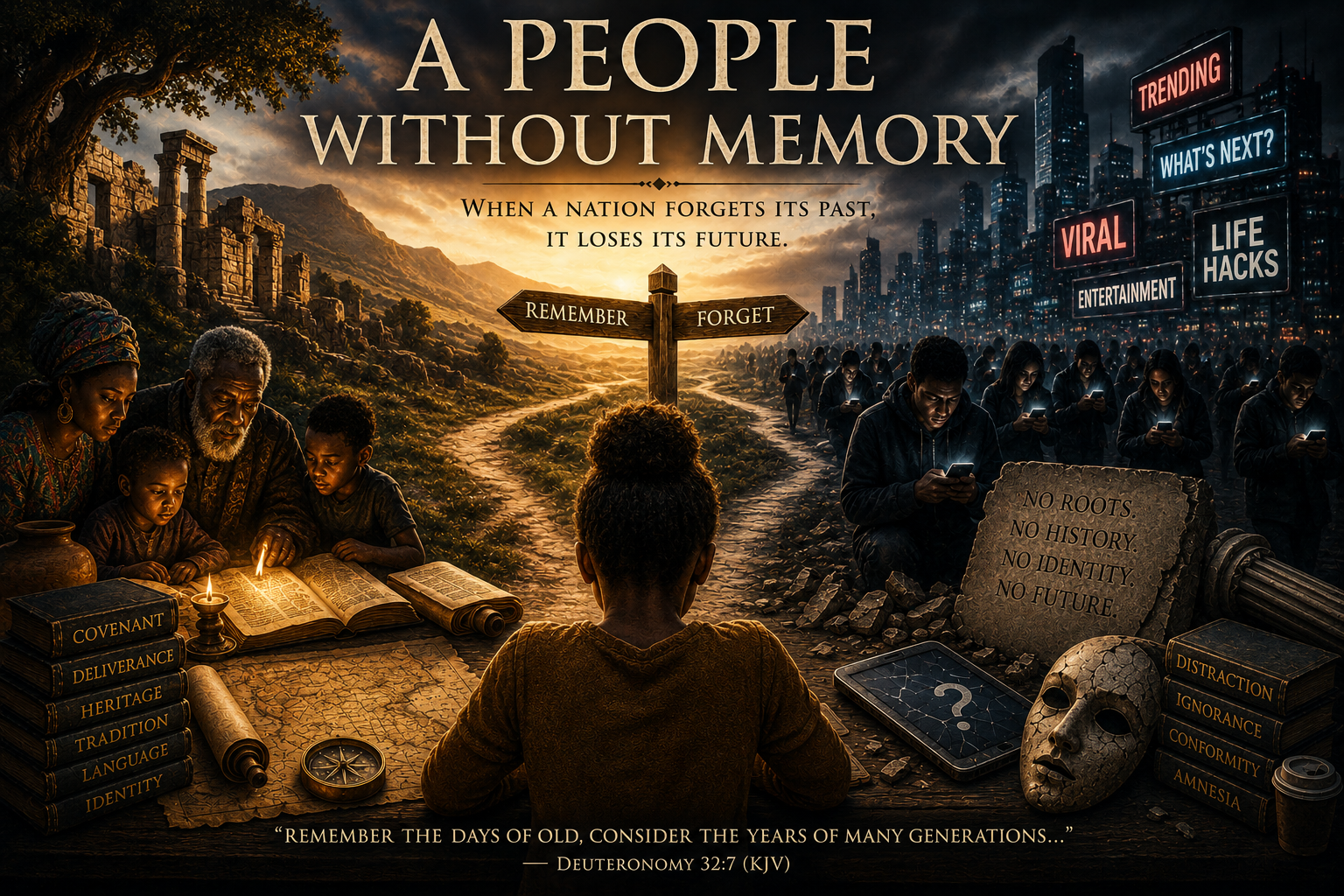
A People Without Memory
A people who lose their memory will eventually lose themselves.
“Remember the days of old, consider the years of many generations…”
— Deuteronomy 32:7 (KJV)
Every civilisation remembers.
A nation remembers its victories.
A family remembers its ancestors.
A people remembers its language.
A culture remembers its customs.
A faith remembers its covenant.
Memory is far more than the ability to recall events. It is the thread that binds one generation to the next. It tells a child where he came from, why his people think as they do, what they value, and what they are expected to preserve for those who come after. Without memory, identity begins to dissolve.
For this reason, the preservation of memory has always been one of civilisation's great occupations. Libraries are built and monuments erected. Genealogies are recorded. Songs are sung and feasts observed. Laws are written down. Parents teach their children, and elders recount what they received from those who came before them.
Civilisations understand something that modern society often forgets: a people who lose their memory will eventually lose themselves.
More Than History
History records what happened. Memory explains why it matters.
Two nations may remember the same event in entirely different ways, because memory is not merely the collection of facts. It is the inheritance of meaning. This is why every civilisation tells stories about its beginnings, not because the past can be relived, but because the future cannot be understood without it.
A child who grows up knowing nothing of his family often spends years searching for his identity. The same is true of nations. A people separated from their history eventually begin to borrow others' identities.
The Fragility of Memory
Memory is surprisingly fragile. It can fade gradually rather than suddenly. One generation neglects to teach. Another forgets to ask. A third assumes that what remains is all there ever was. Then, almost without anyone noticing, the memory of an entire people begins to fade.
Languages disappear. Old customs become unfamiliar. Ancient names lose their meaning. Sacred places become tourist attractions. Traditions persist long after their purpose has been forgotten, and people preserve the practice while forgetting the reason.
Perhaps the greatest loss is not the disappearance of objects or buildings. It is the disappearance of understanding.
A civilisation survives not because it remembers everything, but because it remembers the things that make it itself.
For a civilisation that remembers itself possesses something far greater than information. It possesses identity.
When Memory Is Replaced
Nature does not tolerate a vacuum. When genuine memory disappears, something else inevitably fills the space. Legends replace history. Assumptions replace investigation. Popular opinion replaces evidence. Inherited tradition replaces careful examination.
Consider a name carved in stone that no living person can read; a song passed down through generations in a tongue the singers themselves no longer understand; a feast kept faithfully, year after year, long after anyone can say what it commemorates. The form endures. The meaning has quietly departed.
Soon people begin defending ideas they never questioned, because they no longer remember where those ideas came from. The loss of memory does not produce neutrality. It produces confusion.
Why Scripture Commands Remembrance
Few books place greater emphasis upon remembrance than the Scriptures. Again and again, Israel is commanded to remember — and each command carries its own weight.
Remember the deliverance: “remember that thou wast a servant in the land of Egypt” (c).
Remember the wilderness: “thou shalt remember all the way which the LORD thy God led thee these forty years in the wilderness” (Deuteronomy 8:2).
Remember the sabbath: “Remember the sabbath day, to keep it holy” (Exodus 20:8).
Remember the commandments: “that ye may remember, and do all my commandments” (Numbers 15:40).
Remember the days of old: “consider the years of many generations” (Deuteronomy 32:7).
These are not sentimental reflections upon the past. They are safeguards against forgetting identity. A people who forgets who they are will eventually forget why they exist. The loss of memory is never merely intellectual. It is spiritual.
The Modern Condition
Modern society possesses more information than any civilisation before it. Yet information is not memory. We know more facts, preserve more data, store more images, and archive more documents than any generation that came before — and still we are no closer to understanding ourselves.
The internet can answer almost any question except one: Who are we?
That question cannot be answered by an algorithm. It must be answered through history, reflection, careful investigation, and the honest examination of evidence.
Recovering Memory
Recovering memory does not mean living in the past, nor romanticising former generations. Memory should never imprison us. It should orient us.
A navigator studies the stars, not because he wishes to sail backwards, but because they help him understand where he is and where he is going. The same is true of civilisations. A people secure in their memory are not threatened by honest investigation. They welcome it, for truth does not fear examination.
Indeed, every genuine recovery begins with a willingness to ask difficult questions. Who were our ancestors? What did they believe? How did we arrive where we are today? What has been preserved, and what has been forgotten?
The Responsibility of Every Generation
Every generation inherits. Some inherit wealth. Some inherit institutions. Some inherit books. Some inherit traditions. All inherit memory.
Whether that inheritance is preserved or neglected depends on those who receive it. If we fail to remember, we do not merely lose knowledge — we sever the conversation between generations. We leave those who come after us searching for answers that were once common knowledge.
Perhaps one of the greatest responsibilities of scholarship is not simply the discovery of new knowledge. It is the recovery of forgotten memory.
For a civilisation that remembers itself possesses something far greater than information. It possesses identity.
And a people who remember who they are, are far more difficult to persuade that they are something else.