Reflections · History and Identity
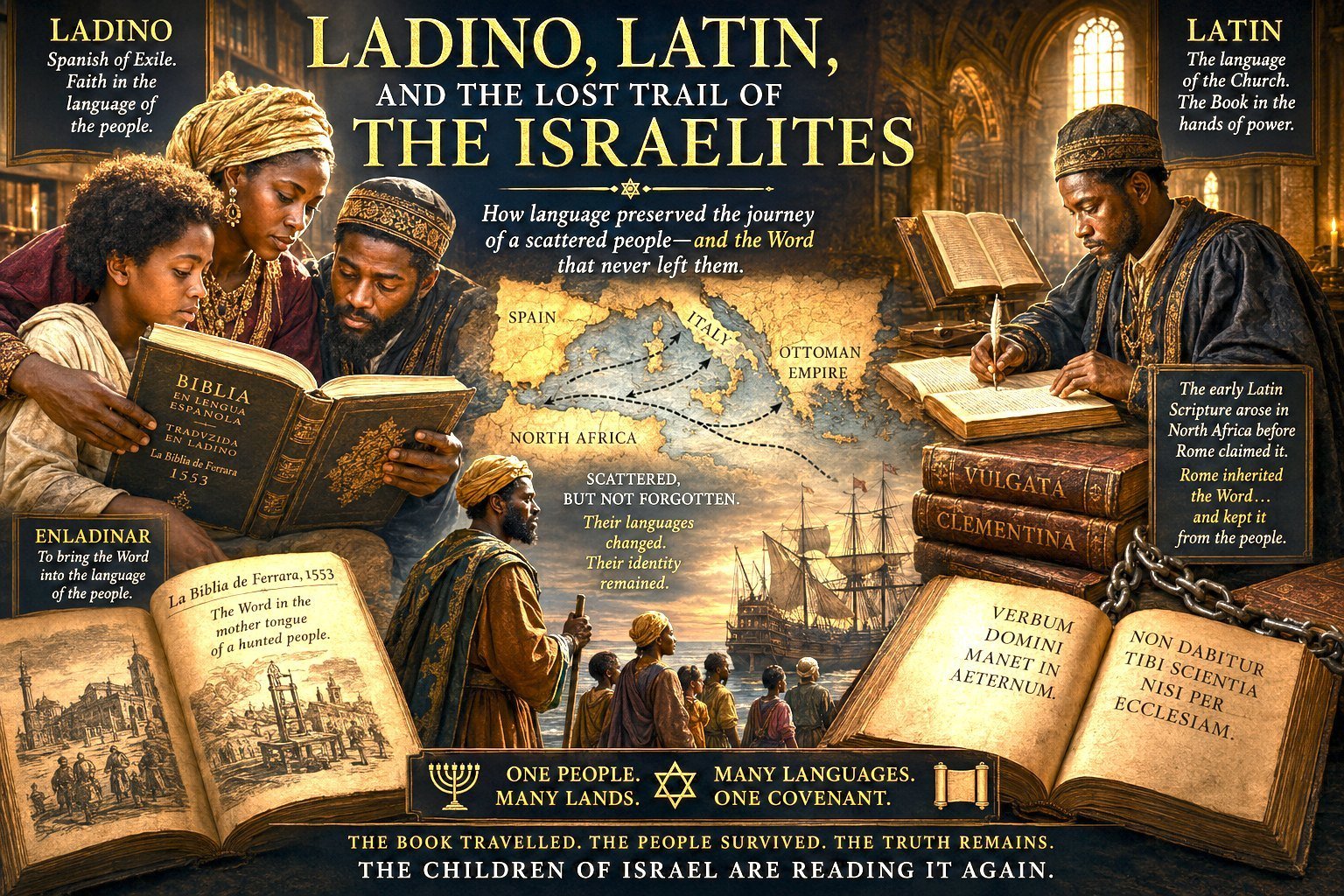
Ladino, Latin, and the Lost Trail of the Israelites
How language preserved the journey of a scattered people — and the Word that never left them.
When people imagine an ancient nation, they often assume that the people must have spoken one language continuously from generation to generation. If that language changed, they assume the identity must also have changed.
But history does not work that way.
A scattered people does not always carry one language wherever it goes. It often adopts the language of the land in which it lives. The language may change, but the people — their customs, their memories, their sacred writings, and their connection to one another — can remain.
This is one of the major arguments developed in the revised and expanded edition of The Hidden Secrets of the True Israelites. The original book contained seven relatively concise chapters. The revised edition has grown into twenty-five chapters arranged in five major parts, with appendices, a glossary, historical timelines, and a detailed examination of the journey of the Israelites from Scripture into the modern world.
It is not simply the original book with a few additional pages. It has become a chain-of-custody investigation:
Who were the Israelites? What did they look like? What languages did they speak? Who preserved their Book? Where did they travel after the destruction of Jerusalem? How did some branches of the scattered people remain free while others eventually entered bondage?
Among the most revealing answers are found in the histories of Ladino and Latin.
The Israelites Spoke the Language of the Land
One of the greatest misconceptions concerning Israelite identity is the idea that the Israelites must always have spoken one permanent sacred language. Yet the historical pattern tells another story.
When Israelites lived among the Babylonians, they learned the language used in Babylon. When they lived under Greek rule, Greek became part of their world. When they lived throughout the Roman Empire, many spoke Greek, Latin, or the regional language of the place in which they had settled. When they lived in the Iberian Peninsula under Moorish rule, they spoke Arabic. When the Christian kingdoms gained control of Spain and Portugal, the people spoke the Romance languages of those lands — Castilian Spanish and Portuguese.
This did not make them Arabs, Babylonians, Greeks, Romans, Spaniards, or Portuguese by covenant identity. It meant that they spoke the language of the land in which they lived.
That principle is important, because language records movement.
A language can become a map. It can reveal where a people lived, who ruled over them, where they were expelled, and where they travelled after exile.
Few languages demonstrate this more clearly than Ladino.
Ladino: Spanish Frozen at the Hour of Exile
Ladino is often described as Judaeo-Spanish, but even that description does not fully capture what the language represents. Ladino developed from the Spanish spoken by the Israelites of the Iberian Peninsula before and during the expulsion of 1492.
When the Israelites were forced out of Spain, they carried with them the Castilian Spanish of that period. While the Spanish spoken inside Spain continued to develop and change, the speech of the exiles preserved many older expressions, pronunciations, and forms.
In that sense, Ladino became almost like a linguistic photograph. It preserved the sound of Spain at the moment the doors were closed against the exiles.
As those communities settled in the Ottoman Empire, North Africa, Italy, Amsterdam, Salonika, Istanbul, and other parts of the Mediterranean world, Ladino absorbed words from Turkish, Greek, Arabic, Italian, and other regional languages. But its foundation remained the Spanish carried out of Iberia.
The very existence of Ladino raises an important question. If the people had been continuously speaking one ancient sacred language among themselves, why would their daily speech have been Spanish? Why would they need Scripture translated into the language of Spain? Why would the language of exile preserve Castilian rather than some supposed unbroken language reaching back to Moses?
Ladino answers with the evidence of its own existence: the Israelites spoke the language of the land.
The Name Ladino Tells Its Own Story
The word Ladino is connected to Latino — Latin. It was also associated with the practice of rendering sacred writings into the common Romance language spoken by the people. The related verb enladinar referred to bringing a text into the language ordinary people could understand.
That principle is spiritually and historically significant. It represents the movement of the Word toward the people. Rather than demanding that the people climb into a difficult scholarly language before they could understand Scripture, the text was brought down into the language of the mother, the merchant, the child, and the household.
The people did not exist to serve the language. The language served the people.
This is the same principle displayed at Pentecost, when every person heard the wonderful works of the God of Israel in the tongue in which he had been born. The message was not hidden behind a linguistic gate. It was made understandable.
The Ferrara Bible: Scripture for a Hunted People
One of the most important examples of this principle is the Ferrara Bible, printed in 1553. It was produced in a world still shaped by the Spanish and Portuguese Inquisitions.
Many Israelites had been forced to convert publicly to Christianity while secretly attempting to preserve the customs and faith of their fathers. These secret practitioners became known as Conversos, Crypto-Jews, or Marranos. After generations of persecution and forced conversion, many could no longer read the older scriptural languages. They needed the Word in the language they actually understood.
The Ferrara Bible answered that need by rendering the First Testament into the Spanish of the Iberian exiles. This was not merely a translation project. It was an act of restoration. A people who had been separated from their history were being given access to that history again. A hunted people were being shown the road back to the covenant of their fathers.
The Ferrara Bible demonstrates that the preservation of identity does not always depend upon preserving one language. Sometimes identity is preserved by translating the truth into the language the scattered people can still understand.
Scattered Does Not Always Mean Enslaved
The revised edition also makes an important distinction that the original treatment did not explore in the same depth. The Sephardic exiles did not all experience the same fate.
Many travelled east and entered the Ottoman territories as free people. They established communities, operated businesses, published books, traded across the Mediterranean, and used Ladino in homes, markets, newspapers, theatres, and places of worship. They were scattered, but they were not enslaved.
Other branches of the Iberian Israelites travelled south and west into Africa. Some were forcibly deported. Some entered Portuguese territories. Some were carried to islands such as São Tomé. Some became trapped within the expanding machinery of Atlantic slavery. These branches belonged to the same broad scattering, but they did not walk the same road.
One road led into exile and merchant communities. Another road led toward Africa, the slave coast, and eventually the ships of bondage.
The revised edition is careful not to treat every Sephardic exile as though he or she became enslaved. That distinction matters, because accuracy strengthens the larger argument. The truth does not need exaggeration.
Latin: The Language Was Roman, but the Book Was Israelite
The discussion of Latin requires the same precision. Latin itself did not originate with the Israelites. It developed in Latium, the region surrounding Rome. The revised edition states this plainly.
But the deeper question is not who created the Latin language. The deeper question is: whose Book was translated into Latin?
The Scriptures did not originate in Rome. They were written by Israelites, preserved among Israelites, and carried by Israelites into the lands of their scattering. When Latin translations of Scripture began circulating in North Africa, the substance being translated was already an Israelite inheritance.
The language was Latin. The Book was Israelite.
This distinction is essential. A person who translates another nation's history into his own language does not become the author of that history. A church that catalogues, organises, or standardises writings does not become the creator of those writings.
Rome may have inherited Latin Scripture, standardised it, and later claimed authority over it, but Rome did not create the covenant, the prophets, the laws, the histories, the Psalms, the apostles, or the Messiah. The Book existed before Rome claimed it.
The North African Connection
The early Latin biblical tradition developed prominently in North Africa. Writers such as Tertullian of Carthage helped establish Latin theological vocabulary, and the Old Latin biblical tradition circulated in African regions before Latin became dominant in the church at Rome.
The revised edition connects this history to the Israelite diaspora already present throughout North Africa and the Mediterranean world. The point is not that every North African church leader can be conclusively identified as an Israelite. The point is that the scriptural inheritance they handled was Israelite before it entered their hands.
The Word had been carried outward through the scattering. The nations translated it. The institutions organised it. Rome eventually claimed it. But its origin remained Israelite.
Ladino Opened the Book; Rome Closed It
This is where Ladino and Latin create one of the most striking contrasts in the revised edition.
Ladino represents the effort to bring Scripture into the language of the people. Rome later used Latin as an institutional barrier between Scripture and the ordinary population. The same broad linguistic inheritance was therefore used in opposite ways.
The exiles translated the Word so that families could understand it. The Roman Church eventually restricted the Word to a language most ordinary people could not understand.
One tradition bent the Book downward. The other raised it behind a wall. One said, "Let the people hear." The other said, "Let the priesthood interpret."
This is not merely a debate about language. It is a question of custody. Who held the Book? Who opened it? Who closed it? Who translated it for the people? Who punished those who attempted to do the same?
The Word Continued to Travel
The revised edition follows this chain of custody much further. It traces the Scriptures from Israelite hands into Greek through the Septuagint, through the Latin biblical tradition, through the scholarship of the Moorish and Iberian worlds, through the Ferrara Bible, and into the struggle to produce Scripture in English.
Men such as John Wycliffe and William Tyndale suffered because they believed ordinary people should have access to the Bible in their own language. That struggle eventually contributed to the publication of the King James Bible in 1611.
Eight years later, in 1619, the first documented captive Africans arrived in English Virginia.
The revised edition asks the reader to consider the significance of those dates. The Book had been prepared in the language of the coming land of bondage before the children of slavery arrived there.
They did not yet know that the history inside the Book was their own. They did not yet know that the curses, scattering, bondage, deliverance, and restoration described in its pages concerned their fathers. But the Book was waiting.
Language Is Not Identity
A people can lose a language and remain a people. A people can adopt another language and remain a people. A people can speak several languages across several countries and still share one ancestry, one covenant history, and one spiritual inheritance.
The Israelites spoke the languages of Egypt, Babylon, Persia, Greece, Rome, Arabia, Spain, Portugal, England, the Caribbean, and the Americas. Their languages changed because their locations changed. Their tongues recorded their scattering.
Ladino did not erase their identity. It preserved the sound of their exile. Latin did not create their Book. It became one of the vessels through which their Book travelled. English did not make the Bible European. It placed the Israelite record into the hands of descendants who had been forced to speak English in the land of their bondage.
Language is not the master of identity. It is one of history's witnesses.
Why This Revised Edition Matters
The revised and expanded edition of The Hidden Secrets of the True Israelites examines these subjects in far greater depth than the original work.
It does not merely state that the Israelites were scattered — it follows the roads of that scattering. It does not merely criticise the modern obsession with language — it examines the real languages historically spoken by the people. It does not simply claim that the Bible belongs to Israel — it follows the Book through a historical chain of custody. It distinguishes between the free Sephardic exile and the captive taken into Atlantic bondage. It separates documented history from doctrine, and repeatedly acknowledges where a claim can be established, where it remains an interpretation, and where further examination is necessary.
That added precision is one of the greatest strengths of the revised edition.
The result is not simply a longer book. It is a fuller investigation into the body, the language, the name, the Book, the scattering, the deception, and the return of the true Israelites.
Ladino and Latin are only two links in that chain. But once those links are examined, the trail becomes much harder to deny.
The people were scattered. Their languages changed. Their Book travelled. Their identity was hidden. But the evidence remained.
And the scattered children of Israel are beginning to read it again.
This reflection draws from the revised and expanded edition of The Hidden Secrets of the True Israelites — a chain-of-custody investigation into the body, language, name, and Book of the covenant people.
Learn more about The Hidden Secrets of the True Israelites →
Documentation
Selected References
Works directly cited, named, or used as a foundation for this reflection.
- Ford, C. D. Hidden Secrets of the True Israelites. Revised and expanded ed. Publication details to be added.
- Lazar, Moshe, ed. The Ladino Bible of Ferrara, 1553: A Critical Sephardic Classical Library 6. Culver City, CA: Labyrinthos, 1992.
- Heine, Ronald E. ‘The Beginnings of Latin Christian Literature.’ In The Cambridge History of Early Christian Literature, edited by Frances Young, Lewis Ayres, and Andrew Louth. Cambridge: Cambridge University Press, 2004.
- Septuagint.
- Wycliffe, John, and collaborators. Wycliffite Bible. c. 1382–1395.
- Tyndale, William. English biblical translations. 1526–1530.
- The Holy Bible, King James Version (1611).