The Proverbial Messenger
The African Emperor Who Died in York
A Reckoning with Roman Britain
History is not what happened. It is what was permitted to be remembered.
A Note on Provenance
Over the past couple of weeks, Scotland has come up repeatedly in my conversations, sometimes because of a Scottish surname, sometimes because of something else Scotland-related entirely, and each time it did, my mind was drawn back to a trip I took earlier this year and the essay that came from it. That piece was written for my online journal, a travel and culture platform I also maintain. But as I kept returning to it, I realised that what the essay was really doing, the argument underneath the travel narrative, belongs here, with you, the readers of The Proverbial Messenger. This is not the travel piece. It is the reckoning that the travel made possible. The trip was wonderful. This essay is about something else. It is about what the historical record of Roman Britain actually contains when you read it without the filter of received wisdom, and what the mechanisms of its omission reveal about the history we have been permitted to know.
History is not what happened. It is what was permitted to be remembered. And what was chosen to be forgotten tells us as much as what was kept.
I. What the Record Contains
The standard account of Roman Britain runs something like this: the Romans arrived in 43 CE, built roads and walls and baths, occupied the island for nearly four centuries, and eventually withdrew. The people of Britain were civilised, or at least administered. The empire left its marks. Then it left.
This account is not wrong. It is incomplete. And the nature of what it leaves out is not accidental.
The historical record of Roman Britain, the portrait panels, the military registers, the legal edicts, the bones in the ground, contains, in plain sight, evidence of an African imperial presence that shaped the course of Western civilisation. Not at the margins. Not as a footnote. At the summit.
The Emperor of Rome. His sons. His Syrian wife and the dynasty they founded together. The first empire-wide citizenship decree in the history of the ancient world. A young woman of suggested North African ancestry buried in York with grave goods that indicate considerable rank. A regiment of Moorish soldiers stationed at the western end of Hadrian's Wall.
The emperor's campaigns, the edict and the military presence from across the empire are in the documentary record. The interpretations this essay draws from portrait evidence and archaeological finds sit within ongoing scholarly discussion, as it will note. What is not in dispute is that this history has received far less attention in the standard British historical account than the evidence warrants. Very little of it is taught. The omission has been remarkably consistent for an accident.
This essay is an attempt to read the record as it actually stands.
II. Septimius Severus, the Emperor at the Wall
The Man the History Books Bury in a Subheading
Septimius Severus was Roman Emperor from 193 to 211 CE. He is one of the most consequential rulers in the history of the empire, military reformer, legal architect, the man who stabilised Rome after the turbulence of the Year of the Five Emperors. He is also the emperor who personally led campaigns into what is now Scotland, in an invasion of Caledonia, from 208 to 211, that reoccupied forts first built under Agricola more than a century earlier and pressed the Roman presence deep into the north.
He was born in Leptis Magna, a Phoenician-founded city of extraordinary grandeur on the North African coast, in what is today Libya. His father's family were of Punic and North African heritage: peoples whose roots in that coastline long predated Rome's arrival. His mother's family had Italian origins. The North African heritage that shaped his upbringing and his outlook came principally through his father's line, and it is that paternal heritage, combined with the portrait evidence, that is consistently identified in the scholarship as defining his African origins. The precise mixture of Punic, Libyan and Italian descent in his ancestry is debated, and this essay does not pretend that debate away.
What is also in the record, and what makes the omission of this fact from standard British historical education particularly striking, is a portrait.
The Severan Tondo: Evidence in Plain Sight
The Severan Tondo is a painted wooden panel, dated to approximately 200 CE, depicting Septimius Severus with his Syrian wife Julia Domna and their two sons. It is one of the few surviving painted portraits of a Roman imperial family. It is held at the Antikensammlung in Berlin, in the Altes Museum, and it is publicly available in high resolution through Wikimedia Commons.
In it, Severus is depicted with a complexion markedly darker than that of his wife. Roman portrait conventions affected how skin tones were rendered, men were conventionally shown darker than women, and scholars approach the Tondo with that caveat in place. Nevertheless, the degree of tonal difference between Severus and Julia Domna has been widely noted, and it cannot be accounted for by convention alone without further argument. The portrait is evidence, careful evidence, not proof in isolation, of how the imperial family was represented, and that representation is consistent with Severus's documented North African paternal heritage.
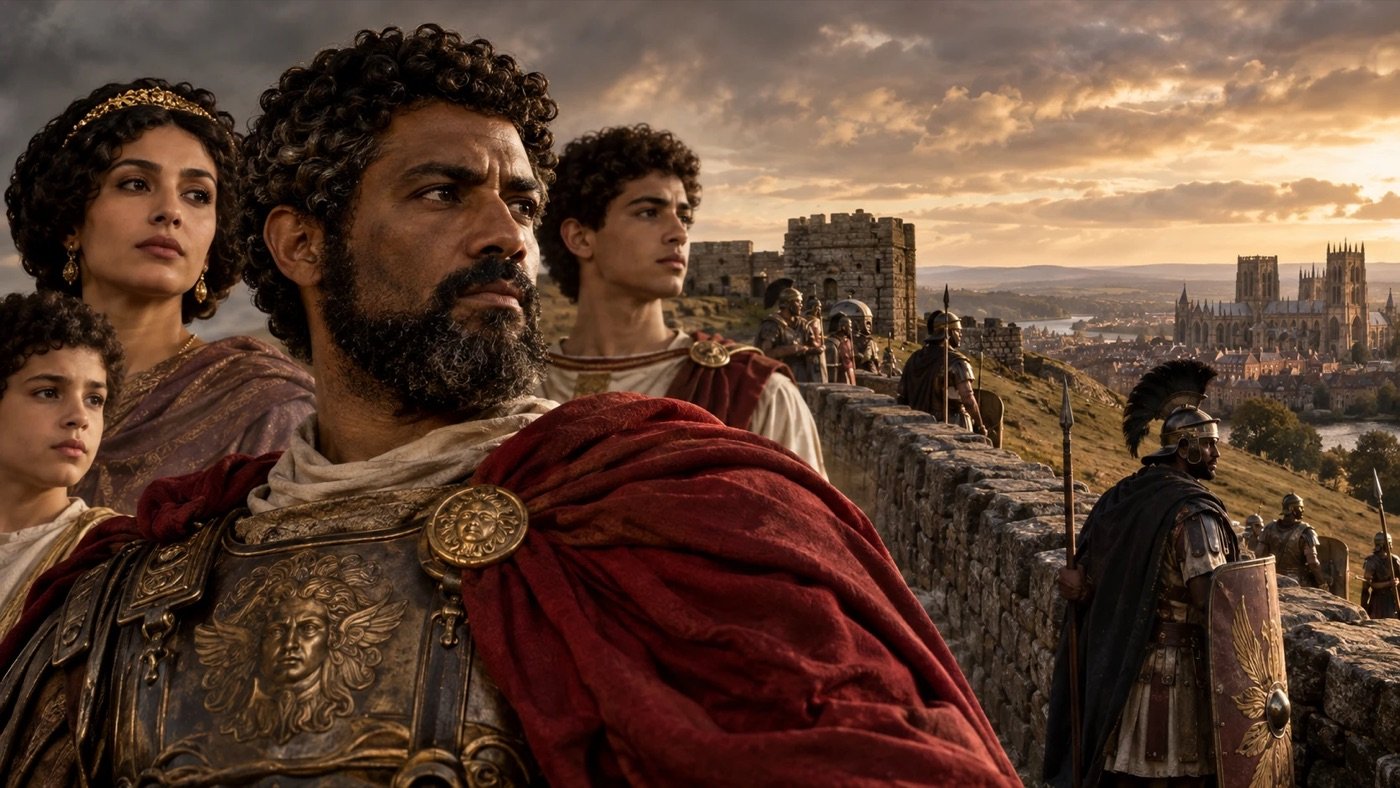
This is not a peripheral figure in British history. This is the Emperor of Rome, the most powerful man in the ancient world, who brought his imperial court to Britain, made York his base while the empire was administered from there during the northern campaigns, led armies onto Scottish soil, and died in York on 4 February 211 CE. The city of York, Eboracum, was, for the duration of the Severan British campaigns, in effect an imperial capital.
I want to say something about why this matters beyond the merely historical. For those of us who study the movements of peoples across the ancient world, who follow the evidence of dispersion and settlement and the deliberate erasure of identity from the official record, the Severan dynasty is not a curiosity. It is a case study. Here is a family of African and Syrian heritage at the absolute pinnacle of Western imperial power, on British soil, in the second and third centuries of the Common Era. And here is the subsequent history of British historical education, in which that family is consistently reduced to a footnote, a subheading, an asterisk. The mechanism of that reduction is itself part of the historical record, if we are willing to read it.
III. The Sons of Severus, Emperors in York
Caracalla and Geta: A North African and Syrian Dynasty on British Soil
Septimius Severus did not come to Britain alone. He brought his imperial household, his wife Julia Domna, an extraordinarily influential Syrian Arab woman whom contemporaries described as one of the most formidable political intellects in the empire, and their two sons: the elder Caracalla, born Marcus Aurelius Antoninus in Lyon in 188 CE, and the younger Geta, born in 189 CE.
These two young men, of North African paternal heritage and Syrian Arab maternal heritage, heirs to the most powerful office in the ancient world, stood on British soil while their father's armies pushed north beyond the Wall into territory Rome had never durably held. For three campaigning years, Britain was not a remote province. It was where the emperor was.
Both sons were already Augusti before their father died, Caracalla had been raised to that rank in 198, Geta in 209. When Severus died in York in 211, they succeeded him there as joint emperors. The succession took effect here. Not in Rome. Not in any of the empire's great eastern cities. In York.
The Murder of Geta and the Damnatio Memoriae
The joint reign did not last.
Caracalla and Geta had despised each other for years. Their rivalry was not merely political, it was visceral, personal, and beyond negotiation. Within the year of their father's death, after the court had returned to Rome, Caracalla had Geta murdered, on 26 December 211. The account that survives from antiquity says Geta died in their mother Julia Domna's arms, killed while seeking refuge with her.
What followed the murder was one of the most comprehensive acts of historical erasure in the ancient world. Caracalla issued a damnatio memoriae against his brother, a formal condemnation of memory. Geta's name was removed from inscriptions across the entire empire. His image was destroyed or defaced on monuments, coins, and official portraiture. His very existence was to be expunged from the official record.
Return to the Severan Tondo. Look at the space where one of the two boys once stood, in front of Severus and Julia Domna. The pigment has been physically scraped away. What remains is a smear, a void, a deliberate absence. That missing face is almost certainly Geta's, the identification most scholars accept, although the panel's history leaves room for a minority alternative.
It is one of the most arresting images in the history of Roman art, a family portrait with a family member violently removed. And it raises a question that the Severan dynasty poses to anyone willing to sit with it: if a Roman emperor could erase his own brother from the official record so thoroughly, what else has been erased from histories we assume are complete?
The damnatio memoriae is a Roman legal mechanism, but the practice it describes, the systematic removal of a person or a people from the official account, is far older and far more widespread than Rome. It is, in various forms, one of the defining experiences of peoples who have been conquered, displaced, or inconvenient to the dominant narrative. The erased face in the Tondo is a symbol that speaks across centuries. Those who have had their names removed from records, their histories declared non-existent, their identities buried under imposed designations, they recognise what that smear means. It means someone decided this person should not be remembered. It does not mean they were not there.
IV. Caracalla, the Tyrant Who Changed the World
What the Senators Wrote
Caracalla has one of the worst reputations in the entire catalogue of Roman emperors. Fratricide. Tyrant. Paranoid. Cruel. The ancient sources, Cassius Dio, Herodian, and the later and less reliable Historia Augusta, paint him in consistently dark terms, cataloguing his excesses and his brutality in detail that leaves little room for nuance.
These sources deserve to be read. But they also deserve to be interrogated. The men who wrote them were Roman senators, or wrote for that world. Caracalla, like his father before him, held the Senate in open contempt. He favoured the military over the aristocracy, raised soldiers' pay, lived among the troops, and made no effort to perform the deference to senatorial privilege that Roman political convention demanded. The men who shaped his legacy were precisely the men he had made his enemies. Cassius Dio, for example, ascribed a purely fiscal motive to the citizenship edict, a reading modern scholars treat as hostile and incomplete, not as a settled explanation.
History, as always, was written by those who held the quill. The Senate, for its part, appears to have held a grudge with equal competence.
The Constitutio Antoniniana, What the Record Actually Shows
In 212 CE, one year after seizing sole power, Caracalla issued the Constitutio Antoniniana.
With a single declaration, he granted Roman citizenship to almost every free person in the empire, from Britain to Egypt, from Spain to Syria. The one significant exception preserved in the surviving text is the dediticii, a legally degraded category of surrendered peoples and certain freed persons. That exception matters, and no honest account should omit it. It does not diminish the scale of what the edict did. Caracalla established a unitary citizenship across three continents: Europe, Africa, and Asia. Before this edict, Roman citizenship, although it had expanded considerably over two centuries, was still held by a minority of the empire's total population. Caracalla ended that exclusivity in principle, permanently.
Every newly enfranchised man received, as a mark of the grant, his adopted names: Marcus Aurelius. Overnight, millions of Africans, Arabs, Gauls, Syrians, Britons, and peoples from every corner of the Roman world bore the name of this emperor of North African and Syrian heritage.
The surviving papyrus of the edict, Papyrus Gissensis 40, the only copy to survive from antiquity, was inscribed in 2017 on UNESCO's Memory of the World Register. UNESCO and the University of Giessen, which holds the papyrus, place it first in a series of world-historically significant documents of citizenship, civil and human rights, preceding the Magna Carta (1215 CE), the Golden Bull of 1356, and the Declaration of the Rights of Man of 1789. The Magna Carta, celebrated for centuries as the foundational document of rights in the Western tradition, came a full thousand years after Caracalla's edict. It applied, in the first instance, to a narrow class of English barons.
A man of North African paternal and Syrian Arab maternal heritage, who succeeded his father as emperor on British soil, issued the ancient world's most far-reaching citizenship decree. That is the documented historical record. The reputation that was subsequently constructed around him, and the degree to which that record has been subordinated to that reputation in the standard historical account, is itself a document, of a different kind.
V. What British Memory Chose to Preserve
Geoffrey of Monmouth and the Historia Regum Britanniae
There is one further dimension to the Severan legacy in Britain, and it comes not from Roman sources but from later British tradition.
In the twelfth century, a Welsh cleric named Geoffrey of Monmouth compiled the Historia Regum Britanniae, the History of the Kings of Britain, drawing on sources he claimed, Welsh chronicles and folk memory that stretched back centuries. In it, he recorded an account of what happened after Severus died in York.
According to Geoffrey, Severus left two sons. Geta was born of a Roman mother. But Bassianus, the name Geoffrey uses for Caracalla, was born of a British woman. The Romans favoured Geta for the succession because he was Roman on both sides. The Britons refused him. They chose Bassianus, because he was of their own kindred through his mother's blood. The two brothers fought. Geta was slain. And Bassianus took possession of the kingdom of Britain, chosen and claimed by the British people themselves.
Geoffrey also departs from the Roman sources on Severus's own death, in his telling, Severus is killed in battle at York, rather than dying of illness there. That divergence is itself a warning about how this source must be used. Geoffrey was untroubled by it. A medieval chronicler with a succession story to tell was rarely detained by a shortage of evidence.
The First Black King of Britain, and What the Tradition Reveals Despite Its Limits
Read on its own terms, Geoffrey's story does something remarkable: it crowns Bassianus, the North African emperor's son, as a king chosen by the British themselves. Britain, in this telling, had a Black king, and chose him. It is important to be precise here. Geoffrey of Monmouth's Historia is considered semi-legendary by modern historians, a blend of earlier tradition, mythology, and invention that cannot be treated as literal historical record. Caracalla's actual mother was Julia Domna, a Syrian Arab woman, not a British woman. Geoffrey gives both brothers different mothers, which the Roman record does not support. On these points, Geoffrey diverges from the Roman sources, and this essay does not ask the reader to prefer Geoffrey on the facts.
But the nature of what Geoffrey's account records is worth examining carefully, because legends do not preserve what literally happened. They preserve what a people chose to believe, what they needed to say about themselves and their world, what they deemed worth passing down before it was committed to writing in the twelfth century.
The British, in the story Geoffrey recorded, chose to remember the son of Septimius Severus as someone with British blood. As a king they elected. As someone who belonged to them, not as an outsider imposed by Rome.
At a time when, in Geoffrey's telling, Rome wanted a successor who was Roman on both sides, the people of Britain said: we choose the other one. The one who is not entirely Roman. The one the empire considers less legitimate.
That choice, preserved in medieval British storytelling, is a document of its own. It is evidence about memory, not evidence about Caracalla's birth.
VI. Not a Moment, a Centuries-Long Presence
The Numerus Maurorum Aurelianorum
The Severan dynasty was not an isolated episode in the African history of Roman Britain. It was the most visible expression of a presence that ran through the entire occupation.
Military records confirm the stationing of North African and Moorish units along Hadrian's Wall. One unit specifically documented is the Numerus Maurorum Aurelianorum, a unit of Aurelian Moors, soldiers from North Africa, attested in the mid-third century at the fort of Aballava, modern Burgh by Sands, near the western end of the Wall, and listed there in the late Roman Notitia Dignitatum. These were men who served at the northernmost military frontier of the Roman world. The record establishes that they were there. What it does not establish, for this unit in particular, is how many remained, raised families or died there, plausible as settlement is, the essay should not present it as documented for these soldiers specifically.
The Ivory Bangle Lady of York
In York, Eboracum, the city where Severus died and where his sons succeeded him, archaeological excavation has produced evidence of a North African presence that extends beyond the Severan dynasty.
The burial known as the Ivory Bangle Lady, dated to the later fourth century CE, more than a hundred and fifty years after Severus, was uncovered at Sycamore Terrace in York in 1901 and subjected, in research published in 2010, to skeletal and isotope analysis. She was a young woman, aged about eighteen to twenty-three. Craniometric analysis suggested a mixture of ancestral traits and an affinity with North African populations; isotope evidence indicates she spent her childhood in the west of Britain, or in coastal western Europe or the Mediterranean, rather than in York itself. Those methods are not DNA testing, and the ancestry assessment in particular has been questioned by later specialists: it should be read as a strong suggestion argued by the Reading researchers, not as a genetic confirmation. The grave goods, ivory and jet bangles, blue glass earrings and beads, a glass mirror and a bone mount inscribed "Hail, sister, may you live in God", indicate a woman of considerable rank and wealth. She was not presented by the evidence as a slave or a soldier. She was someone of standing, whose family origins may have pointed toward North Africa, living in Roman York long after the Severan campaigns had ended.
The Roman occupation of Britain lasted from 43 CE to approximately 410 CE, nearly four hundred years. Throughout that period, the documentary and archaeological record confirms the presence of soldiers, merchants, officials, and their families from North Africa, Syria, the Middle East, and beyond. Britain under Rome was not an ethnically uniform province. It was a crossroads of the ancient world.
The presence of North African and Middle Eastern peoples in Roman Britain is not a recent discovery. It is in the documentary record, the military registers, the portrait panels, and the bones in the ground. The question of why this record has been so consistently minimised in the standard historical account of Britain, why the image of Roman Britain that persists in popular culture remains one of pale-skinned legionaries in a grey northern landscape, is not a historical question. It is a political one. And answering it honestly requires acknowledging that the version of history we inherit is always also a version of power.
VII. Edinburgh and the Name That Would Not Stay Buried
The City That Announces Itself
The trip that produced this essay took me to Edinburgh on a train from London, following a route that has carried scholars, soldiers, and pilgrims for centuries. I was born and raised in the United Kingdom, so Scotland is not entirely foreign territory for me culturally. But I had never been. The distinction between knowing a place and standing in it collapsed the moment the train crossed the border and the landscape changed.
Edinburgh is a city of layers. Medieval stone built on volcanic rock, centuries of faith pressed into every carved surface, the Reformed church standing where older traditions stood before it and did not entirely disappear when it arrived. Walking the Royal Mile and Victoria Street slowly, not as a tourist collecting photographs but as someone following a question, I was struck by the particular quality of spiritual texture in this city. It is not merely beautiful. It is dense with memory.
I am not given to entering active places of worship. There is an unsettled feeling that comes over me at the threshold of a space dedicated to another form of devotion, and I have learned over time to honour that feeling rather than override it. The exterior of St Giles' Cathedral on the Royal Mile, its carved stonework, its weight, its centuries of accumulated prayer pressing outward, spoke to me entirely from the outside. Architecture tells its own history, if you know how to read it.
Jacobite, Jacobus, Jacob
It was in Edinburgh that the linguistic discovery arrived, quietly, as these things tend to.
I had been reading about the Jacobite movement for years before I visited Scotland. Diana Gabaldon's Outlander series, which I had read extensively before this trip, is set largely in the world of the 1745 rising and its catastrophic aftermath at Culloden. The suppression that followed Culloden, the banning of tartan and Highland dress under the Dress Act, the disarming acts, the abolition of heritable jurisdictions and the assault on the clan system, was a programme of cultural dismantling conducted with deliberate thoroughness. The emigration of large numbers of Scots to the Americas and beyond belongs to the longer history that followed, including the Clearances of the next century, and should not be compressed into the immediate aftermath of 1746 alone. Taken together, it is one of the better-documented examples in British history of a state dismantling a people's identity from the inside out.
The word Jacobite derives from the Latin Jacobus.
Jacobus is Jacob, Jacobus being the Latin form of both James and Jacob, which is why the supporters of the exiled King James II and VII and his heirs were called Jacobites.
For me, as an Israelite, that derivation is not a linguistic curiosity. It is a thread. In the usage I have set out elsewhere, on this site and in my books, the name Jacobite carries a distinct and specific meaning: the children of Jacob by descent who have not yet claimed their inheritance and returned, Jacobites, not yet living as Israel. That is the doctrinal usage, and Scotland does not change it. What Scotland gave me was something narrower and, for that reason, more arresting: the same root name, Jacobus, surfacing in an entirely separate British history, attached to a people fighting to preserve a lineage, a king and a right to determine who governed them. The Jacobites of Scotland were fighting for a King James. The children of Jacob were scattered across continents. Two entirely different histories. One ancient name running through both of them. Names do not travel by accident. They carry something of the stories from which they came. The name Jacob, the patriarch who wrestled with the angel, the father of the twelve tribes, the wanderer who became a nation, has echoed across cultures, languages, and centuries in ways that continue to surface in unexpected places. Scotland was one of those places.
VIII. What the Record Demands
History does not behave the way we are taught to expect it to behave. It does not divide neatly into separate civilisations with separate stories. It moves. It crosses oceans and continents. It hides in names and bones and portrait panels and military registers and the oral traditions of peoples who refused to forget what official accounts tried to make them forget.
The evidence examined in this essay is not new. It has not been uncovered recently. The Severan Tondo has been in Berlin since the twentieth century, its earlier provenance is unknown, and has been reproduced and discussed for decades. The military record of the Numerus Maurorum Aurelianorum has been in the scholarly literature for decades. The Ivory Bangle Lady of York was excavated in 1901 and analysed and reported in 2010. The Constitutio Antoniniana was inscribed on the UNESCO Memory of the World Register in 2017.
None of it has been hidden. All of it has been available.
The emperor's campaigns, the citizenship edict, and the broad presence of peoples from across the empire in Roman Britain are established in the documentary and archaeological record. The interpretation of specific pieces of evidence, the Tondo, the Ivory Bangle Lady, Geoffrey of Monmouth, involves scholarly debate that this essay acknowledges where relevant. What the record does not dispute is this: that a man of North African paternal heritage and his sons, by a Syrian Arab mother, stood at the summit of the Western world's most powerful empire, that they were in Britain when that empire passed to them, that one of them issued the most far-reaching citizenship decree in the ancient world, and that later British tradition chose to remember the elder son not as a foreign conqueror but as belonging, by invented British blood, to the people of this island.
The record stands.
The question is whether we are willing to read it.
I travel with a question that does not rest. Wherever I go, Istanbul, Cambodia, Qatar, Scotland, Dubai, and every destination still ahead, I am looking for the threads. The evidence of my people. The traces of the Israelites in the historical record of every civilisation I visit. I do not always find what I am looking for. Sometimes I find something I was not looking for, which is often more valuable. Scotland gave me the name Jacob surfacing in the history of a Highland rebellion. It gave me an African emperor standing at the northernmost frontier of the Roman world on what would become British soil. It gave me the reminder that the history we are permitted to know is never the whole of what happened. There is always more. There is always a thread worth following, a name worth tracing, a face behind the smudge in the portrait. Keep looking.
Look again. Think deeply. Seek understanding.
— C. D. Ford
Key Sources and Evidence Cited
- The Severan Tondo: Painted wooden panel, c. 200 CE. Antikensammlung, Staatliche Museen zu Berlin (Altes Museum, inv. 31329). Publicly available: Wikimedia Commons. One face erased, almost certainly Geta's, following his damnatio memoriae.
- Septimius Severus: Roman Emperor 193–211 CE. Born Leptis Magna, Libya, 145 CE. Of Punic / North African paternal heritage and Italian maternal heritage. Died York (Eboracum), 4 February 211 CE.
- Caracalla (Marcus Aurelius Antoninus): Born Lyon, 4 April 188 CE. Son of Severus and Julia Domna (Syrian Arab). Augustus from 198 CE; sole emperor from December 211. Issued the Constitutio Antoniniana, 212 CE.
- Geta: Born 189 CE. Augustus from 209 CE; co-emperor on his father's death, 211 CE. Murdered in Rome, 26 December 211 CE. Subject of damnatio memoriae.
- Constitutio Antoniniana: 212 CE. Granted Roman citizenship to almost all free persons in the empire, the dediticii excepted. Surviving text: Papyrus Gissensis 40 (University of Giessen), inscribed on UNESCO's Memory of the World Register in 2017 as the earliest in a series of significant documents of citizenship, civil and human rights.
- Geoffrey of Monmouth: Historia Regum Britanniae, c. 1136. Records a British tradition of Bassianus (Caracalla) as a king chosen by the British, through an invented British mother. Semi-legendary source, diverges from Roman accounts on Caracalla's maternity and on Severus's death, used in this essay as evidence about memory, not about fact.
- Numerus Maurorum Aurelianorum: North African Moorish unit. Attested in the mid-third century at Aballava fort (Burgh by Sands), near the western end of Hadrian's Wall, and listed there in the Notitia Dignitatum.
- The Ivory Bangle Lady: York, later fourth century CE; burial excavated 1901, Sycamore Terrace. Craniometric and isotope analysis (Leach et al., 2010, University of Reading) suggested North African ancestry and a childhood outside York, the ancestry method is debated and no DNA result is cited. High-status burial. Yorkshire Museum, York.