The Proverbial Messenger
The Lost Art of Reflection
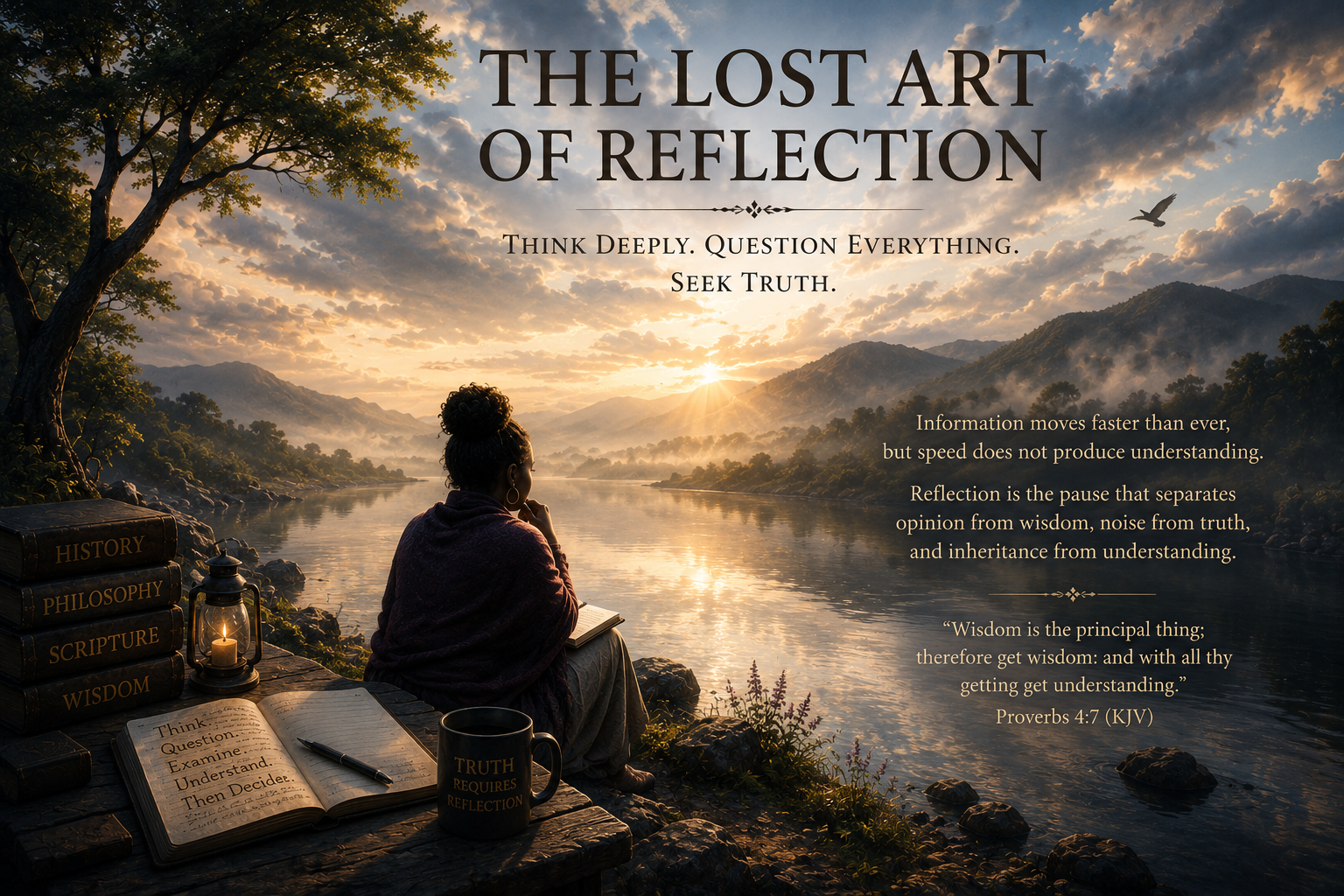
Information moves faster than ever, but speed does not produce understanding.
“Wisdom is the principal thing; therefore, get wisdom: and with all thy getting get understanding.”
— Proverbs 4:7 (KJV)
We live in an age of unprecedented access to information, and thoughtful reflection has never been rarer. Every hour, opinions arrive through our phones and our screens, packaged into short videos, headlines, and endless scrolling commentary. Information moves faster than it ever has. Speed, however, does not produce understanding.
Technology is not the enemy. It is one of humanity’s great achievements — the power to speak across continents in an instant, to preserve whole libraries, to reach historical sources once locked away from ordinary people. Properly used, these tools widen learning and deepen our grasp of the world.
The danger lies elsewhere.
Modern technology has made thinking optional.
Ideas now arrive already interpreted. Conclusions are supplied before questions are asked. Images stand in for careful reading, headlines for investigation. Algorithms decide what we see next, and steady entertainment leaves little room for quiet consideration. We take in information without pause, yet seldom stop long enough to ask whether it is true.
The discipline of pausing to think has quietly become one of the rarest in modern life.
There was a time when thinking was expected to take time.
Reflection is like allowing muddy water to become still. While it is constantly stirred, nothing can be seen clearly. Only when the surface settles does what was always there become visible.
A difficult question might occupy a person's mind for days or even years. Books were read slowly. Conversations unfolded over long evenings. A letter travelled for weeks before a reply could be written. Reflection was not an interruption to life; it was part of life itself.
Today we often mistake immediacy for understanding. We feel pressure to respond before we have considered, to form opinions before we have examined, and to speak before we have listened. In gaining the ability to know almost everything instantly, we have quietly forgotten that wisdom has never arrived in a hurry.
Why Reflection Matters
Every civilisation is built upon ideas. Before there are governments, laws, institutions, or revolutions, there are thoughts; before people act, they first believe. True or false, every culture rests upon assumptions that were once accepted, then repeated, then inherited by generations who no longer remember accepting anything at all.
So understanding the world takes more than collecting facts. It takes examining the ideas that produced them. Why does a society prize certain customs? Why do two nations read the same history in opposite ways? Why do institutions defend the particular doctrines they defend? Why does a generation inherit convictions no one in it has personally examined?
These are not questions that memorised facts can answer. Reflection is an unusual discipline because it asks us to become comfortable with uncertainty. It is willing to leave a question unanswered until better evidence appears. It would rather arrive slowly at the truth than quickly at a convenient conclusion. That patience is becoming increasingly uncommon, yet nearly every great discovery, whether in history, philosophy, science or Scripture, began with someone willing to linger over a question that others considered already settled.
The ability to stop, observe, compare, and question has always separated thoughtful men and women from those who merely repeat the opinions of their age.
What Is Philosophy?
The word philosophy is often shut away in universities, among scholars and the ancient dead. But philosophy exists long before it reaches a classroom.
Every person already possesses one.
The question is not whether we have a philosophy, but whether we have examined it.
Our sense of justice, authority, family, education, government, and morality — even our understanding of God — grows out of ideas we have absorbed over a lifetime. Whether examined or not, those ideas determine how we read the world. A nation’s schools express a philosophy. A political movement expresses one. A court of law expresses one. So do the quiet assumptions we make about history and human nature.
The question is not whether we hold a philosophy. The question is whether we have ever inspected it. Most philosophies are not consciously chosen. They are inherited quietly through childhood, reinforced by institutions, and strengthened by repetition until they appear to be nothing more than common sense. Yet what one generation accepts as obvious, another may later recognise as assumption. The history of ideas reminds us that certainty is often inherited long before it is examined.
The Inherited Mind
Most people believe they reasoned their way to their opinions. In truth, we inherit most of what we believe — as surely as we inherit a mother tongue we did not invent.
Consider how little of it we chose. A man defends a view at his own table with real conviction, having never once traced where it came from or asked whether it would survive an honest look. He did not reason his way in; he was raised inside it, and mistakes the walls of the house for the shape of the world.
Here is what the machinery of the modern age has quietly changed. We imagine that we observe, then weigh, then conclude. More often the conclusion arrives first — already formed, already interpreted — and we supply the reasons afterward, to defend what we were handed. We are seldom asked to think. We are asked to react to thinking done elsewhere: by someone we cannot see, for reasons we never learn.
Real examination begins with a single uncomfortable question:
How do I know that what I believe is true?
That question has changed civilizations. It has unsettled empires, corrected long errors, and exposed corruption. It has led honest men and women to reconsider what entire generations had accepted without a second thought.
The Courage to Examine
Questioning is not rebellion. To weigh an idea honestly is not disrespect; it is responsibility. History shows, again and again, that accepted beliefs have later proved incomplete, mistaken, or false — and that progress usually waited on someone willing to test a claim against evidence rather than against its popularity.
The principle holds everywhere: in history, politics, education, and theology alike. An idea should not be believed because it is old, nor because it is new. It should be examined — because truth can bear examination, and error cannot.
Ideas Have Genealogies
They have parents.
They have ancestors.
They have moments of birth, seasons of growth, and sometimes periods of decline. They travel across languages, kingdoms and civilisations. They are translated, misunderstood, challenged, defended and occasionally forgotten before being rediscovered centuries later.
Few ideas appear suddenly. Most have lived many lives before reaching us.
To trace an idea back to its beginning is to understand not only what it means, but why it came to exist in the first place. Only then can we distinguish between what we have carefully examined and what we have merely inherited.
Perhaps reflection has always required something that cannot be manufactured.
Silence.
Not merely the absence of sound, but the deliberate decision to step away from the constant demand for immediate reaction. Reflection asks us to read the paragraph again. To reconsider the evidence. To entertain the possibility that we may be mistaken. It asks us to listen before we speak and to understand before we judge.
Modern life rarely rewards such habits.
Wisdom almost always does.
A Discipline Worth Recovering
Modern life rewards speed; considered thought asks for patience. Modern culture prizes the instant reaction; wisdom waits for deliberate judgment. Modern media rewards certainty; real learning usually begins by admitting how much we do not yet know.
Perhaps that is why the discipline of pausing has grown so uncommon. Reflection asks more of us than information ever will. It demands patience where the modern world rewards speed, concentration where distraction is abundant, and humility where certainty is often mistaken for wisdom. Yet nearly every lasting achievement of civilisation began with someone willing to stop, to look, and to think.
The Purpose of The Proverbial Messenger
The purpose of this publication is not to add to the pile of information. The internet already holds more than any of us could read in a lifetime.
Our purpose is to encourage examination.
Some of these essays will explore Scripture. Others will investigate history, or philosophy, or literature, or the labour of scholars. Some will set competing interpretations side by side and trace an idea back to where it began.
The articles that follow will not always offer comfortable conclusions. Some will challenge familiar assumptions. Others may recover voices long forgotten or revisit questions many consider already settled. Their purpose is not to provoke disagreement for its own sake, nor to replace one set of inherited conclusions with another.
Their purpose is simpler.
To slow the conversation down long enough for genuine examination to begin.
Agreement is not asked. Reflection is.
For without it, we merely inherit the conclusions of others. With it, we begin the long and worthwhile pursuit of wisdom and understanding.