The Proverbial Messenger
The Moors We Were Taught to Imagine
Race, Religion, and the Remarkably Inconvenient History of a Word
A name imposed upon a people can tell us as much about the people doing the naming as the people being named.
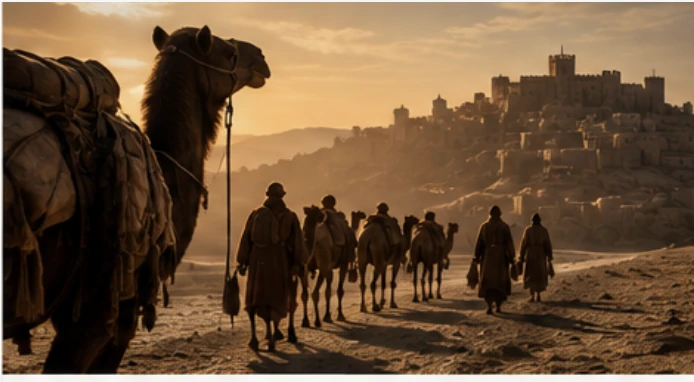
The road is awake before the sun.
A camel protests somewhere behind you. Leather creaks. Men call to one another across the dust, and someone is arguing over the weight of a bundle that was apparently considerably lighter when it was loaded yesterday. There is salt in the caravan, and cloth, leather, grain and manuscripts. Perhaps gold is moving in the opposite direction. News travels too, although nobody has bothered to list it among the merchandise.
Ahead lie the settlements that make an impossible landscape navigable. Beyond them, North Africa; beyond that, the Mediterranean; and across a remarkably narrow stretch of water, Iberia. People have travelled through this world for centuries: traders, soldiers, scholars, pilgrims, captives, interpreters and adventurers. They do not all look alike. They do not all speak alike. They do not all worship alike, and they certainly do not carry identical ancestry.
Centuries later, Europe will perform an impressive administrative miracle. It will call a considerable number of them Moors. And we, being obedient students of history, will spend generations pretending that explains everything.
It does not.
Before Islam, There Were Mauri
The first problem with the familiar image of the Moor is chronological. We are commonly taught to hear Moor and think Muslim: medieval Spain, turbans, mosques, North African armies crossing into Europe. Yet the word was already old when Islam arrived.
The Latin term Mauri—singular Maurus—was used to refer to the inhabitants of ancient Mauretania, the Roman territory that extended across parts of what are now Morocco and Algeria. Greek and Roman writers used forms of the term centuries before Muhammad was born and centuries before Muslim armies entered Iberia in 711.
A geographical caution is necessary because ancient Mauretania is not the modern country of Mauritania farther south. The similarity is enough to tempt the hurried reader into transporting an ancient population several hundred miles without so much as offering them a camel. However, the distinction matters.
Whatever the precise linguistic history of Mauri, one fact is not especially difficult to establish: the word existed before Islam. This immediately creates difficulty for the definition that Moor means Muslim. It may later have been used that way. It certainly acquired strong associations with Muslim populations. But Islam did not create the word, and religion cannot explain its entire history.
That is the first assumption we need to put down.
The second is that the people called Moors were one people.
They were not.
When the Word Began to Expand
Originally, Mauri had a geographical and ethnographic association with northwest Africa. After the Islamic expansion through North Africa and into Iberia, European use of the term increasingly acquired a religious dimension. However, even then, Moor and Muslim were not automatically interchangeable.
The Chronicle of 754, written in Iberia within living memory of the conquest, distinguishes between Arabs and Mauri. Both groups could belong to the Muslim armies, yet the writer still considered the terms meaningful enough to make a distinction.
That is an unusually useful piece of evidence because it comes from close to the events themselves. The chronicler did not know that centuries later we would prefer the tidier formula:
Moors = Muslims.
Apparently nobody had informed him.
The term continued to broaden. Depending on the century, writer and context, Moor could denote North African origin, Muslim affiliation, African identity, perceived darkness of complexion, connection with Iberia, foreignness—or several of these at once.
Modern discussions sometimes attempt to solve the problem simply by replacing Moor with Berber. That helps only so far.
The indigenous peoples of North Africa, many of whom today identify as Amazigh or Imazighen, were obviously central to the history. But Berber itself has historically covered numerous populations, communities, languages and political formations. Replacing one enormous historical label with another enormous historical label and declaring the matter settled is perhaps not history's finest hour.
The useful question is therefore not merely:
What did Moor mean?
It is:
Who used the word, when, where, and about whom?
Were the Moors Black?
Eventually somebody asks it, usually rather loudly.
Were the Moors Black?
Modern argument has developed an unfortunate habit of offering two answers as though they are the only possibilities. One side declares that the Moors were Black. The other replies that they were Arabs and Berbers. History refuses both invitations to become that simple.
Ancient and medieval uses of Mauri did develop real associations with dark complexion and blackness. By the early seventh century, Isidore of Seville was repeating an etymological explanation that connected the name to blackness. Later European literature and art would strengthen that association considerably.
However, that does not prove that every person called a Moor belonged to a single Black population, any more than the presence of Arabs or Amazigh peoples proves that blackness was somehow absent from the category. North Africa was not populated by one physically identical people. Neither was medieval Iberia.
There was no medieval paint chart marked:
MOOR — SHADE 7
The evidence simply will not permit us to manufacture the equation Moor = Black and stop thinking. However, neither will it permit us to erase the longstanding European association between Moors, Africa and blackness because that association has become inconvenient to a modern narrative.
Both are shortcuts.
And shortcuts are precisely how we arrived at the problem in the first place.
Who Actually Crossed the Water?
Stand at the northern edge of Africa.
Across the Strait of Gibraltar is Iberia. Not another universe. Across the water. That geographical fact is worth remembering because our historical imagination frequently separates Africa and Europe far more dramatically than geography ever did.
People crossed the strait. Goods crossed it. Armies crossed it. Languages, marriages, political alliances and ideas crossed with them. In 711, forces from North Africa entered Iberia and defeated the Visigothic king Roderick, beginning the political transformation that would lead to the emergence of al-Andalus.
Schoolbook history often gives us the memorable summary:
The Moors conquered Spain.
Very well.
Who were they?
The army was commanded by Tariq ibn Ziyad, whose name survives in Jabal Tariq—Gibraltar. He is commonly identified as Berber, although the details of his ancestry are less secure than popular retellings sometimes suggest. Medieval traditions differ over his precise origin.
Already the commander of “the Moors” refuses to sit quietly inside the label assigned to him.
Then there is Kaula al-Yahudi—Kaula the Jew—remembered in later accounts as one of Tariq's commanders. He is associated with fighting in the conquest, commanding a mixed force that included Jews and Berbers, taking territory in Catalonia and later rebelling against Umayyad authority before his death.
Whether every detail preserved in the later narratives can be treated with equal confidence is a question for the historian. However, his appearance in the tradition is valuable for another reason.
Consider what happens to him when we say simply:
The Moors took Spain.
The sentence does not merely shorten the story.
It rearranges it.
Arab disappears into Moor. North African disappears into Moor and so does the Amazigh, and Kaula the Jew. A collection of people participating in the same military and political event becomes, in retrospect, a single people.
That is precisely the problem this essay concerns. The question is not whether Kaula was secretly the “real Moor,” any more than Tariq was. The question is what happens to actual people when a later label becomes more memorable than the people standing beneath it.
The Peninsula Was Never Two Sides
The simplification continues once the conquest is over.
Say Muslim Spain, and the imagination promptly arranges medieval Iberia into two opposing camps: Muslims on one side, Christians on the other. The actual peninsula was considerably less cooperative.
There were Arabs and North Africans, Amazigh peoples and indigenous Iberians. There were Muslims, Christians, converts and communities whose circumstances changed as governments changed. There were Israelites living under both Muslim and Christian rulers, taking part in the commercial, political and intellectual life of the peninsula.
They do not require a separate chapter in this essay. They require only that we do not make them disappear. Consider Hasdai ibn Shaprut, born at Jaén around 915, physician to Abd al-Rahman III at Córdoba and involved in diplomacy at the highest levels of the caliphate.
Or Samuel ibn Naghrillah, born at Córdoba in 993, who became vizier in Granada, commanded armies and wrote poetry. Their presence does not mean that "Moor" was another word for "Israelite". It was not.
It means that the world later compressed under headings such as “Moorish Spain” contained people whose religion, ancestry, language, and political allegiance cannot all be recovered from that adjective. This is a more important distinction.
The historical problem is not deciding which population deserves ownership of the word Moor. The problem is expecting one inherited European word to do the work of describing all of them.
Meanwhile, Back on the Road
Our traveller has been waiting rather patiently.
He moves through one of the great commercial systems of medieval Africa. The Sahara is formidable, certainly, but it is not empty, nor is it an impenetrable wall separating a sophisticated Mediterranean north from an isolated African south.
Caravan networks linked North Africa with communities across the Sahara and Sahel. Towns prospered because people, merchandise, scholarship and religion moved through them. Nearer the Mediterranean, those networks met another commercial world reaching into Iberia and beyond.
Our traveller may encounter people whose homes lie in the Maghreb, the Sahara or the Sahel. He may trade with people whose commercial relationships reach far beyond the place in which he meets them. Some are Muslim. Some are not. Some are local. Some are passing through. Some may cross the Mediterranean. Others may have come from across it.
Now imagine a European writer looking at some portion of this enormous human landscape and reaching for a familiar word.
Moor.
Then imagine us, a thousand years later, demanding that the word function like a DNA test.
It cannot.
The Word in the Records
Words do not travel through history alone. They travel through documents.
A Roman writer records Mauri. A medieval chronicler uses the same inherited terminology in a changed political world. A translator centuries later renders it Moors. Another historian reads the translation, and somewhere along the way the possibility that the word changed meaning begins disappearing.
Then the schoolbook arrives.
By that point a term that has described geography, political affiliation, religion, perceived appearance or foreignness at different moments can begin to look like the permanent name of a permanent people.
This is how historical vocabulary becomes a trap.
A military chronicler may not use “Moor” as a playwright does. A Roman geographer does not necessarily mean what a medieval Christian polemicist means. A seventeenth-century English audience brings associations to the word that an eighth-century Iberian writer could not have possessed.
The label therefore has to be read in its setting. A label is not a photograph. It is not a census. It is not a genetic report. It is certainly not a substitute for asking what the people being labelled called themselves.
Then Shakespeare Walks Onto the Stage
Nearly nine centuries after the crossing of 711, an English playwright gives Europe one of its most famous Moors.
The first printed edition announces him as:
Othello, the Moore of Venice.
Not Othello the Berber or Othello the Arab, or Othello the Muslim.
The Moor.
Shakespeare is not writing an ethnographic study, and Othello should not be mistaken for one. But literature can preserve something equally interesting: the assumptions a writer expects an audience to understand without explanation.
Shakespeare does not stop to define Moor. The word already carries meaning. And the play makes it impossible to pretend that blackness was absent from that meaning. Before Othello even enters, Iago calls him an “old black ram.” Roderigo invokes his “thick-lips.” Desdemona's whiteness is deliberately placed against Othello's blackness.
That evidence needs to be handled carefully. Othello does not prove that every Moor throughout history was Black. He proves something more precise and therefore more useful: by Shakespeare's England, a visibly Black African man could be presented to an audience as the Moor without the description appearing contradictory. Blackness had become part of the range of meaning the word could carry.
The word had travelled.
The Moor of Venice
There is another reason Othello matters.
Look at where Shakespeare puts him.
Venice.
He is not standing outside Europe peering through its gates. He commands European soldiers. Venetian senators depend upon his military skill. He participates in the machinery of a Mediterranean state, and Desdemona falls in love with him after hearing the stories of the life that brought him there.
He is simultaneously part of that society and marked as different from it: African and Venetian, outsider and commander, respected and insulted, necessary and racialised. No contemporary academic vocabulary is required to make that observation interesting.
The contradiction is the point.
It also shows how far the word has travelled. The Mauri of ancient northwest Africa have passed through Roman geography, Muslim expansion, Iberian politics, Mediterranean movement and European racial imagination. By the seventeenth century, a title page can simply say The Moore of Venice.
The audience understands something.
Our difficulty is in determining how much of what they understood belonged to the ancient word, and how much had accumulated along the way.
When Representation Becomes Memory
Eventually the person begins disappearing behind the image.
Chronicles, plays, paintings, romances and later Orientalist art produce generations of Moors for European audiences. Sometimes he is Black, sometimes brown. Sometimes magnificently dressed, sometimes threatening, sometimes exotic. Sometimes Muslim above everything else, sometimes African above everything else, sometimes Arab-looking or turbaned, and sometimes several of these things simultaneously.
After enough repetition, representation begins masquerading as memory.
We stop asking who the people were and begin thinking:
I know what a Moor looked like. I saw one in a painting.
Painted centuries later.
By somebody who may never have met the person he imagined.
Historical investigation can be terribly inconvenient that way.
A Name Is Not a People
This is where the real problem finally emerges.
The modern mind wants ancestry and identity to behave like a filing cabinet: one drawer for Arabs, another for Amazigh peoples, another for Africans, Israelites, Europeans, Muslims and Christians.
Medieval people had not been informed of our filing system.
People moved. Families intermarried. Political loyalties changed. Languages changed. Religions changed. Governments changed. A person's geography, ancestry, faith, language and political allegiance did not always arrive in one neat package.
A North African Muslim living in Iberia could be called a Moor. So could someone whom a European writer principally understood through appearance or origin. Another writer might inherit the term from an older geographical tradition. A later writer might use the word almost entirely as a religious contrast.
Those uses cannot simply be collapsed into a single biological identity. But neither should one later meaning be projected backwards and allowed to erase all the others. That is why a name imposed upon a people is evidence not only about the people being named. It is evidence about the people doing the naming. That may be the most important thing the Moor can teach us.
Because once somebody else names you, your geography can become your religion. Your religion can become your race. Your race can become your character. Your character can become a stereotype.
And eventually the stereotype can be handed to children as history.
No caravan ever carried anything quite so efficiently.
So Who Were the Moors?
The answer is wonderfully frustrating.
There is no single sentence capable of containing every person whom history called a Moor.
The earliest ancestry of the term takes us to ancient northwest Africa. Later European usage increasingly connected Moors with North African Muslims and with Muslim Iberia. Over time the term developed associations with Africa, Islam, foreignness and blackness without becoming perfectly synonymous with any one of them.
And the people standing beneath that name remained diverse.
The army of 711 alone should cure us of imagining otherwise. Tariq himself comes to us through uncertain traditions of origin. Arabs and North Africans participated in the conquest. Amazigh forces were heavily involved. Later traditions preserve Kaula al-Yahudi commanding Jews and Berbers within that same political movement.
“The Moors conquered Spain” is therefore not entirely false.
The error was believing that the Moors must therefore have been the name of one uncomplicated people.
The people were never that uncomplicated.
The word was.
Or rather, we made it appear so.
Perhaps we have spent too much time asking what a Moor was. The more revealing question may be who was using the name—and what that writer, artist, chronicler, government or society needed the Moor to be.
Because the changing meanings of Moor do not make the word useless as historical evidence.
They make the word itself part of the evidence.
A Note from the Author
My interest in this question grew from the much larger investigation behind my book, The Hidden Secrets of the True Israelites: Revised Extended Edition, which examines Israelite identity through Scripture and historical records and follows questions of geography, migration, identity and the changing names by which peoples have been described across centuries.
That book goes considerably further than this reflection. This essay deliberately does not.
Before asking larger questions about what became of particular peoples, there is a smaller historical discipline that must come first: we have to distinguish the people who actually lived from the categories later placed upon them.
Mauri is not automatically Muslim. African is not automatically Arab. Religion is not ancestry. Description is not identity. And a word inherited by one century does not necessarily mean what it meant to the century that first used it.
Perhaps that is why old names are worth examining so carefully.
Sometimes the secret is not that the people disappeared.
Sometimes it is that the name changed.
Look again. Think deeply. Seek understanding.
— C. D. Ford