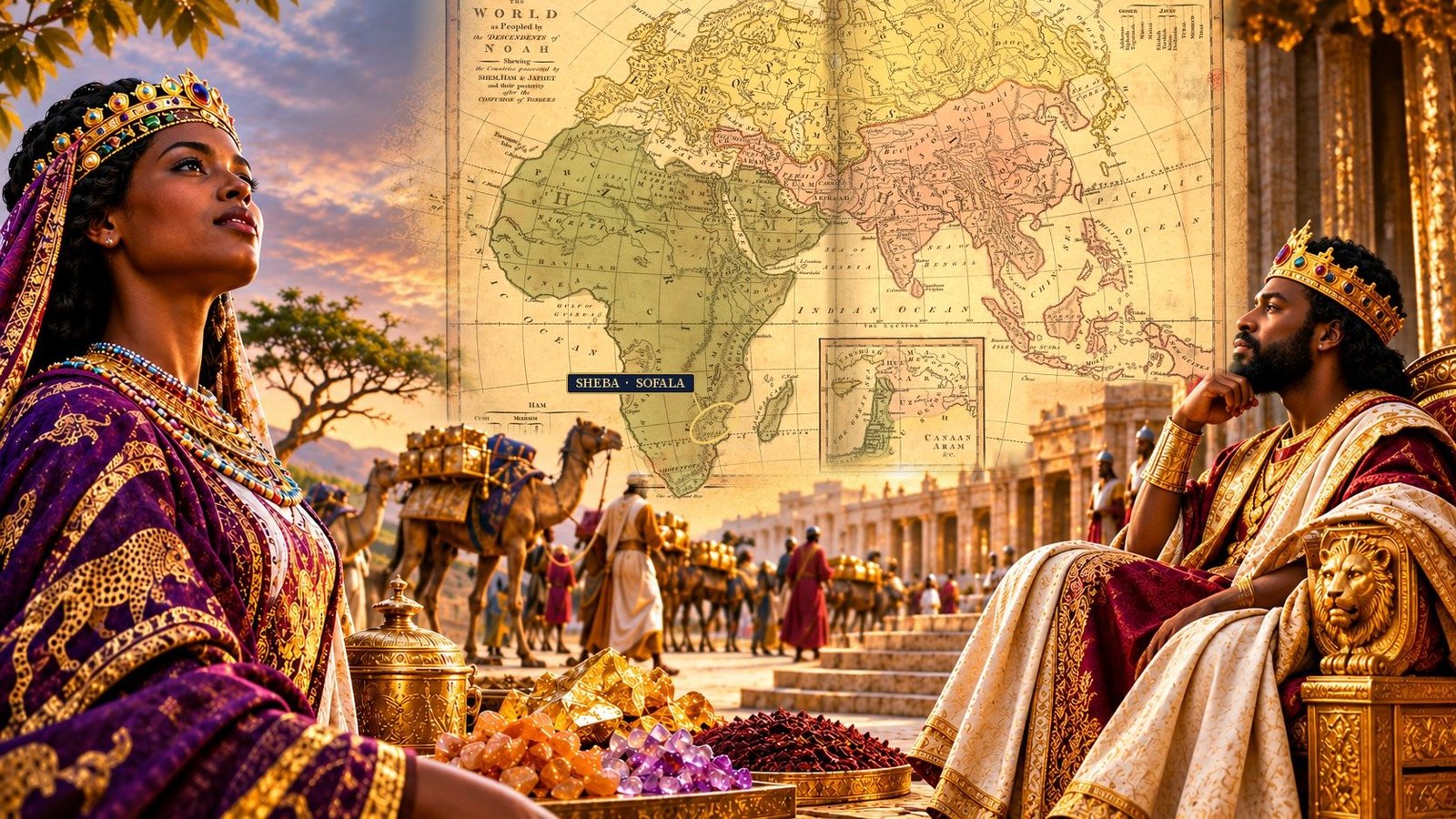
The Proverbial Messenger
The Real Sheba
Why the Queen of Sheba Was Not Arabia’s: A Map, a Genealogy, and the Gold of the South
She was standing in the first genealogy the Bible gives, in her father’s house, in the south.
Every schoolbook knows where the Queen of Sheba came from, and the schoolbooks disagree. Arabia claims her for the incense kingdom of Yemen. Ethiopia claims her as the mother of its kings. Both claims are old and confident, and they have been repeated so often that they have come to look like knowledge.
There is a problem. The only ancient record of this woman never calls her Arabian, and never calls her Ethiopian. It calls her queen of Sheba, and Christ gave her a title more exact than either claim: “The queen of the south shall rise up in the judgment with this generation... for she came from the uttermost parts of the earth to hear the wisdom of Solomon” (Matthew 12:42).
The queen of the south. This essay takes that title seriously and follows the evidence. The evidence holds four discoveries, each in plain sight for anyone who reads the page closely. A name seated beside its father in a trade list, with its cargo itemised. A royal archive that begins two hundred years too late and contains no queen at all. A king’s inscription in stone, keeping apart two kingdoms that tradition later merged. A name lettered on a map, across the gold country of the south. None of this takes the Queen out of Africa. It gives her an older African home.
Genealogy gives the character. Settlement gives the address.
The Name Is a Crowd
The search has been confused from the start by a fact that Genesis states plainly and its readers skip: the name Sheba is not one man. It is a crowd.
Here is the first Sheba, and he is the one who matters. “And the sons of Cush; Seba, and Havilah, and Sabtah, and Raamah, and Sabtechah: and the sons of Raamah; Sheba, and Dedan” (Genesis 10:7). Sheba, son of Raamah, grandson of Cush, of the line of Ham, seated inside a named household in the first genealogy the Bible gives.
Here is the second Sheba. A Sheba also appears among the thirteen sons of Joktan, of the line of Shem, and the text fixes that household’s dwelling in the same breath: “And their dwelling was from Mesha, as thou goest unto Sephar a mount of the east” (Genesis 10:30). A different man, a different line, an eastern address.
Sheba must not be confused with Seba, his uncle, and this is where the trouble began. Seba was the first-named son of Cush, and his name is spelled differently in the language of Israel. Arabia’s famous kingdom was called Saba. On the map this essay follows, Saba lies in the territory of Seba, the uncle, in southern Arabia, not in the territory of Sheba, the nephew. The schoolbooks went wrong by treating Sheba and Seba as one.
In Genesis 10, a name is identified by its family, not merely by finding it on the page. The chapter is a record of where families settled, and it says so in its own refrain, repeated for each of Noah’s sons: the families are divided “after their families, after their tongues, in their countries, and in their nations” (Genesis 10:20). Households settle together.
There is a third Sheba, whose family belongs to Arabia, and a careful reader will think of him: Sheba, son of Jokshan, grandson of Abraham through Keturah (Genesis 25:3). “Jokshan begat Sheba, and Dedan.” He too has a brother called Dedan, and Keturah’s family belongs to Arabia in the prophets’ own geography (Isaiah 21:13; Jeremiah 25:23–24). So which Sheba do the prophets mean? The company he keeps will tell us.
Her Company Gives Her Away
Here is the first discovery: whenever the Bible names Sheba beside his relatives, they are Raamah’s family. It is not hidden in an archive. It is in the text, in three places.
First, the father. Ezekiel, listing the trading houses that supplied the city of Tyre, names a firm in a single breath with its founder: “The merchants of Sheba and Raamah, they were thy merchants: they occupied in thy fairs with chief of all spices, and with all precious stones, and gold” (Ezekiel 27:22). Sheba and Raamah: the son beside the father, exactly where Genesis 10:7 placed him.
And this firm sells exactly what the Queen brought: chief of all spices, all precious stones, gold. Open the account of her visit, written centuries earlier: “And she gave the king an hundred and twenty talents of gold, and of spices very great store, and precious stones: there came no more such abundance of spices as these which the queen of Sheba gave to king Solomon” (1 Kings 10:10). Gold. Spices. Precious stones. A talent was a heavy weight, usually reckoned at around thirty kilograms, so one hundred and twenty talents is several tonnes of gold. Ezekiel’s firm trades in the Queen’s cargo, item for item.
Then the uncle and the brother. The Psalmist sets Sheba beside his uncle: “The kings of Tarshish and of the isles shall bring presents: the kings of Sheba and Seba shall offer gifts” (Psalm 72:10). Two kings, two nations, nephew and uncle, side by side and never merged. The same psalm returns with the gift in hand: “to him shall be given of the gold of Sheba” (Psalm 72:15). And Ezekiel sets him beside his brother: “Sheba, and Dedan, and the merchants of Tarshish” (Ezekiel 38:13). In Ezekiel’s market list, Dedan’s goods are “horns of ivory and ebony” (Ezekiel 27:15), the goods of the African side of the trade.
Father. Uncle. Brother. Every time the record places the name beside its kin, the kin belong to the household of Raamah, in the house of Cush. That is not one verse lifted out of context. It is a fingerprint, pressed into the record three times, in two different books.
The Dedan beside Sheba is Raamah’s son, not Keturah’s, and Ezekiel shows it in his own book. In his market list, Sheba stands beside Raamah his father, and Dedan brings ivory and ebony from the African side. Ezekiel does know traders of these names on other roads too, beside Asshur, and beside “Arabia, and all the princes of Kedar” (Ezekiel 27:20–23), for traders travel. But where he seats Sheba beside his own family, the family is Raamah’s, and a prophet does not change families between chapters.
The Character of Her House, and the Queens of the South
The Queen’s family came from Cush, the ancient Nile kingdom that the King James Bible calls “Ethiopia”. Cush lay in what is now Sudan, south of Egypt. It is not the modern state of Ethiopia, and in this essay it is called Cush. Cush is not the Queen’s address. It is her family’s heartland, the ancient seat of the house from which Raamah’s line went out, and it is described here to show the character of the family she belonged to. Genealogy gives the character. Settlement gives the address.
Cush is not her address, because Raamah’s line did not stay in the heartland. It went out and settled, and the Queen is found where her father’s house settled, not where her grandfather’s house reigned.
The house of Cush was known for two things: gold, and queens who ruled in their own right. Cush was already ancient when Solomon was born, and gold was its signature: the region’s later name, Nubia, is commonly derived from the Egyptian word for gold, and Herodotus records its people sending Persia gifts of unrefined gold, ebony and great elephant tusks. Cush was also the one civilisation of that world in which queenship was native. Arabia had its occasional queens, Zabibe and Samsi among the northern Arab tribes, but they were exceptions in a world of kings. In Cush, queens ruling in their own right were the custom. They were called the Kandakes, and they reigned at Meroë for centuries. Pliny calls Candace “a name that has passed on through a succession of queens for many years”. The office still stood in the age of the apostles: “an eunuch of great authority under Candace queen of the Ethiopians, who had the charge of all her treasure” (Acts 8:27). Gold, and queens ruling as a matter of course: that is what it meant to belong to the house of Cush.
That character travelled with the family, and the far south, where the map will place it, shows the same signature. At Mapungubwe, a hilltop in the far north of South Africa, the first great gold kingdom of southern Africa buried its royalty. In 1933 excavators found a grave read as a king’s, with a sceptre, a bowl and a rhinoceros, all of gold, and near him a woman buried sitting upright, as royalty was buried there, with more than a hundred gold bangles at her ankles and thousands of gold beads. Her excavators have read her as a queen. She lived two thousand years after Solomon, so she is not the Queen’s contemporary. She is a portrait of that region in its own documented age, and she shows that a queen with a fortune in gold was no stranger there.
Arabia: A Kingdom Two Centuries Too Late
Arabia’s claim fails on dates. The kingdom of Saba in Yemen was real and powerful, rich on the frankincense and myrrh the ancient world burned in its temples. Nothing in this essay requires Arabia to be small. It requires Arabia to be dated.
Here is the second discovery: Saba does not appear in any record until two centuries after Solomon. It first appears in the eighth century BCE; the earliest commonly dated mention is an Assyrian tribute list of 715 BCE, recording gifts from Ita’amara the Sabaean. Some scholars would date Sabaic writing a little earlier, but nothing from those centuries names a queen or a journey to Jerusalem. Solomon reigned in the tenth century. Between the Queen’s journey and the first written trace of the kingdom said to have sent her lie two silent centuries.
Saba’s own records never mention her. When its inscriptions do come, centuries of them, naming king after king, they contain no queen. Not one. Scholars have read this archive for a hundred years, and the Queen is not in it. A claim can survive one missing document. It cannot survive a whole archive that is silent about the very person it is meant to explain.
The names sound alike, but sound is not family. That is Arabia’s strongest argument: Saba sounds like Sheba, and scholars point out that the two names correspond across the languages. But the record does not identify this Sheba by the sound of his name. It identifies him by the father he stands beside, and that father is Raamah.
The reference books that place Raamah’s family in Arabia rest on place names, and place names are not family trees. They point to an ancient oasis called Dedan in north-west Arabia, and to a place called Regma on the Persian Gulf, named by the geographer Ptolemy and read as Raamah. The names are real, but the reading is not compelled. More than one family bore the name Dedan, and Ptolemy wrote eleven centuries after Solomon. And Arabia’s wealth was of a different kind: it grew rich on incense, carried north by caravan. The Queen’s gift was gold first, measured in talents. The two do not match, because the countries are not the same.
India: The Other Brother
India’s Sheba is a different man, from a different family. Old maps do letter a Sheba in India, and he is a genuine Sheba: Joktan’s son, of the line of Shem, whose whole family Genesis sends east, toward “Sephar a mount of the east.” What India did supply to Solomon’s court came as cargo in the Tarshish ships: “gold, and silver, ivory, and apes, and peacocks” (1 Kings 10:22). Those were long-distance trading fleets carrying goods from many lands; the map this essay follows even letters Tarshish on the African coast. Peacocks in a ship’s hold do not make a visiting queen an Indian. She came in person, out of the south.
Ethiopia: Its Own King Keeps Them Apart
Ethiopia’s claim needs the most care, because for many people the Queen of Sheba is not only history but faith. The question is only which African house was hers.
The Bible never calls her the queen of Ethiopia, and that alone is telling, because the Bible names rulers by their nations. Tirhakah is “king of Ethiopia” (2 Kings 19:9). Candace is “queen of the Ethiopians” (Acts 8:27). When Scripture means Ethiopia, it says Ethiopia, and it sets Egypt, Ethiopia and Seba side by side as three distinct peoples in a single verse (Isaiah 43:3). It calls her the queen of Sheba, after her own people. A queen named for Sheba is Sheba’s queen.
The third discovery is carved in stone: Ethiopia’s own king kept Saba and Ethiopia apart.
In the fourth century CE, King Ezana of Aksum, the highland kingdom that would become modern Ethiopia, listed the lands he ruled in inscriptions carved in three languages. Among them he names the Sabaeans, the Ethiopians and Kasu, which is Cush. On the king’s own stone, Saba and Ethiopia are two separate lands, kept apart by the very monarch whose country would later merge them, and Cush is a third. Nowhere does Ezana claim descent from Solomon, or any link with the Queen.
The country we call Ethiopia today did not exist in Solomon’s time. Ezana was the first to give the name Ethiopia to the highland kingdom; before him, the name belonged to Cush. The kingdom of Aksum itself does not appear in the record until around the first century CE, some ten centuries after Solomon. In the centuries after her, the highlands held only small kingdoms, such as Dʿmt, which was not Ethiopia in name and not hers by descent. And her visit ends where the Ethiopian claim needs it not to end: “So she turned and went to her own country, she and her servants” (1 Kings 10:13). No son is named or hinted at. A text that records her gift down to the last talent would not forget to mention an heir.
The story of an Ethiopian son came late. Ethiopia has kept this queen at the centre of its national memory and faith for some seven centuries, and that devotion deserves respect. But it was the Kebra Nagast, Ethiopia’s national epic, written in the fourteenth century CE, that first gave her an Ethiopian son and an Ethiopian throne. A nation’s love for a queen tells us much about the nation. It cannot tell us where the queen was born.
The Ground: Gold, and a Meridian
The Queen belongs to Raamah’s house, of Cush. Two witnesses show where that house settled: her cargo and a map.
Her cargo points south. Gold comes first in her gift, one hundred and twenty talents of it. The account’s highest praise goes to the spices, but what points to a country is the mix: gold in talents, spices in great store, precious stones. One coast of the ancient world answers that inventory, and it lies to the south. Down the African shore lies Sofala, in today’s Mozambique, the port for an inland plateau, now Zimbabwe, dotted with ancient gold workings. Its gold is not a guess: the royal graves of Mapungubwe and the stone cities of Great Zimbabwe are rich in it, and medieval Arab geographers call Sofala a land of gold as a matter of course. From that port the monsoon winds carried ships north along the coast and up the Red Sea toward Israel. No invoice from Solomon’s century survives from that coast, and none is claimed. What is claimed is region and continuity: in every age for which there is evidence, that coast was gold country, and its sea road ran north.
Silence counts against Arabia but not against the south, because the two silences are different. The objection is fair: Arabia is refused here for two silent centuries, while the south is accepted across a silence of nearly two thousand years. But Arabia was a kingdom that wrote, carved thousands of inscriptions in stone, and never names her. That silence means something. The southern coast kept no written records at all, so its silence proves nothing either way. There the case rests where it has rested from the start: on the genealogy that places her father’s house in the south, and on the gold that comes from her direction.
The map is the fourth discovery, and it puts SHEBA in southern Africa. Robert Wilkinson’s Atlas Classica, a London atlas first published in 1797 and drawn from the settlements of Genesis 10, carries a plate called “The World as Peopled by the Descendents of Noah”. It letters the household of Raamah down the African coast: Raamah himself, and Dedan beside him, their names running south until they run out below the Zambezi. The uncle, Seba, is set across the sea, in Arabia: a different son of Cush, on a different shore. And there, in capitals across the Sofala country, the map sets the Queen’s household name: SHEBA. Wilkinson did not invent this southern placing. The Portuguese who first traded on that coast identified Sofala with Ophir, the source of Solomon’s gold, in 1502, and Milton fixed the idea in English verse: “Sofala, thought Ophir.” They named Ophir, not Sheba. But a coast believed for three centuries to be the source of Solomon’s gold is just where a mapmaker reading Genesis 10 would set the family whose wealth was gold, and Wilkinson set it there.
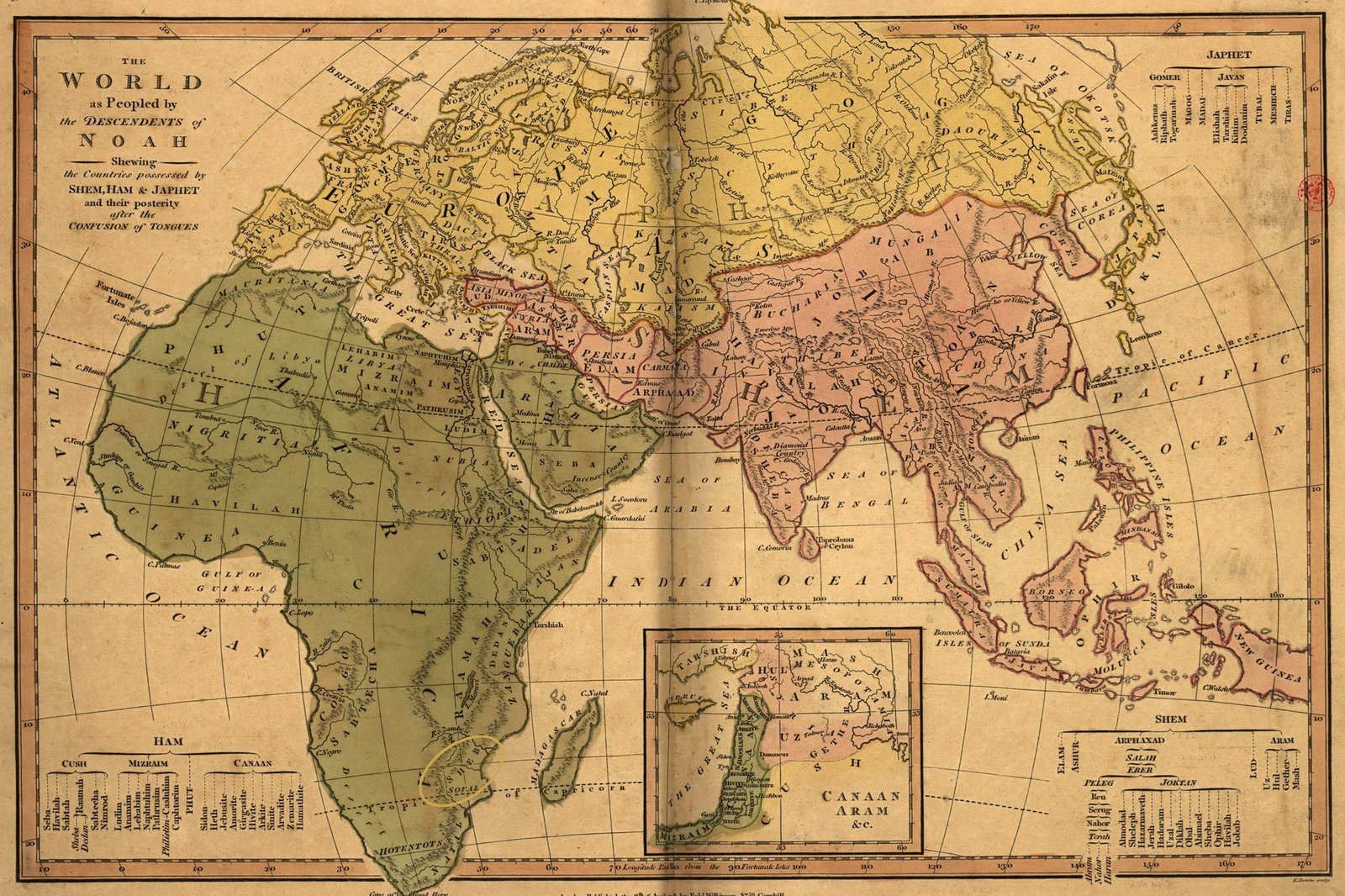
Sofala lies almost due south of Jerusalem. Sofala is at about 34.7 degrees east and Jerusalem at about 35.2: less than half a degree apart, almost on the same line of longitude. The figures are modern, and that line also crosses Sudan, Kenya, Tanzania and Malawi, so it is not a proof. It is a striking coincidence. Queen of the south is not a preacher’s flourish. On the map, it is very nearly a coordinate.
The Confusion Has a Birthday
If the record is this plain, why is the world so confused? Because the confusion has an origin, and it can be dated.
The confusion began with translation. When the Scriptures were put into Greek at Alexandria, in the third and second centuries BCE, Greek had no way to write the “sh” sound, so Seba and Sheba came out with the same name, Saba, in the very verse that introduces them both (Genesis 10:7). The alphabet quietly made one name of two men. The Jewish historian Josephus, writing in Greek in the first century CE, inherited that single name, and over centuries of copying the two households merged on the page. That is how Arabia’s Saba came to inherit a queen of Cush. The text in the language of Israel never merged them. Jewish scribes copied it letter by letter, keeping Seba and Sheba apart in the very same verse, and when the King James translators of 1611 worked from that text rather than from the Greek and Latin translations, the two men stood apart again on the English page: Seba for the uncle, Sheba for the nephew. The distinction this essay follows is not new. It has stood in the King James Bible for more than four hundred years. But by 1611 the merged name had already shaped some eighteen centuries of tradition. Yet Josephus also preserves something on Africa’s side: he sends Raamah’s other son, Dedan, to settle “a nation of the western Ethiopians”, and he calls the Queen herself queen of Egypt and Ethiopia. He wrote a thousand years after her, so he is a supporting witness and no more. The foundation of this essay is Genesis.
A few verses do place Sheba’s traders in Arabian company, and they change nothing. Job’s raiders are “the Sabeans” (Job 1:15), Jeremiah hears incense coming “from Sheba” (Jeremiah 6:20), and Isaiah gathers Sheba’s camels with the dromedaries of Midian and Ephah, of Keturah’s line: “all they from Sheba shall come: they shall bring gold and incense” (Isaiah 60:6). These are trade roads and caravans, and they are freely granted: a trading house is found on every road its goods travel, and being on a road is not the same as living there. The identification rests on the passages where the record places Sheba beside his father, and a cargo list cannot overrule a genealogy.
The South, Settled
So the trail runs plainly. A trade list places Sheba beside his father Raamah, selling the Queen’s own cargo. Arabia’s archive opens two centuries too late and has no queen in it. Scripture names her for Sheba, never for Ethiopia, and Ethiopia’s own king keeps Saba and Ethiopia apart. And a London map, drawn from Genesis itself, letters her family’s name across the gold country behind Sofala, almost due south of Jerusalem.
She has been sought in Yemen’s inscriptions, which do not name her, and enthroned by an Ethiopian epic written some twenty-three centuries after she travelled. All along, she was standing in the first genealogy the Bible gives, in her father’s house, in the south.
If the record seats her there, in her own family, with her own cargo, under her own title, why have we spent so many centuries looking for her everywhere except where her family stands?
Look again. Think deeply. Seek understanding.
— C. D. Ford
This essay is drawn from the eleventh chapter of my forthcoming book, Clothed in Fire, Built on Sand, which will be launched on 20 February 2027. The essay follows one road of that chapter — the map, the genealogy, and the gold of the south. The chapter itself travels further, and the question of the borrowed crown is answered there in full.