The Proverbial Messenger
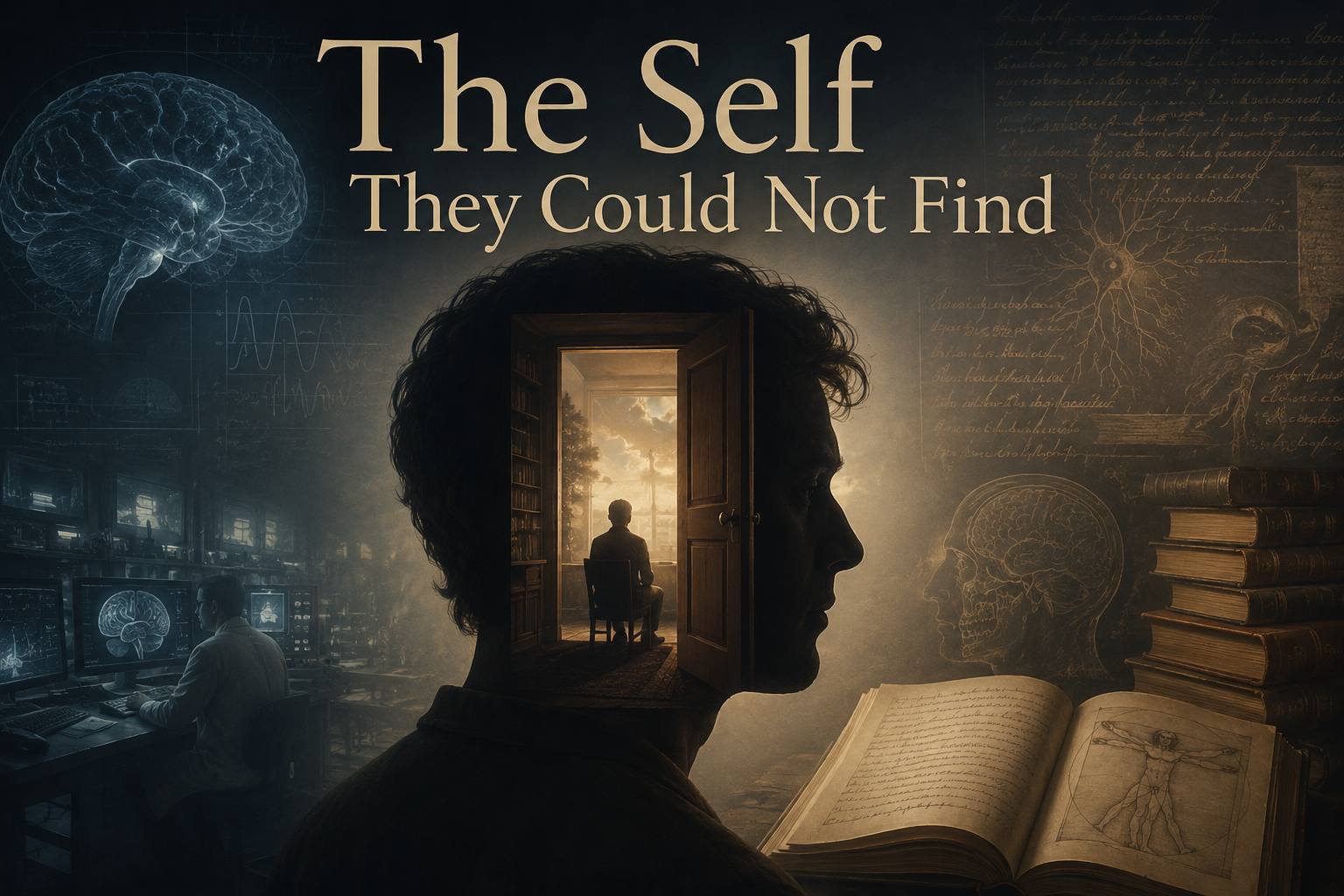
The Self They Could Not Find
The most immediate thing you know has been declared a mistake on the strength of a search.
The Thing They Could Not Find
“For what man knoweth the things of a man, save the spirit of man which is in him?”
— 1 Corinthians 2:11 (KJV)
There is one room no one else will ever enter.
You have lived in it your whole life. It is where your thoughts occur before you speak them, where a memory returns unbidden, where grief sits, where a melody plays that no one around you can hear. Others may know your face, your voice, your history. They may one day know your brain in the finest detail. But the room itself — what it is like to be you, on the inside — has only ever had one occupant.
This is not mysticism. It is the plainest fact of your existence, and Scripture stated it long before neurology could: what man knows the things of a man, save the spirit of the man which is in him? The brain is public. Anyone may examine it, as they would examine any object. The mind is private, and always has been.
Which makes a certain modern verdict worth examining.
Some years ago a major magazine gave its cover to the search for the mind. The reporting was genuine and often remarkable: instruments now trace a signal inward from the eye, register the flush of fear in a small structure of the brain, and mark the firing of cells as an old memory reassembles. Impressive work, and worth doing. But the article closed on a conclusion that reached far past its instruments. After more than a century of looking, it announced, researchers had found no place in the physical brain for a self to reside — and had therefore concluded that no such self exists.
Set that beside the room you have lived in all your life. The most immediate thing you know — that you are here, reading this, someone to whom these words are happening — has just been declared a mistake, on the strength of a search.
It is worth asking what, exactly, that search was looking for. And where.
What the Instruments Actually See
The article reports that researchers watched a thought take place, that they watched vision itself. But an electrode in the gray matter does not watch vision. It watches tissue respond. It records the retina and the inner brain doing their physical work — and it never once sees what the animal sees. The seeing happens in the one room the electrode cannot enter. Stimulate a memory in my brain with every device you own, and you still cannot tell me what I am remembering. Only I can, because only I am inside.
Picture a letter written in a language no one has yet deciphered. A careful scientist could tell you everything physical about it: the fiber of the page, the metal salts in the ink, the pressure of the pen, the age of the paper to the year. He could measure every property the letter possesses — and still not read one word of it. For the meaning of the letter is not among its physical properties. It rides upon them; it could not reach you without them; and it is not the same thing as them. To announce that the letter is nothing but ink and fiber is to have measured everything and understood nothing. The words were never going to appear under the microscope. That is not where words are.
The mind is like the meaning, not like the ink.
A Feeling Is Not a Reaction
We are told, now, that a feeling is a chemical reaction — that what you call sorrow is a cascade of molecules and nothing further. Consider how strange the claim is. Chemical reactions do not hurt; sorrow does. No account of neurochemistry, however complete, contains the ache of loss or the warmth of being loved. You may read the whole description and never once wince. The description is public. The ache is yours alone. Something in the feeling escapes every measurement we make of it, and that something is the feeling itself.
C.S. Lewis saw where this habit of mind leads. Attend to a rose, he observed, and you have it whole; but begin explaining it away — the color handed off to the optic nerve, the scent to the chemistry of the nose — and if you are not careful, “in the end there is no rose left.” Follow the reduction faithfully and everything of worth drains from the world by the same logic. Not the rose only. Love becomes a chemical event, music a disturbance of air, beauty a trick of wavelength. And you know better. You have stood before something beautiful and known it was more than light.
The Error in the Search
But the deepest trouble is not what the verdict costs. It is that the verdict does not follow.
Return to how the conclusion was reached: a century of looking failed to locate the self within the physical brain, so the self was pronounced not to exist. Consider the shape of that reasoning. A man searches high and low for something invisible, finds nothing, and concludes there is nothing to find. But if a thing is invisible by its very nature, no amount of looking will turn it up — and its failure to appear proves only that he searched for it in the one place its nature forbids it to be. You do not disqualify the mind by failing to find it in the brain, any more than you disqualify meaning by failing to find it in the ink. The mind was never going to appear on the instrument. That is not where minds are. We hold the mind to be real not because it shows up under an electrode, but because we reason to it, plainly and successfully, from what nothing else can explain.
And there is a final cost the verdict cannot survive. If every thought is only the determined firing of cells — one physical state producing the next, like railway cars behind an engine — then the thought that reached this very conclusion is also only a firing of cells. It was going to occur whether or not it was true. As Lewis argued, we have no reason to trust that one accident can give a faithful account of all the other accidents; the shape a spill happens to take tells you nothing reliable about the vessel that was upset to make it. So if the reductionist is right, his verdict is not a discovery. It is a reflex. The argument, followed honestly, erases the mind that produced it — including his own. A view that abolishes the knower cannot be trusted to have known anything.
And here is the thing worth noticing — the thing beneath the thing. This maneuver is not new. It is one of the oldest in the record: the confident authority who cannot locate something by his chosen instrument, and who declares, on that failure alone, that it was never there. More than minds have been erased this way. Whole peoples have been told, by men holding the measuring rods of their day, that what they knew themselves to be simply did not exist — because it could not be found where the instrument happened to be pointed. The error is always the same. It mistakes the limits of a method for the limits of reality.
The Occupant of the Room
So the self they could not find is not missing. It is the very thing reading this sentence — the one occupant of the one room, doing now exactly what it has always done: taking in meaning that no electrode will ever display.
None of this argues against studying the brain. Mapping it is good and patient work, and the correlations are real: touch the tissue and the thought is disturbed. But a correlation is not an abolition. To move from the mind depends on the brain to the mind is only the brain is to reach past the evidence and pronounce a soul out of existence — and to pronounce, along with it, the one doing the pronouncing.
You have lived in that room your whole life. You know it is not empty. And a people who know, from the inside, that they are not nothing are very hard to persuade otherwise.