The Proverbial Messenger
Which Olive?
The Curious Case of the “Olive Complexion”
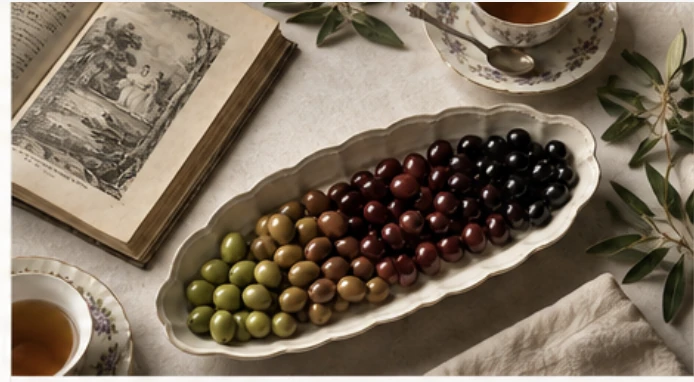
Brown, reddish-brown, purple-brown, black. Nobody looks like a green olive.
It happened over tea.
We were discussing complexion when that familiar expression appeared, the way it always does, unannounced and entirely sure of itself:
Olive-skinned.
Nothing remarkable about that. We have all heard it. We know approximately what we are expected to imagine: someone Mediterranean-looking perhaps, somewhere between pale and brown, possibly golden, possibly tanned, and—if the modern beauty industry is consulted, and it insists on being consulted—possessing that mysterious greenish undertone we have all apparently agreed exists, though nobody present could quite say who agreed to it, or when.
Then I asked a very simple question.
Which olive?
There was laughter. The confident kind—the kind that assumes a question is rhetorical and will shortly apologise for existing.
It did not apologise. It sat there.
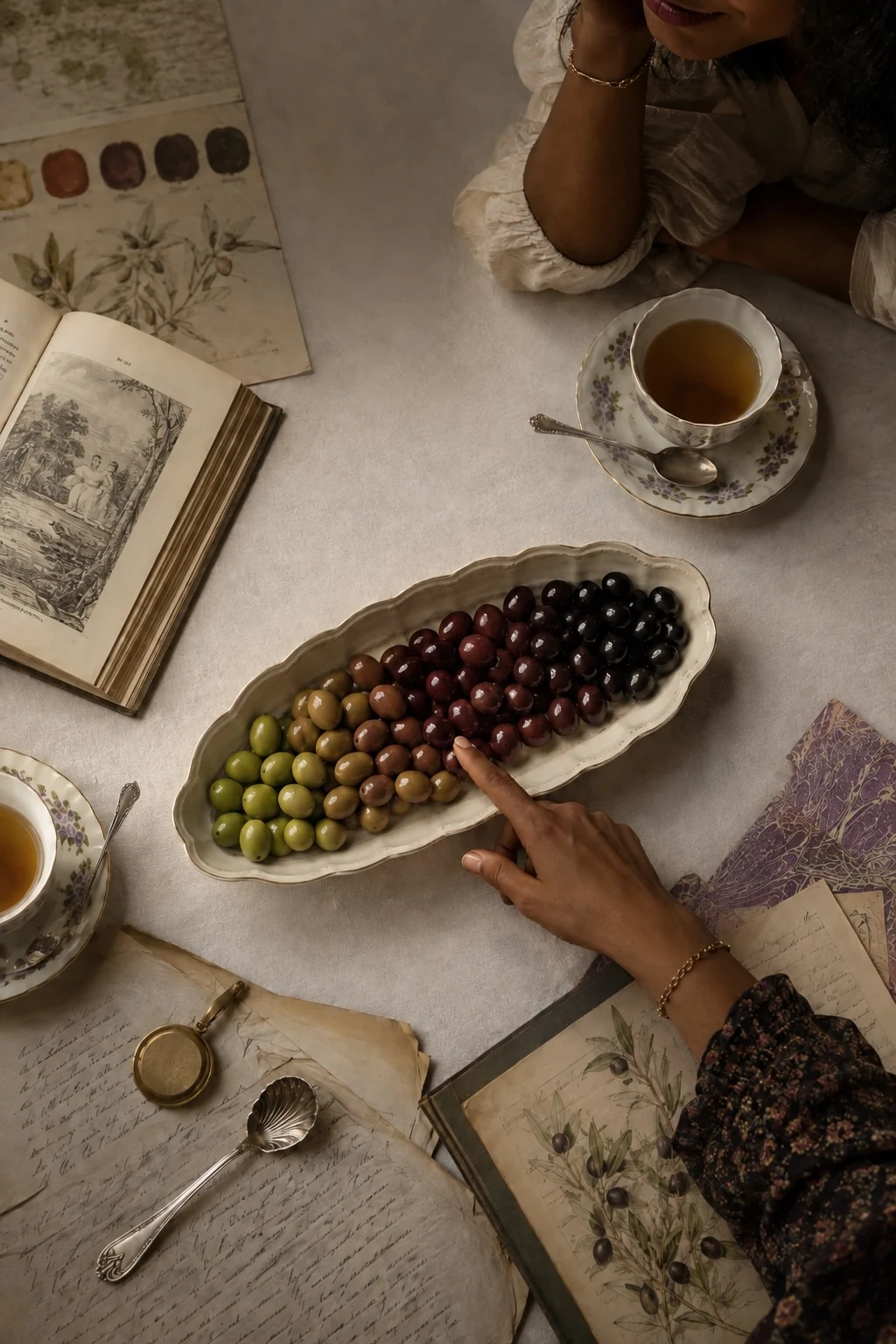
And after looking at olives properly—actual olives, in an actual bowl, the way one looks at a thing one has been describing people with for three centuries and has apparently never examined—both young ladies told me essentially the same thing: they would never look at an olive in quite the same way again.
Neither, perhaps, should we.
The Poor Green Olive Has Been Given Far Too Much Responsibility
When someone says “olive complexion,” our modern imagination has been trained—like a dog at the sound of a particular bell—to reach immediately for the green olive.
But why?
Have we met people who resemble green olives?
I have not.
Perhaps I have been attending the wrong tea rooms. Or the wrong olives.
The olive tree, meanwhile, appears completely unaware of the rules we have imposed upon it, and shows not the slightest inclination to cooperate.
Olives are green at certain stages, certainly. But as they mature, depending upon variety and ripeness, they can become reddish, brown, reddish-brown, purple-brown, deep purple and extremely dark—sometimes appearing virtually black, and looking, frankly, rather pleased with themselves about it.
Now look at humanity again.
Brown skin? Plenty.
Golden-brown skin? Certainly.
Reddish-brown skin? Everywhere.
Deep brown skin? Obviously.
Brown skin carrying a reddish, bluish or purplish cast? Absolutely.
Very dark skin conventionally described as black? We have been describing human beings that way for centuries, without requiring a single fruit’s assistance.
Green?
Well.
Apparently that is the olive we decided was important. The others, one assumes, simply hadn’t the right connections.
Complexion Is Not the Same Thing as Undertone
Part of the confusion comes from collapsing two different ideas into one: complexion and undertone.
When an older writer describes someone as having an “olive complexion,” he is not necessarily standing there performing a twenty-first-century cosmetics analysis, colour wheel in one hand, ring light in the other. He is describing what the person looks like.
That distinction matters.
A complexion is something observed at the surface. If I describe somebody as having a pale complexion, a ruddy complexion, a brown complexion or a dark complexion, I am describing the visible appearance of that person’s skin—the sort of thing one can verify by looking at the person, a method historians seem oddly reluctant to trust.
An undertone is something rather different. In modern cosmetic terminology, it refers to the subtler colouring perceived beneath the dominant surface colour—the sort of thing one requires a beauty counter, a strip of white paper and considerable patience to establish.
Yet somewhere along the way, the two ideas became muddled, and nobody sent out a memo.
An historical description of an olive complexion can now be read as though the writer were secretly telling us about a green undertone, which would make him either remarkably prescient or in possession of a rather unusual travelling companion.
That is quite a leap.
A person may have a brown complexion with golden undertones, a deep brown complexion with reddish undertones, or a dark complexion carrying cooler blue or purplish tones.
And yes, modern cosmetics also recognises what it calls an “olive undertone,” often described as greenish or grey-green.
Fine.
But if what you actually mean is a green undertone, I have another dangerously simple question:
Why not call it a green undertone?
Why summon the entire olive, with all its history, all its varieties, all its opinions?
The olive has enough problems.
And Then There Is the Actual Fruit
This is where the whole thing becomes deliciously inconvenient.
If we genuinely wish to use olives as an analogy for human colouring, then the green olive—unripe, notoriously bitter straight from the tree, and, like its riper relatives, unwilling to become lunch without first being cured—may actually be one of the least visually persuasive examples available to us.
Look at ripe olives.
Brown. Mahogany. Reddish-brown. Purple-brown. Deep purple. Naturally dark, sometimes appearing virtually black.
These colours—or colours remarkably close to them—are readily observable across human complexions. One need not squint. One need not consult a swatch.
And not merely as surface colours.
When we turn to undertones, the argument does not suddenly rescue the green olive either—it does not even show up to defend itself.
Rich brown and dark skin can visibly carry golden, reddish, cool, bluish and even purplish casts. Anyone who has spent time actually looking at the enormous variety of human pigmentation, rather than glancing at it and reaching for the nearest available cliché, knows that “brown” itself contains an astonishing spectrum.
Some brown skin appears golden. Some appears red. Some almost copper. Some carries a cool blue cast. Some deep complexions can appear almost purple in certain light.
So even if we insist upon discussing undertones, the brown, reddish-brown, purple-brown and very dark olives remain remarkably useful comparisons.
In fact, they may be considerably more visually recognisable as human colouring than the green one, which has spent this entire essay looking increasingly out of its depth.
Yet somehow we bypass the brown olive.
Ignore the reddish-brown olive.
Step neatly over the purple-brown olive.
Walk straight past the black olive, as though it hadn’t RSVP’d.
Reach triumphantly for the green one.
And announce:
“There. That explains human skin.”
Does it?
What Did “Olive” Originally Mean?
This is where the history becomes considerably more interesting than the cosmetics counter.
The English expression “olive complexion” has been used for centuries, but historical writers were not necessarily using our present-day categories of skin colour, whatever the modern ear would like to assume on their behalf.
Older European descriptions of complexion employed a wonderfully imprecise vocabulary: brown, tawny, swarthy, sallow, dark, black and olive, among others—a vocabulary that seems to have functioned less like a system and more like a shrug with syllables attached.
These terms overlapped. Their meanings shifted according to period, author and population being described.
Seventeenth-century English traveller Thomas Coryat, for example, described the Mughal emperor Jahangir’s complexion as neither white nor black but between the two, using “olive” for that intermediate colouring.
That is important.
He was not telling us that Jahangir had discovered an exceptionally flattering green foundation, several centuries ahead of the market.
He was attempting to describe visible human pigmentation, using the only word he had that seemed to fit, and getting on with his travel journal.
Historical sources can similarly place olive alongside tawny, brown and darker complexions. The word belonged to a broad and often inconsistent European vocabulary for describing people whose colouring did not fit neatly into the simple poles of “white” and “black.”
Even modern dictionary definitions preserve something of this distinction, rather sheepishly. Olive as a colour may refer to grey-green. But an olive complexion is commonly defined in terms such as yellowish-brown or brownish.
There it is.
Brown has quietly returned through the back door, hoping nobody would notice it had been locked out of its own word.
And once we acknowledge that, the unquestioned association between “olive complexion” and green becomes considerably less secure.
Because if the complexion being described is brownish, yellow-brown, tawny or somewhere within that broad family of visible human colouring, why are the naturally brown, reddish-brown, purple-brown and very dark ripe olives treated as though they have nothing whatsoever to contribute to the discussion? They did the actual ripening. The least we owe them is an invitation.
They are olives too.
Rather inconveniently, they may even look more like us.
A Small but Important Caveat
There is another reason for caution when encountering the word olive in descriptions of historical figures. Jesus the Christ, for example, has frequently been represented or described in later commentary as having an “olive” or “olive-toned” complexion—a description offered with tremendous confidence by people separated from Him by many centuries, several continents and, in a good number of cases, a paintbrush.
But here the same question must be asked.
Which olive—and whose description?
The Bible itself does not describe Jesus the Christ simply as having an “olive complexion.” That terminology belongs to later descriptions and reconstructions of His appearance, offered by writers and artists working from imagination, tradition, or the prevailing assumptions of their own century rather than from an eyewitness account of His skin. It should therefore not be quietly treated as though olive were a Biblical racial classification, nor should a modern definition of olive skin—green undertone and all—be projected backwards and presented as evidence of precisely what He looked like.
Indeed, this is exactly why the language matters. If olive historically encompassed brownish, tawny and darker visible complexions, while the actual fruit itself ranges through brown, reddish-brown, purple and black, then saying that someone was “olive-toned” still leaves us with the question this entire essay has been asking:
What did the person using the word actually mean?
The description may be relevant. It simply is not self-interpreting.
And if we are going to use the olive to tell us what an Israelite looked like, we might at least have the courtesy to invite the ripe olives into the conversation—rather than the one variety that never quite made it to the table.
The Problem With Reading Colour Backwards
This becomes especially important when historical figures are described as having an “olive complexion.”
We cannot simply take a twenty-first-century cosmetics chart, locate the box labelled olive, hold it up against a face three hundred years dead, and declare the matter settled.
Language changes.
Categories change.
Ideas about race change.
Even the boundaries of colours change—ask anyone who has argued with a paint shop about the difference between “sage” and “olive” and lost.
An older writer saying that someone was olive, swarthy, tawny or dark was describing what that writer believed he saw, through the only vocabulary his century had handed him. Such words have to be interpreted within their own period, alongside other descriptions of the person, their ancestry, portraits where reliable, geography and documentary evidence—the unglamorous, unhurried work that a single adjective is being asked, quite unfairly, to skip.
“Olive” cannot bear that historical burden by itself.
It certainly cannot magically settle someone’s racial identity, however confidently it is deployed at dinner parties.
That is particularly relevant to an argument I have made before, in an earlier discussion of the philosopher Baruch Spinoza and the various attempts—some more scholarly than others—to determine what historical descriptions of his appearance actually tell us about his identity. The same word did a great deal of unearned work there too.
Calling someone “olive” does not settle the matter.
It raises another question:
What did the person using the word olive mean by it?
And yes—I am aware I have just walked through this list once already. I make no apology for walking through it again, because apparently it needs saying twice: the period, the writer, other descriptions, portraits where reliable, ancestry, geography, documentary evidence. All of it. Every time. No shortcuts, and certainly none via fruit.
One adjective cannot carry an entire racial history upon its back.
Especially when we cannot even agree upon which colour olive we are talking about.
Perhaps We Should Let the Olive Speak
So I propose a small experiment, and I promise it requires nothing more advanced than a bowl and a willingness to be embarrassed.
The next time someone mentions an “olive complexion,” picture an actual bowl of olives.
Not merely the green ones. The green ones have had quite enough attention already.
Put the whole family on the table.
Green. Golden-green. Brown. Reddish-brown. Mahogany. Purple-brown. Deep purple. Black.
Then place beside them the extraordinary range of human complexions that have existed throughout history.
Now ask yourself:
Which olives actually resemble human skin?
Suddenly our unquestioned preference for green becomes rather amusing—the sort of thing that seemed perfectly sensible right up until someone made you look at it directly.
Perhaps “olive complexion” was never the precise racial classification later generations have sometimes tried to make it. Perhaps it was simply another imperfect human attempt to describe the enormous spectrum of colour existing between categories that were themselves never particularly precise.
That does not make historical descriptions of olive skin useless.
Quite the opposite.
It means we have to read them properly, rather than reaching for the nearest cosmetics-counter shortcut and calling it scholarship.
If a historical source tells me that someone had an olive complexion, I am perfectly willing to listen.
I simply refuse to supply the olive for him.
Was he describing something golden-brown? Brown? Tawny? Reddish-brown? Dark?
Was he distinguishing the person from someone described as white? From someone described as black?
What did olive mean to him?
Those are historical questions.
“Olive means green undertone” belongs to a modern cosmetic framework, not the descriptive framework Coryat was using in the seventeenth century.
And the two should not be confused.
So perhaps the humble olive has taught us something after all.
Sometimes an expression becomes so familiar that familiarity begins masquerading as evidence. We stop examining the words because we think we already know what they mean, and a word left unexamined for long enough starts behaving like it owns the place.
Then someone puts a bowl of olives on the table.
And suddenly there is a problem.
Because the brown olive is sitting there, arms folded.
The reddish-brown olive is sitting there, arms folded.
The purple-brown olive is sitting there, arms folded.
The black olive is sitting there, arms folded.
All looking considerably more like human beings than their green cousin, and all of them, frankly, owed an apology.
And none of them seem particularly impressed by our scholarship.
Which olive?
I suspect I shall be asking that question for quite some time.
Look again. Think deeply. Seek understanding.
— C. D. Ford