Reflections · History and Identity
The Book Was Waiting
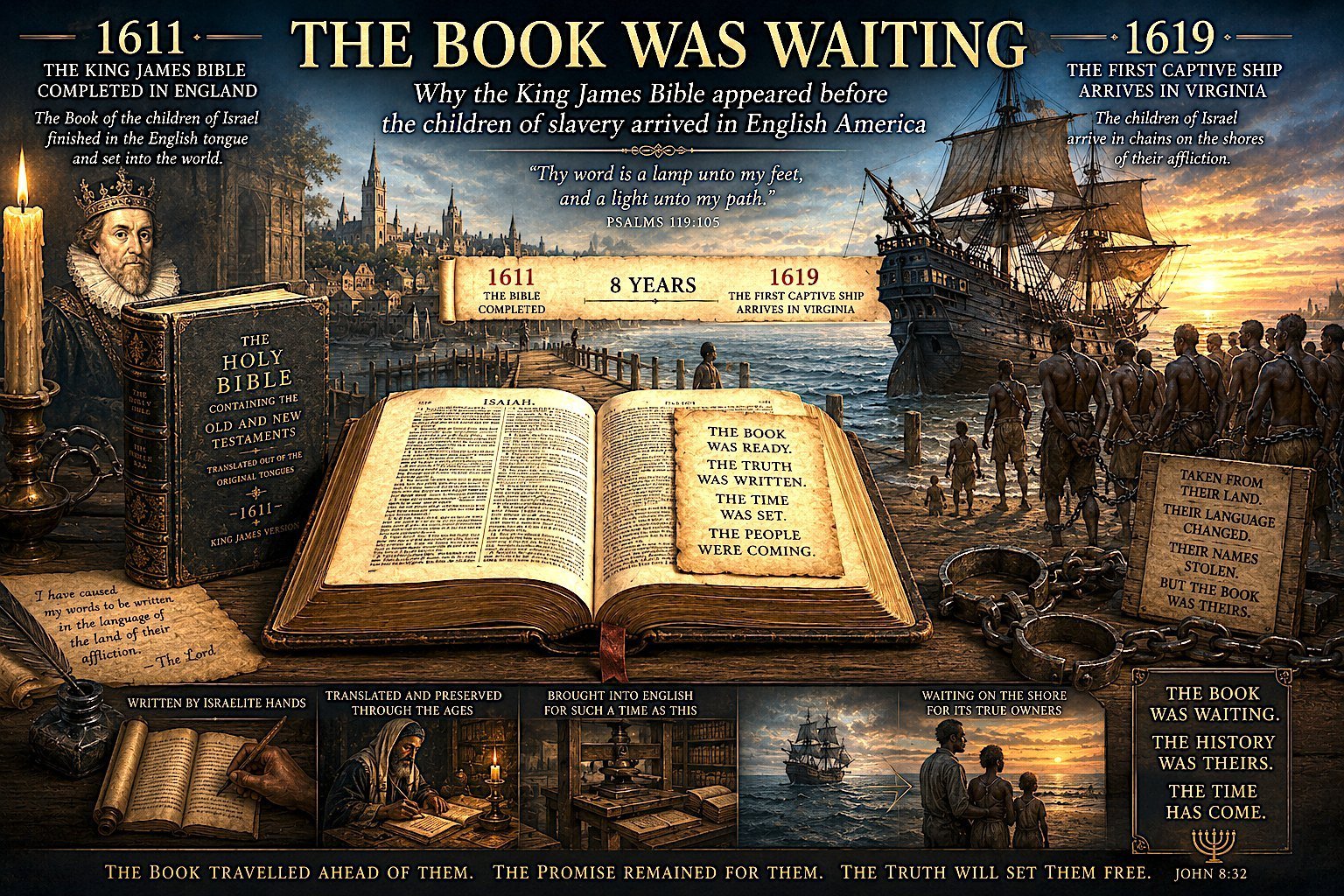
Why the King James Bible appeared before the children of slavery arrived in English America.
There are dates in history that seem ordinary until they are placed beside one another. Then the pattern becomes difficult to ignore.
The King James Bible was published in 1611. The first documented ship carrying captive Africans into English Virginia arrived in 1619. Eight years separated the Book from the people who would later be forced to read it in the language of their bondage.
The Bible was already there. It had already been translated into English. It had already entered the world that would become the New Egypt of the children of slavery.
Before they arrived, their history book was waiting.
This is one of the central arguments developed in the revised and expanded edition of The Hidden Secrets of the True Israelites. The original book introduced the identity of the descendants of slavery, but the revised edition follows the evidence much further. It traces not only the journey of the people, but also the journey of the Book that travelled alongside them.
The question is no longer simply: who wrote the Bible? The deeper question is: whose hands carried it, preserved it, translated it, opened it, closed it, and finally placed it into the language of the enslaved?
That is the chain of custody of the Book.
Before There Was a Bible, There Was a People
The Bible did not begin as a European religious text. Its history began with the Israelites. Before the writings were translated into Greek, Latin, Spanish, or English, the laws, histories, prophecies, songs, and covenant belonged to the children of Israel.
The commandments were given to Israel. The prophets arose from Israel. The kings, priests, apostles, and disciples were Israelites. The Messiah came through the line of Abraham, Isaac, Jacob, Judah, and David.
Christian Europe did not create this history. Rome did not originate it. The translators of later centuries did not become its authors merely because they rendered it into another language. A person may translate another nation's history, but the history does not become his.
The Bible remained an Israelite Book, regardless of the language into which it was carried.
The First Great Translation
One of the earliest major links in the chain was the translation commonly known as the Septuagint. The First Testament was rendered into Greek for a world in which Greek had become a dominant language. According to the tradition preserved in the manuscript, seventy-two Israelite elders — six from each of the twelve tribes — participated in the work.
That detail matters. The first major movement of the Scriptures into another language was not the theft of the Book by foreigners. It was Israelites carrying their own Word into a language that could be understood within the world in which they were living.
The language changed. The ownership did not. The Book was still Israelite.
The Book Travels Through the Scattering
After the destruction of Jerusalem and the scattering of the people, the Scriptures travelled wherever the Israelites travelled. They moved through Egypt, North Africa, the Mediterranean, Asia Minor, Spain, Portugal, and eventually northern Europe.
The people did not always speak the same language. They spoke Greek in one region, Arabic in another, Castilian in Spain, Ladino in exile, and later English in the lands of their bondage. But the Word continued moving.
This is important, because scattering does not mean disappearance. A people may lose political power. They may be expelled from their homeland. They may be forced to conceal their identity. They may speak the language of another nation. Yet they may still preserve their history through books, customs, memory, and teaching.
The Book became one of the principal witnesses that the people had not vanished.
The Book Was Kept Open Among the Moors
During the medieval centuries, the Bible was not always freely available to the common people of Christian Europe. Latin increasingly became the language of the Church, while ordinary people spoke developing forms of English, French, Spanish, German, and other regional languages. The common person could attend a service without understanding the language in which Scripture was being read.
But in the Moorish and Iberian world, Israelite scholars continued studying, copying, discussing, and translating the Scriptures. They worked in Arabic. They worked in Spanish. They produced writings for communities that needed the Word in the language they actually understood.
This is the same principle examined in the history of Ladino: the Word was brought down into the language of the people. While religious institutions were building walls around Scripture, the scattered people continued opening it.
The Book remained alive because it remained readable.
The Hidden Israelites
The Inquisition created another kind of Israelite witness: the hidden keeper of the covenant. Many Israelites in Spain and Portugal were forced to convert publicly to Christianity. Some became known as Conversos or Marranos. Outwardly, they conformed to the religion of the ruling powers. Privately, some continued preserving fragments of the faith of their fathers.
They lived behind a mask. They taught children quietly. They guarded customs within the home. They preserved what they could, often at great personal risk.
The revised edition draws a connection between these hidden Israelites and the broader history of biblical preservation. A people officially expelled or converted did not necessarily cease to exist. Some remained inside European society under altered names and identities. Their learning did not disappear simply because their ancestry had been forced underground.
This is one reason the contribution of Israelite scholarship to later biblical translation cannot be measured only by looking for men openly identified as Israelites. Some could not safely declare who they were.
The Ferrara Bible
In 1553, the Ferrara Bible was printed in Spanish for the Iberian exiles and secret Israelites who needed Scripture in a language they understood. This Bible was not produced merely for scholars. It addressed a people who had been separated from the writings of their fathers by persecution, conversion, exile, and time. They needed the Word in Spanish because Spanish was the language they still possessed.
The Ferrara Bible therefore became another link in the chain. It preserved the discipline of rendering Scripture carefully into the language of ordinary people. It stood within the stream of Iberian learning that preceded the great English translations.
The journey toward the King James Bible did not begin suddenly in England. It had already passed through centuries of Israelite scholarship, exile, translation, and preservation.
The Price of an English Bible
The right to read Scripture in English was not won easily.
John Wycliffe produced a complete handwritten English Bible in the fourteenth century. He was condemned, and years after his death his remains were dug up and burned. William Tyndale translated the Second Testament from Greek into English. His wording later formed a substantial portion of the King James Bible. For that labour, he was strangled and burned.
These men challenged a system that treated Scripture as the possession of institutions rather than the inheritance of the people. They believed the ploughboy should be able to know the Bible. They believed the Word should be heard in the language spoken in the home, the street, and the field.
That was the same principle seen in Ladino. Bring the Book to the people. Do not force the people to climb through a priesthood before they can reach it.
King James and the Authorized Version
In 1604, King James commissioned a new English translation of the Bible. The translators did not begin with nothing. They built upon earlier English translations, especially the work of Tyndale. They consulted ancient texts, grammarians, commentaries, and generations of biblical scholarship. Much of that learning had been preserved through Israelite scribes and teachers.
The revised edition distinguishes between what can be established historically and what belongs to the doctrine of the book. The historically defensible point is that the translators depended heavily upon texts and scholarship preserved through Israelite tradition. The additional doctrinal position is that some individuals connected to the work may themselves have descended from hidden Israelites who remained in England after earlier expulsions.
The book does not pretend that every such identity can be proven by surviving records. Its larger point does not require that claim. The translators were working with an Israelite Book, an Israelite history, and a scriptural inheritance preserved through Israelite custody.
In 1611, the work was completed. The King James Bible entered the English-speaking world.
Then Came 1619
Eight years later, a ship arrived at Point Comfort in Virginia carrying captive Africans. Those captives entered an English colony. They entered a world whose developing laws, commerce, worship, and education would be conducted primarily in English.
Their descendants would be forced to speak English. They would be renamed in English. They would labour under English-speaking masters. They would be taught from an English Bible.
But the Bible placed before them contained a history that looked strangely familiar. A people carried into bondage. A people stripped of their name. A people scattered among nations. A people serving enemies in hunger, thirst, nakedness, and want. A people brought into another Egypt. A people who would one day remember themselves.
The enslavers believed they were giving the captives a religion of obedience. But they were also placing into their hands the record of their own fathers.
The Book They Used to Control Us
The Bible was frequently misused during slavery. Selected passages were preached to demand submission. Masters emphasised servants obeying masters while ignoring the judgement pronounced against oppressors. They taught a pale European Christ. They presented Israel as another people. They attempted to turn the Book into a chain.
But the Book would not remain chained to their interpretation.
The descendants of slavery found Moses. They found Pharaoh. They found Egypt. They found the Red Sea. They found Daniel in captivity. They found the children of Israel crying under oppression. They found a God who heard the cries of the afflicted.
The enslavers attempted to give them Christianity. The captives found Israel.
This is why the spirituals were filled with the names, images, and language of the First Testament. They sang of crossing Jordan. They sang of Moses. They sang of Pharaoh's army. They sang of going into Canaan. Even before they fully understood their identity, they recognised their condition inside the Book. Their spirits remembered before their history had been restored.
The Bible Was Not the Slave Master's Book
The fact that slave masters possessed Bibles did not make the Bible theirs. A thief may hold an inheritance without becoming its rightful heir. A conqueror may possess the records of another nation without becoming the subject of those records. A church may interpret a covenant while standing outside the bloodline to which that covenant was given.
The enslavers held the Book. But they were not the people of the Book. The captives were.
This is one of the greatest reversals in history. The people who claimed ownership of Scripture were using it against the descendants of the very nation that had written it. The children of Israel were being beaten beneath quotations taken from their own family history. They were being told to accept bondage by men reading from the record of the God who delivered Israel from bondage.
The contradiction could not remain hidden forever.
The Chain of Custody
The revised edition presents the Bible's journey as a chain of custody. The laws and histories were given to Israel. The Scriptures were written and preserved by Israelites. Israelite elders carried the First Testament into Greek. The scattered people carried the Word throughout the Mediterranean. Israelite scholars kept it open through the Moorish and Iberian centuries. The Ferrara Bible carried it into the Spanish of the exiles. English translators drew upon texts and learning preserved through Israelite scholarship. The King James Bible appeared in 1611. Captive Israelites arrived in English Virginia in 1619.
The Book had travelled ahead of them. It had entered the language they would be forced to speak. It was waiting in the country of their affliction.
The manuscript asks whether this was merely coincidence. Its answer is no. The God of Abraham, Isaac, and Jacob had placed the history of His people within their reach before they understood that it belonged to them.
The Book Remembered Us
The descendants of slavery were taught that they had no history. Their names had been taken. Their families had been divided. Their countries of origin had been obscured. Their languages had been suppressed. Their identity had been reduced to colour.
But the Book remembered what the world demanded they forget. It remembered the covenant. It remembered the scattering. It remembered the ships. It remembered the bondage. It remembered the curses. It remembered the promise of restoration.
The people may have forgotten the Book was theirs. The Book had not forgotten them.
Why the Revised Edition Goes Further
The original edition of The Hidden Secrets of the True Israelites established the central identity argument. The revised and expanded edition develops the full historical structure surrounding it. It follows the movement of the Bible from Sinai through translation, exile, persecution, and preservation. It examines the role of Ladino and the Ferrara Bible. It considers the suppression of vernacular Scripture. It follows the emergence of the English Bible and the publication of the King James Version. It then places 1611 beside 1619 and asks the reader to recognise the pattern.
This is not presented merely as an interesting coincidence in publishing history. It is presented as providence. Before the people entered bondage, their history was prepared in the language of that bondage. Before they knew their name, the record of their name was waiting. Before they understood the curses, the curses had been translated. Before they recognised the covenant, the covenant had already crossed the ocean.
The Book arrived first. The people came eight years later. And four hundred years after that arrival, the descendants of those captives began reading the Book with different eyes. Not as strangers. Not as converts to somebody else's religion. But as the children whose history had been waiting for them all along.
This reflection draws from the revised and expanded edition of The Hidden Secrets of the True Israelites — which follows the Bible's chain of custody from Sinai to the shores of bondage.
Learn more about The Hidden Secrets of the True Israelites →
Documentation
Selected References
Works directly cited, named, or used as a foundation for this reflection.
- Ford, C. D. Hidden Secrets of the True Israelites. Revised and expanded ed. Publication details to be added.
- Lazar, Moshe, ed. The Ladino Bible of Ferrara, 1553: A Critical Sephardic Classical Library 6. Culver City, CA: Labyrinthos, 1992.
- Heine, Ronald E. ‘The Beginnings of Latin Christian Literature.’ In The Cambridge History of Early Christian Literature, edited by Frances Young, Lewis Ayres, and Andrew Louth. Cambridge: Cambridge University Press, 2004.
- Septuagint.
- Wycliffe, John, and collaborators. Wycliffite Bible. c. 1382–1395.
- Tyndale, William. English biblical translations. 1526–1530.
- The Holy Bible, King James Version (1611).