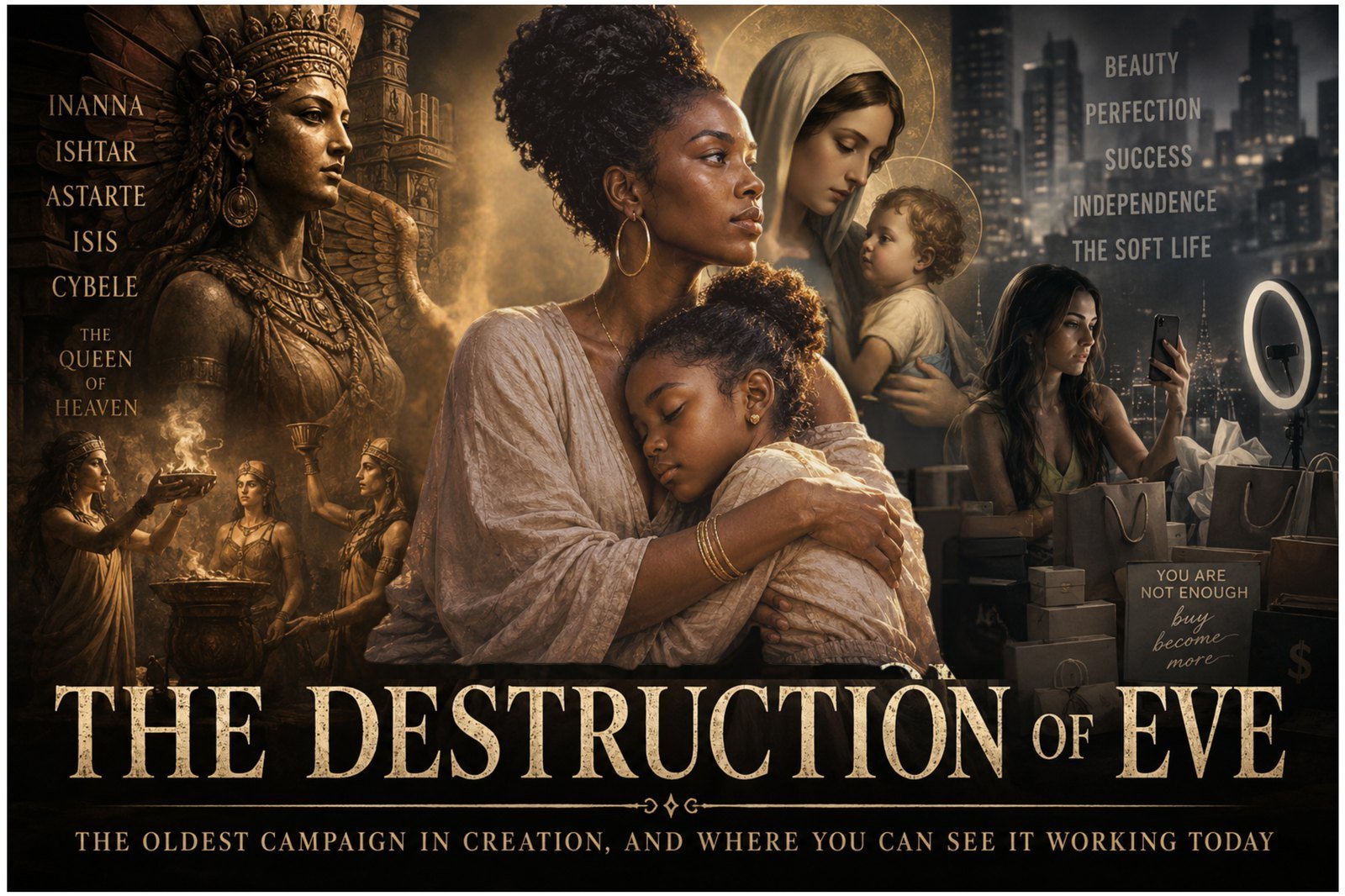
Reflections · The Destruction of Eve, Part One
The Oldest Campaign in Creation
Something has been done to you. You were not supposed to notice.
Something has been done to you. Not by accident, and not by the ordinary drift of culture. Deliberately, patiently, over a very long time.
You were not supposed to notice. Most women do not.
The Design That Was Targeted
The Creator made one man and one woman. Not a god and a goddess. Not interchangeable beings. A man, and a woman taken out of the man — the only creature in all of creation formed not from dust but from living flesh. Distinct. Complementary. Each carrying something the other does not have.
That design is the target. It has always been the target.
Because if you want to destroy a people, you do not begin with the men. You begin with the woman. Confuse her identity and the family loses its centre. Remove her from her natural place and the next generation is unmoored. Turn her against the man and you leave them both alone and unprotected, and easier to manage.
This is not theory. It is history, and it can be traced.
The Enemy's Own Wound
Before he ever spoke to a woman, he wanted something for himself. Isaiah records his sentence in his own words — five declarations, each beginning with the same two words:
I will ascend into heaven, I will exalt my throne above the stars of God … I will ascend above the heights of the clouds; I will be like the most High.
Isaiah 14:13–14
He wanted deification. He was refused it.
Now watch what he offers the woman. In the garden, the first thing he ever said to her was not disobey God. It was not hate God. It was:
Ye shall be as gods.
Genesis 3:5
He offers her the exact thing he was denied, in the exact terms he was denied it. This is not a random deception. It is his own wound, reproduced in her.
And notice how it arrives. He does not command. He asks a question, and lets her reach out her own hand. She believes it was her idea.
That is the whole of his method, and it has not changed in six thousand years. The most complete deception is the one that arrives as your own conclusion.
The Goddess: What She Actually Does
The goddess does not lower a woman. She elevates her — out of the body, out of the household, out of the ordinary consecrated life she was designed for, and up onto an altar where she can be adored, and where she can no longer do anything at all.
A woman on an altar bears no children. Keeps no covenant. Teaches no daughter. Stands beside no man. She is worshipped, and she is alone.
That is the mechanism. The elevation is the removal.
It is called honour. It is control.
Her Names
She is not one figure. She is a shape that recurs, in culture after culture, on every continent, wearing a different face and performing the same office.
In Sumer she is Inanna. In Babylon and Assyria she becomes Ishtar. Among the Canaanites and Phoenicians she is Astarte, Asherah, Anath. In Egypt she is Isis, and Hathor, and Sekhmet. In Phrygia she is Cybele, the Great Mother, and Rome imports her. In Greece she is Aphrodite, Artemis, Demeter, Gaia; in Rome the same women renamed — Venus, Diana, Ceres.
Further out, the same shape. Freyja and Frigg among the Norse. Brigid among the Celts, who was quietly reissued as a saint when the old religion was traded for the new. Devi, Kali, Durga, Parvati and Lakshmi in India. Guanyin in China, Kannon in Japan, Amaterasu in the Shinto shrines. Yemoja, Oshun and Oya among the Yoruba, carried across the Atlantic in the holds of ships and re-planted in Cuba, in Brazil, in Haiti under new names. Pachamama in the Andes. Mami Wata along the West African coast.
Look at what they do. Mother. Fertility. Love. War. The waters. The moon. The dead.
And over and over, across languages that never met, a single shared title: the Queen of Heaven.
A Note on Honesty
It is often argued that all of these are one woman — that a single historical queen was deified, and every goddess after her is a copy. That reconstruction is popular in certain circles. It is contested by historians. And this essay does not need it.
What is not contested is the pattern. The god and the goddess, paired. The mother elevated. The queen of heaven. It appears everywhere, and it appears early, and no one has explained why.
And Scripture does not deal in patterns.
It names her.
Scripture Names Her
The Creator does not treat this as a metaphor. He treats it as the specific, recurring, named sin of His own people.
They forsook the LORD, and served Baal and Ashtaroth.
Judges 2:13
Never Baal alone. Always the pair. Solomon, given more wisdom than any man alive, went after Ashtoreth the goddess of the Zidonians (1 Kings 11:5), and that is where the kingdom began to tear.
But the passage every woman should read is Jeremiah, because Jeremiah shows the mechanism — and shows that the women were its operational centre.
The children gather wood, and the fathers kindle the fire, and the women knead their dough, to make cakes to the queen of heaven.
Jeremiah 7:18
The whole household is enlisted. It looks like family life. It looks warm.
And when Jeremiah confronts them, they are not ashamed. They answer him with arithmetic. When they burned incense to the queen of heaven, they say, they had plenty of food and saw no evil; since they stopped, they have wanted for everything (Jeremiah 44:17–19).
They had run the numbers. The goddess, they said, worked.
That is the most frightening exchange in the prophets. Because the goddess never arrives as a demon. She arrives as a result. She comes with prosperity, with belonging, with a circle of women kneading dough together, with the feeling of finally being seen.
She comes as everything the woman was actually made for, offered by the wrong hand.
Centuries later, a riot breaks out in Ephesus because a preacher is threatening the trade in silver shrines. Listen to what the city shouts for two solid hours:
Great is Diana of the Ephesians.
Acts 19:28
And Paul, writing to Rome, names the transaction with total precision. They
worshipped and served the creature more than the Creator.
Romans 1:25
The creature. Not a demon. A created being, receiving what belongs to the One who made her.
The Mother on the Pedestal
Then the altar was carried into the church.
There is nothing wrong with honouring the woman who bore the Messiah. Scripture records her own words: from henceforth all generations shall call me blessed (Luke 1:48). She was faithful. She was obedient. She was courageous in a position that could have cost her everything.
But honour and elevation are not the same thing.
Somewhere between remembrance and devotion, the mother stopped pointing towards God and became a destination. Prayers that belong to the Father were redirected to her. Titles accumulated. Mother of God. Mediatrix. Advocate. Queen of Heaven.
That last one should stop every reader of Scripture where she stands.
It is not a devotional invention. You have already read it. It is the title of the woman the daughters of Judah baked cakes for, and the Creator never speaks of it once with approval.
Isis nursed Horus long before Mary held her son. The mother and the divine child is one of the oldest images in the world, and it is powerful because motherhood is powerful. That is precisely why it was taken.
The enemy rarely invents. He inherits, renames, and re-dresses.
The woman was never created to receive worship. She was never created to replace the Father. Her greatness was in her obedience, not in her exaltation.
The greatest honour ever given to Mary was not that men crowned her.
It was that the God of Israel trusted her.
Those are not the same thing.
Why Nobody Sees It
Satan himself is transformed into an angel of light.
2 Corinthians 11:14
The counterfeit does not arrive looking dark. It arrives looking like healing. Like mothering. Like the earth. Like peace.
Read any modern prayer to the Divine Mother and you will find there is not one ugly line in it — and that every petition in it is a petition Scripture directs to the Father. Protect me. Heal me. Prosper me. Show me the path. Walk with me.
Not one word has been added. The words are identical.
Only the recipient has been changed.
That is not a new religion. It is a substitution.
The Second Move: From Elevation to Dissolution
Goddess spirituality today rarely worships the feminine alone. Read its own literature and it will tell you, approvingly, that the masculine and the feminine are two aspects of one divinity, worshipped together, balanced, complementary — Lakshmi and Vishnu, the God and the Goddess, yin and yang.
This is the second stage, and it is the one that gets missed.
First the woman is raised to divinity. Then the male and female divinities are set side by side as equal halves of one principle. Then, inevitably, they are merged — because two halves of one thing logically resolve into a single being containing both.
That resolution has a face, and it has had one for centuries. Male and female in one body. Human and animal fused. One finger pointing up, one pointing down. As above, so below. The figure is not shock imagery. It is the conclusion of an argument the goddess opens.
And once the categories dissolve at the level of divinity, they dissolve everywhere beneath it. If the divine is neither male nor female, or both at once, then nothing made in its image needs to be either. Man, woman, mother, father, husband, wife — every fixed thing becomes negotiable.
The theology arrives first. The culture follows a century later and calls it progress.
The Receiving End
There is a woman who is worshipped, and there is a woman who worships. The campaign needs both, and it destroys both.
Consider the modern altar. In February 2017, at the Grammy Awards, one of the most famous women alive performed pregnant with twins, dressed in gold, crowned, on a stage flooded with flowers. Billboard, Quartz, academics at Howard University and Yoruba practitioners themselves all read the performance the same way: an invocation of Oshun, the Yoruba orisha of the waters, fertility, love and gold, whose signature is a marigold-yellow cloth. The imagery had already appeared in her visual album the year before. Her mother and her daughter appeared onstage in the same yellow. Reports of the performance describe her dancers bowing before her.
Set aside every question about what one woman believes in private. That is not ours to pronounce, and it does not matter to the argument.
Look instead at what the culture did with it, because the culture told on itself. She is called Queen. She is called a goddess, in earnest, by grown women. A pop star was crowned in gold and knelt to on international television, and almost nobody found it strange.
Four thousand years ago in Babylon, a woman was crowned and knelt to. She was called the Queen of Heaven.
It was not strange then either.
And what does the altar cost the woman on it? Ask the queen who built one. Everyone wanted something from her — a blessing, a child, rain, victory, healing. No one ever asked whether she was tired. She had gained reverence and lost herself, and the altar she built for the world became the room she lived in alone.
This is the enemy's cruellest arrangement. He does not only take the woman on the ground. He takes the one on the pedestal, and the taking looks so much like honour that she thanks him for it.
Part Two follows the campaign out of the temple and into the present — the modern instruments, the two cages, the labels, the business of making women feel incomplete, and the woman you were made to be.
Documentation
Selected References
Works directly cited, named, or used as a foundation for this reflection.
- The Holy Bible, King James Version (1611).