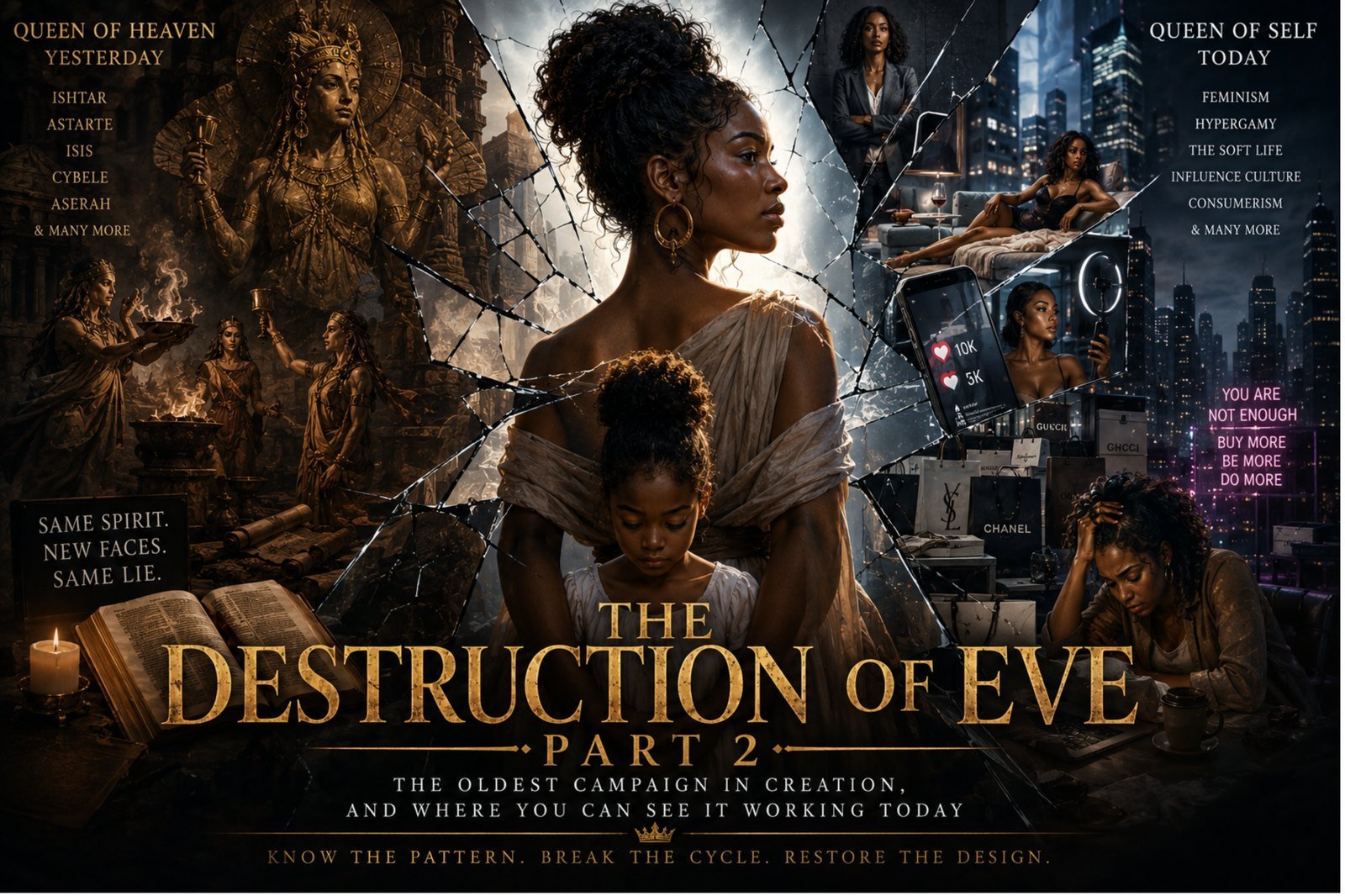
Reflections · The Destruction of Eve, Part Two
The War You Didn't Know You Were In
The temple never closed. It changed its address.
Part One traced the campaign from the garden to the temple: the enemy's own wound reproduced in the woman, the goddess raised on every continent, the queen of heaven named in Scripture, and the two women the altar consumes — the one crowned and the one kneeling.
The temple never closed. It changed its address.
The Modern Instruments
The altar has changed its appearance. The goddess is no longer called Isis. She is called the empowered woman. The independent woman. The woman who needs no one. She is on your screen every day, in your feed, in the content you consume, in the language your circle uses to affirm each other.
She looks like freedom.
She is the same altar.
Consider the feminist movement — not as a monolith, but as a historical event with specific origins and specific beneficiaries.
In the mid-twentieth century, white middle-class women in Western nations organised around a genuine grievance: they were confined to the domestic sphere, barred from professional life, legally subordinate to their husbands. Their movement to change this was a response to their specific circumstances.
The Black woman was not in that house as the wife.
She was in that house as the help.
She had been working — in fields, in kitchens, in other people's homes, in factories — not as an act of liberation but as an act of survival. Her labour was never optional. Her family required it. She was not burning her bra to enter the workforce. She was already in it, underpaid and unprotected, with no movement advocating for her.
The feminist movement borrowed the language and imagery of the Black experience to strengthen its argument. Then it handed the Black woman an ideology built for someone else's problem and told her this was her liberation too.
What it actually moved every woman towards — Black, white, and otherwise — was away from femininity itself. Away from the idea that being a woman, specifically and fully, was a complete and valuable thing. The movement framed domesticity as diminishment, motherhood as limitation, and the desire for a husband and family as evidence of conditioning rather than legitimate human need.
Read that list again. Confuse her identity. Remove her from her natural place. Turn her against the man.
It is the oldest strategy in this book, translated into a language a modern woman would applaud.
The Other Cage
When a pendulum is driven hard enough in one direction, the swing back is not correction. It is momentum.
The daughters of the movement that told them to need no man have raised daughters of their own, and those daughters have been handed the opposite instruction and told that it is the cure.
Hypergamy — a woman's desire for a capable, responsible, providing man — is not a modern corruption. Women have always sought husbands who could protect and provide for a family. There is nothing unnatural in it.
The corruption is in the substitution. The search for character has been quietly replaced with the search for comfort.
The soft life. The soft wife. The tradwife. Curated kitchens, curated children, curated calm, and a husband who solves every problem. For some women this is the honest fruit of a good marriage. For many more it is a performance, and an expensive one — because it teaches a woman to weigh a man by his income before his righteousness, and it leaves her with nothing at all when he leaves, hardens, falls, or dies.
Two cages. One tells her she needs no man. The other tells her she needs nothing but a wealthy one.
Both were built by someone who profits from where she is standing.
What It Costs
Look at the results, and ask who they serve.
Fertility rates are falling across the developed world. Women are delaying and foregoing childbearing in numbers that demographers describe as a population crisis. The reasons given are economic, environmental, personal. The reasons underneath those reasons are rarely examined.
Infertility among the young is rising. Endometriosis, polycystic ovarian syndrome, and hormonal disruption are increasingly common. The food supply has been altered — not conspiratorially, but commercially. Chemicals, preservatives, endocrine disruptors, and genetically modified organisms entered the food chain in the name of efficiency, shelf life, and yield. The downstream effects on human hormonal health are documented. Cancer, obesity, heart disease, and reproductive disorder have risen in parallel with the industrialisation of food. This is not disputed science. It is available to anyone who looks.
The men are being affected too. Testosterone levels have been declining measurably across generations. The softening that results is not simply cultural — it has biological dimensions researchers are still mapping. A man quietly diminished is a man who is easier to manage. Less likely to protect. Less likely to lead.
And a woman who has been taught that needing a man is weakness will never notice that the man beside her has been weakened.
They are both in the water. Neither of them can see it.
The Labels
Every era has its names for women who step outside the approved boundaries.
Today the approved boundary is strength — specifically, a performance of strength that requires no softness, no vulnerability, no dependence, and no man. The woman inside that boundary is celebrated. The woman outside it is labelled.
The Sapphire — the Black woman who is loud, aggressive, emasculating. A stereotype so old it has its own history in American entertainment, used for decades to make the Black woman's legitimate anger look like pathology.
The Strong Black Woman — which sounds like praise and functions like a cage. Strong enough to carry everything. Strong enough to need nothing. Strong enough to birth a nation and raise it alone. The strength is real. The expectation that she perform it without rest, without support, and without complaint is not admiration. It is exploitation with better branding.
The Karen — the white woman whose complaints are treated as aggression, whose concerns are pre-labelled as racism, who has been given a name that functions as a silencing mechanism regardless of the specific situation.
These labels do not liberate women. They herd them. They define the acceptable range of female behaviour and punish everything outside it.
The woman who internalises the label begins to police herself. She becomes the instrument of her own containment.
The Business of Making Women Feel Incomplete
What is done to the woman is not only spiritual. It is profitable.
Entire industries depend on her believing that something is wrong with her.
She is not beautiful enough, and is sold cosmetics. Not young enough, and is sold procedures. Not thin enough, and is sold diets. Not shaped enough, and is sold surgery. Not successful enough, and is sold ambition. Not feminine enough, and is sold softness. Not independent enough, and is sold empowerment. Not peaceful enough, and is sold wellness. Not spiritual enough, and is sold crystals, courses, retreats, and rituals.
Whatever she is, there is another product waiting to correct her. The message changes with the market. The accusation never changes.
You are not enough as you are.
Even her rebellion has been packaged and sold back to her. The career woman became a product. The traditional wife became a product. The independent woman became a product. The soft-life woman became a product. The goddess became a product. Each identity arrives with its own clothing, vocabulary, books, subscriptions, influencers, and carefully arranged photographs. She is told she is finally becoming free. She simply has to keep purchasing the evidence.
This is why the ideal keeps moving. Yesterday she was told to be thin; today she must be shaped. Yesterday ageing was ordinary; today every line must be erased. Yesterday she was told to leave the home and prove herself in the workplace; today she is told to return to it, dress beautifully, bake bread, and present domestic life as an immaculate performance.
One cage is exchanged for another, and both are sold as liberation.
There is very little softness in having to perform softness for an audience.
The market cannot tolerate a woman who believes she is already enough. A contented woman is difficult to sell to. A woman who understands her own body does not panic every time it changes. A woman who understands her calling does not reinvent herself every season. A woman who knows the Creator made her does not need the world to tell her what a woman is.
So the whisper continues. Improve. Transform. Upgrade. Rebrand. Manifest. Become.
It is the same whisper. It has always been the same whisper. Ye shall be as gods.
But the design was not unfinished. The woman was never a problem waiting for an industry to solve her.
The work in front of her is not to manufacture a new identity.
It is to recover the one that was taken.
The Young Men
No examination of what is being done to women is complete without looking at what is simultaneously being done to men — because the two campaigns are not separate. They are the same campaign, working from both ends.
The young Black man enters a school system that was not designed for the way he learns, moves, or processes the world. He is medicated, disciplined, and pushed towards the exits earlier and more aggressively than his peers. The prison system that waits for him is not an accident of poverty. It is an industry — one that requires a steady supply of bodies, and has arranged the conditions of certain communities to provide them.
A generation of women raised without fathers. A generation of men raised without a clear understanding of what they are for. Both of them carrying wounds they did not choose, shaped by systems they did not build, handed ideologies that tell them the wound is each other.
The Creator made them for each other.
The campaign has spent centuries making sure they cannot find their way back.
The Woman Who Carries Everything
Some women never planned to become both mother and father.
Life chose for them. Death took a husband. Abandonment left an empty chair. Addiction, violence, neglect, or plain irresponsibility left a burden on one pair of shoulders that was never meant to rest there.
These women are not failing. They are surviving, and often performing two callings because someone else walked away from one. They deserve compassion, admiration, and practical help.
But survival was never meant to become the ideal.
There is dignity in carrying it alone. There is tragedy in being convinced that alone is better. And that is precisely what the culture now tells her — that needing no man is the highest form of success, that independence is not a hardship she rose to meet but the destination itself.
The Creator did not say it was good for the man to be alone. He did not intend the woman to bear every burden by herself either.
Where a father is absent, wisdom looks for what is missing and finds it where it can. A grandfather. An uncle. An older brother. A trusted elder. A faithful teacher. A righteous friend of the family. For a boy, the presence of an honourable man becomes an anchor — it shapes identity, discipline, and respect. For a girl, watching a man love and protect her without manipulation teaches her what honour looks like long before she chooses a husband.
Discernment is essential. Not every man is worthy of that trust, and there are too many painful stories to pretend otherwise. But because some men have abused their position, it does not follow that children no longer need righteous men in their lives.
Where one can be found, find him.
The burden becomes lighter when a community helps carry it.
The Woman You Were Made To Be
There is a portrait in Proverbs 31 that has been flattened for generations into a checklist no woman can meet.
Read it again.
She is a businesswoman. She evaluates land and buys it out of her own earnings. She plants a vineyard. She manufactures and sells. She trades internationally. She manages a household. The text says explicitly that she is physically strong. She gives to the poor. She speaks with wisdom. She does not fear the future, because she has prepared for it.
And she is also a wife. Also a mother. Also a woman whose husband trusts her completely and whose children rise up and call her blessed.
But notice what she is not.
She is not a machine. The same body that labours without tiring also carries children. The same body knows weariness. Pain. Cycles. Mornings when strength simply is not there. A woman who has to rest because of exhaustion, illness, pregnancy, or the ordinary rhythms of her own body has not failed Proverbs 31. She is living it. Wisdom knows when to work. Wisdom also knows when to stop. There is no shame in a blanket, a hot water bottle, and a quiet evening when the body asks for mercy instead of productivity. The Creator who made her also made the Sabbath.
And she is not performing. She was not building a brand. Her household was not content. Her marriage was not marketing. Her children were not evidence that she had mastered femininity. She worked because her household needed her. She rested because her body needed her. She gave because the poor needed her. She prepared because wisdom required it.
Her husband trusted her. Her children blessed her. Her God saw her.
That was enough.
She is not one thing. She is not confined. She is not diminished by her femininity or by her relationships. She is the whole picture of what a woman is when the campaign has not reached her.
The world did not offer you this. It offered you a goddess instead.
The goddess who answers to nothing and needs no one. Who has absorbed the masculine until neither remains distinct. Who is powerful the way a symbol is powerful — impressive, untouchable, and entirely alone.
You were not made to be a goddess.
You were made to be a woman — and there is nothing, nothing, more powerful than that, once you understand what it means.
What To Do With This
You do not have to accept any framework to sit with what has been written here.
You only have to look.
Look at the language you and your friends use about yourselves, and ask where it came from. Look at the crystal, the card, the chart, the circle, and ask what it is quietly teaching you about where power lives.
Look at the food on your plate and ask what was done to it before it reached you. Look at your fertility — yours, your friends', your generation's — and ask why the rates are what they are.
Look at what you have been sold this year in order to become acceptable, and ask who was made rich by your dissatisfaction. Look at the labels placed on you, and ask who benefits from you wearing them.
Look at the men around you and ask what shaped them, and to whose advantage.
Look at the woman the culture keeps crowning, and ask what the crown cost her. Ask what the goddess has actually delivered to the women who accepted her. Then ask why the offer keeps being made.
And then look at the woman you actually are, underneath everything that has been done to her.
She is still there. She has been there the entire time.
Waiting for you to stop performing and start asking questions.
The war is real. You are already in it.
The first act of resistance is simply this: knowing.
The full story of this war, told through twenty-one women across six thousand years, is The Death of Eve: A Chronicle of the Eternal Woman.
Documentation
Selected References
Works directly cited, named, or used as a foundation for this reflection.
- Ford, C. D. The Death of Eve: A Chronicle of the Eternal Woman. Publication details to be added.
- The Holy Bible, King James Version (1611).