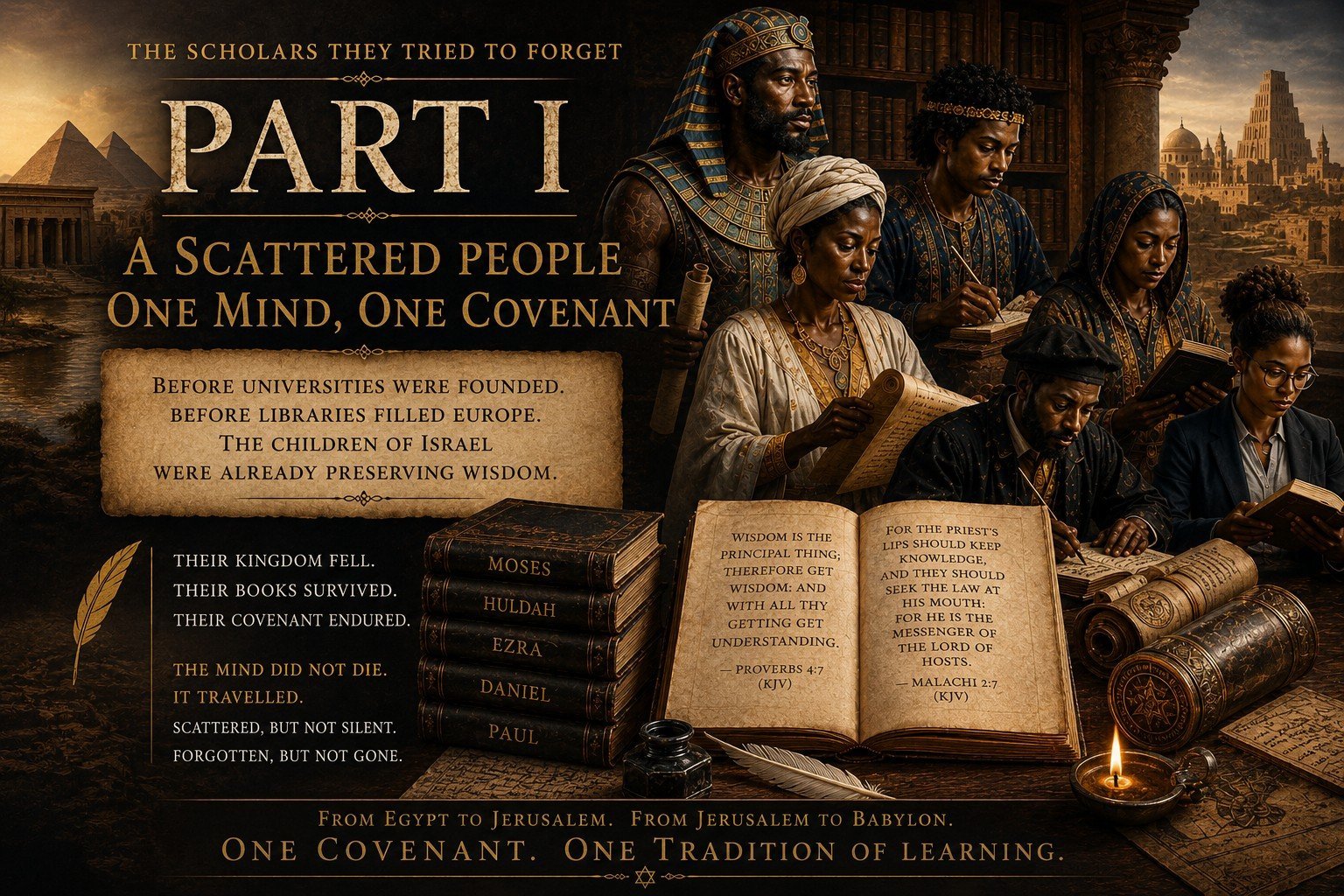
Reflections · The Scholars They Tried to Forget, Part One
A Scattered People, One Mind, One Covenant
Scattered does not mean silent. A people may lose its kingdom and still carry its mind.
There is a version of history in which the children of Israel disappear after the destruction of Jerusalem. In that version, they vanish from the intellectual record and reappear only as victims of slavery, as though the centuries between held nothing.
But scattered does not mean silent.
A people may lose its kingdom and still carry its mind. It may be driven from one country to another and still establish schools, preserve manuscripts, translate texts, advise kings, and shape the learning of nations that later forgot they were there.
The Israelite story is therefore not only a story of bondage. It is also a story of learning.
Long before Oxford became synonymous with scholarship, before Córdoba became a centre of illumination, before Timbuktu held its libraries in the desert, the intellectual history of Israel had already begun — in Scripture. It begins with Moses. It continues through Huldah. It appears again in Daniel. And from there, the pattern travels through the lands of the scattering.
Moses: Learned in All the Wisdom of Egypt
Before Daniel stood among the scholars of Babylon, Moses was educated within the royal world of Egypt. He was born an Israelite during a period when Pharaoh had ordered the destruction of Israelite sons, yet he was raised inside the very household that had condemned his people.
The Second Testament states:
And Moses was learned in all the wisdom of the Egyptians, and was mighty in words and in deeds.
Acts 7:22
This was not a minor education. Moses was raised near the centre of Egyptian government, law, administration, architecture, and learning — the knowledge of one of the most powerful civilisations of the ancient world.
Yet the palace could educate Moses without possessing him. He learned Egypt's wisdom, but he remained an Israelite. He was trained within the system of Pharaoh and later sent by the God of Israel to confront it.
The deliverer understood the empire from within. His authority did not come from Egypt. His education did.
His commission came from the God of Abraham, the God of Isaac, and the God of Jacob. Moses would become far more than the man who led the Israelites out of bondage. He became the lawgiver through whom the commandments, statutes, and structure of the nation were delivered. Under the direction of the God of Israel, he helped transform a captive population into an ordered people with law, worship, and national identity.
Egypt taught Moses how kingdoms operated. The God of Israel taught him how a righteous nation should live.
Moses establishes the first principle of this history: the Israelite scholar did not begin in Babylon, Córdoba, Oxford, or Timbuktu. Long before any of them, an Israelite mind had already mastered the highest learning of the most powerful empire on earth.
Huldah: The Scholar Whom the Kingdom Consulted
The intellectual history of Israel cannot be told only through its men. Long before modern societies debated whether women should be educated or interpret sacred writings, an Israelite woman stood as an authority to whom a king turned in a national crisis.
Huldah appears during the reign of King Josiah, at a critical moment in the history of Judah. During repairs to the house of the God of Israel, Hilkiah the priest discovered the Book of the Law. Josiah, hearing its words, understood that the nation had departed from the commandments and that judgement stood before them.
Josiah needed more than someone who could read the document. He needed someone who could interpret it.
The royal delegation included Hilkiah the high priest and the king's own scribes and officers. Yet when the king commanded them to enquire of the God of Israel concerning the Book, they went to a woman:
So Hilkiah the priest… went unto Huldah the prophetess.
2 Kings 22:14
That decision tells us something extraordinary about her standing. The high priest went to her. The royal scribe went to her. The officers of the king went to her. They did not approach her as a curiosity. The record offers no apology for consulting a woman. They went because she was qualified.
Huldah's scholarship was not merely the ability to read words written on a scroll. She understood their meaning. She could connect the written text to the condition of Judah. She could distinguish between the judgement pronounced upon the nation and the mercy granted to a repentant king. Her response was direct: "Thus saith the LORD God of Israel, Tell the man that sent you to me…" She spoke with authority because she understood both the Book and the God who gave it.
Huldah was not presented merely as the wife of Shallum, though the record names her husband. Her significance rested in her own calling: Huldah the prophetess. She interpreted the law at the moment of its national rediscovery. Her judgement helped set in motion Josiah's reforms and the public reading of the covenant.
The recovered Book passed through the hands of a priest. Its words were brought before a king. But its meaning was confirmed through a woman.
Two Foundations of Israelite Learning
Together, Moses and Huldah establish two essential dimensions of Israelite scholarship.
Moses demonstrates that an Israelite could master the learning of the most powerful foreign empire and turn that education toward the service of the God of Israel. Huldah demonstrates that intellectual and scriptural authority within Israel was not confined to men.
One was educated in the palace of Egypt and became the deliverer and lawgiver of a nation. The other lived in Jerusalem and became the interpreter to whom priests, scribes, and royal officials turned. Moses shows that foreign education could be transformed into service to the God of Israel. Huldah shows that the highest questions of law, covenant, and national judgement could be brought to an Israelite woman.
From them, the story moves naturally to Daniel.
Daniel: Wisdom in Captivity
Daniel was not educated in the land of his fathers. He was taken captive. Jerusalem had been conquered, the vessels of the house of the God of Israel had been carried into Babylon, and select young Israelites were chosen for training in the king's service.
These young captives were chosen because they were "skilful in all wisdom, and cunning in knowledge, and understanding science." They were then taught "the learning and the tongue of the Chaldeans."
Daniel's education took place inside the political and intellectual centre of the empire that had destroyed his homeland. Yet Babylonian education did not erase his Israelite identity. He learned the language of the court. He mastered its systems of knowledge. He served within its government. But he remained faithful to the God of Israel.
This distinction matters. Daniel did not reject learning because it came from a foreign nation. Neither did he surrender his covenant because he studied among foreigners. He learned without being spiritually absorbed. He served without forgetting who he was.
The God of Israel gave Daniel and his companions "knowledge and skill in all learning and wisdom." When they were examined by the king, they were found to be "ten times better" than the magicians and astrologers of Babylon.
Daniel's life demonstrates that captivity did not destroy Israelite intellectual ability. It revealed it. The captive stood before kings because the gift remained within him.
The Language of the Land, but the Mind of the Covenant
Moses learned the wisdom of Egypt. Daniel learned the tongue of the Chaldeans. The Israelites of later empires used Aramaic and Greek. The Israelites of Moorish Spain spoke Arabic and Castilian. The Iberian exiles carried Ladino. Others later worked in Latin and English.
The language changed according to place. The ability to learn did not. Nor did covenant identity depend upon speaking one supposedly permanent sacred language.
The scattered Israelite could enter a foreign court, study a foreign tongue, operate within a foreign system, and still remain a child of the covenant. That is not a departure from the Israelite story. It is one of its recurring patterns.
It is also the bridge to what came next — because after Babylon, the same pattern reappears in city after city across the lands of the scattering: Córdoba, Oxford, Timbuktu, and finally the New World.
Part Two follows the Israelite mind out of Scripture and into the diaspora — the libraries of Córdoba, the halls of Oxford, the desert scholarship of Timbuktu, and the schoolhouses built by the freed descendants of bondage.