Reflections · The Scholars They Tried to Forget, Part Two
The Mind That Travelled
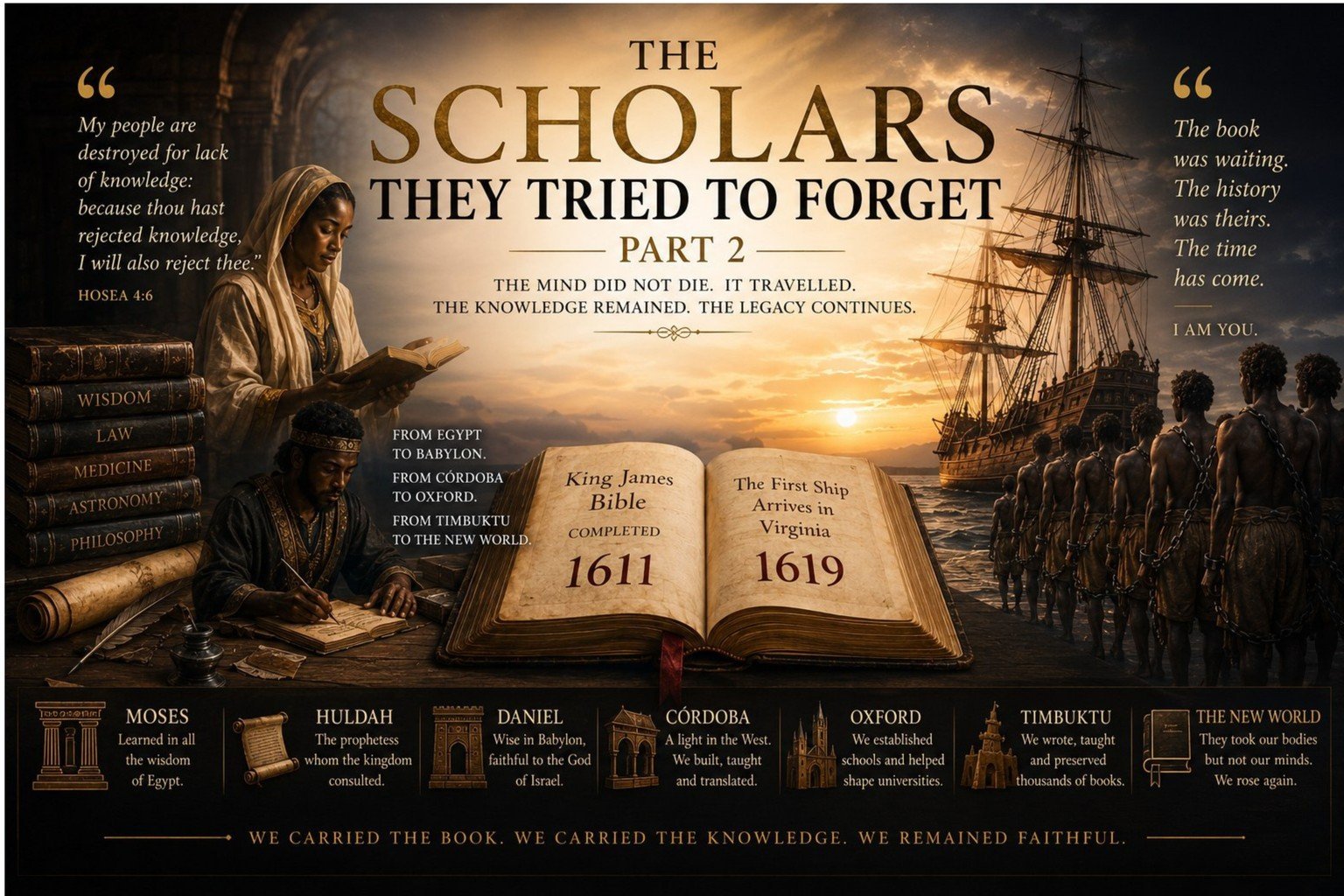
The mind did not die. It travelled. The knowledge remained. The legacy continues.
Part One traced the intellectual history of Israel through Scripture — Moses, learned in all the wisdom of Egypt; Huldah, the scholar to whom priests and the king turned; and Daniel, whose wisdom stood before rulers in captivity. The language changed with the land, but the mind of the covenant endured.
After Babylon, the same pattern reappears in city after city across the lands of the scattering.
Córdoba: A City of Books and Light
Centuries after Babylon, another intellectual centre arose in al-Andalus, the Moorish land of the Iberian Peninsula. Córdoba became known as one of the great cities of learning in the medieval world. Its libraries, schools, physicians, philosophers, mathematicians, translators, and astronomers made it a centre of illumination at a time when much of Christian Europe had limited access to advanced scholarship and books.
Israelites lived within that world. They spoke Arabic under Moorish rule and later adopted the Romance languages of the Christian kingdoms. They served as physicians, translators, diplomats, financiers, poets, philosophers, and legal scholars. They did not merely exist in Córdoba. They contributed to the culture that made Córdoba significant.
This was a plural intellectual society in which Muslim, Israelite, and Christian scholars worked in overlapping worlds. Ancient works were translated. Medical knowledge was preserved. Astronomy, mathematics, philosophy, law, literature, and grammar flourished.
The Israelite scholar often stood at a crucial crossing point. He could move between Arabic and Romance languages. He could interpret older scriptural and philosophical traditions. He could carry knowledge between communities that did not always speak directly to one another.
This made him not only a student of civilisation, but one of its bridges.
The People Behind Europe's Intellectual Awakening
Europe often tells the story of its intellectual revival as though knowledge suddenly reappeared on its own. The Renaissance is presented as a European rediscovery of classical wisdom. But knowledge does not vanish for centuries and then reconstruct itself without custodians.
Someone preserves the manuscripts. Someone teaches the grammar. Someone translates the medical texts. Someone carries the numbers, charts, methods, commentaries, and arguments from one world into another.
The learning that moved through Muslim Spain and the wider Mediterranean world contributed to that awakening, and Israelite scholars were part of that transmission. They served as interpreters between Arabic, Latin, Castilian, and other languages. They preserved and passed on knowledge. Their work entered European centres of learning even when their names were later erased.
This is one of history's recurring injustices. A people helps build an institution. The institution grows powerful. Then the institution retells its history without them.
The builders disappear from the building.
Oxford and the Forgotten Community
Medieval Oxford contained a significant Israelite community. The Israelites were not hidden at the distant edge of the town. They participated in its commerce and learning. They included merchants, financiers, property holders, scholars, and teachers. Christian scholars sought their assistance with Scripture, grammar, and older texts. The Israelites were part of the intellectual environment from which Oxford developed.
This does not mean that every college was founded exclusively by Israelites. The stronger point is that Oxford did not emerge in an intellectual vacuum. Israelite scholarship formed part of its early world. Names connected with the medieval community remained attached to properties and halls — Moses Hall and Jacob's Hall preserved the names of Israelite forefathers within the city.
The same England that later expelled the Israelites had already benefited from their knowledge. In 1290, King Edward I ordered the expulsion of the Israelites from England. A community that had participated in English society for generations was officially removed.
But an expulsion does not erase every intellectual trace. Documents remain. Properties remain. Transactions remain. Names remain. Methods remain. The people may be driven out, but the institution continues using what they helped establish.
One of the most striking references concerns Jacob of Oxford, an Israelite financier connected to the recorded history of the institution. The surviving transaction turns vague statements about influence into visible evidence. There was a man. There was a transaction. There was a document. There was an Israelite hand within the recorded foundation of an English institution.
The contribution does not have to be exaggerated to be meaningful. Historical precision makes the argument stronger. The Israelites were there. They were literate. They were economically active. Their knowledge was sought. Then their presence was diminished within the official story.
Timbuktu: The Library in the Desert
The intellectual trail does not stop in Europe. It travels south. Timbuktu became one of the most important centres of manuscript culture and higher learning in the medieval world. Its scholars studied law, theology, astronomy, mathematics, commerce, medicine, ethics, and governance. The city was connected to the Songhai world and to long-distance trade routes crossing the desert.
Books were valuable. Scholars were honoured. Families created and preserved private libraries. Students travelled to study under respected teachers. The surviving manuscripts demonstrate that West African intellectual history was far richer than colonial narratives admitted.
This challenges two common myths at once. The first is that Israelites disappeared from the African record. The second is that Africa possessed no serious intellectual tradition before European colonisation. Timbuktu disproves the second claim by its very existence.
Sankore and the Support of Women
The story of Timbuktu also makes room for women. The tradition surrounding Sankore includes the support of a wealthy woman who helped finance it. Whatever terminology one prefers — mosque, school, university, or scholarly complex — women were not entirely absent from the preservation of education. They could possess wealth. They could finance institutions. They could preserve manuscripts. They could participate in cultures where knowledge was treated as a communal inheritance.
This connects naturally with Huldah. The learned Israelite woman was not a modern invention. The teaching of children, the preservation of family memory, and the transmission of identity often depended upon women. When public institutions were destroyed, the home became the school. When formal worship was forbidden, mothers taught quietly. When men were expelled, imprisoned, killed, or transported, women often carried what could not be openly kept.
The intellectual history of a scattered people is not only the history of famous men. It is also the history of the women who funded, interpreted, taught, copied, preserved, and remembered.
Knowledge Carried Into Bondage
The intellectual character of the people did not disappear when they were placed in chains. The slave ship changed their condition. It did not change their capacity.
This distinction is essential. Slavery created the appearance of ignorance by making education illegal, separating families, and confiscating books. The enslaved were then blamed for the condition deliberately imposed upon them. A person forbidden to read was called unintelligent. A person whose language had been beaten out of him was called uncivilised. A people whose books had been confiscated or destroyed were described as having no history.
But the mind survived. It appeared in oral history, coded spirituals, craftsmanship, farming knowledge, and legal petitions. The hunger for learning among the descendants of slavery was not the sudden awakening of a people who had never known books. It was the reappearance of something bondage had tried to bury.
The Schoolhouse After Slavery
One of the clearest signs of this re-emergence appeared after emancipation. Formerly enslaved people built schools. They raised money from communities that possessed very little. They studied after working long days. Parents who could not read insisted that their children learn. Church buildings became classrooms. Teachers travelled into dangerous regions. Students of many ages sat together because whole generations had been denied formal instruction.
This was not imitation of the former master. It was recovery. A people who had once produced scribes, judges, teachers, interpreters, and physicians was reaching again for what had always belonged to them.
Education became more than preparation for employment. It became evidence of personhood. To read was to contest the lie that the enslaved possessed no mind. To write one's own name was to reverse the slave ledger. To study the Bible independently was to challenge those who had used selected verses to demand submission. To establish a school was to declare that the next generation would not remain in the darkness imposed upon their parents.
"I Am You"
The most powerful declaration in this history is also the simplest: I am you.
Moses says it from Egypt. Huldah says it from Jerusalem. Daniel says it from Babylon. The scholar says it from Córdoba. The teacher says it from Oxford. The manuscript keeper says it from Timbuktu. The freed student says it from the New World.
The message is not that every scholar in every centre of learning was an Israelite. Nor is it that all knowledge originated with one people. The message is continuity. The intelligence visible in the child of slavery did not begin after slavery. The capacity of the modern descendant did not suddenly appear in the Americas. The mind travelled. The gift survived conquest, exile, forced conversion, expulsion, and bondage.
When a descendant of slavery enters a university, writes a book, teaches a class, or studies the law, that person may be stepping back into an inheritance rather than entering a foreign world for the first time.
"I am you" closes the distance between the ancient captive and the modern student.
Moses' discipline is not foreign to you. Huldah's authority is not foreign to you. Daniel's wisdom is not foreign to you. The scholar of Córdoba is not foreign to you. The teacher of Oxford is not foreign to you. The manuscript keeper of Timbuktu is not foreign to you. Their story does not belong only to museums and institutions. It belongs to the people whose intellectual identity was stolen along with their name.
Education Without Forgetting the God of Israel
Each stage of this history returns to one central principle: while living in a foreign land, the Israelite remained faithful to the God of Israel.
Moses learned Egypt's wisdom, but he did not bow to Pharaoh's gods. Daniel learned Babylon's language, but he did not worship Babylon's images. The Israelite could learn Arabic without surrendering his covenant identity. He could work in a Christian institution without accepting that Christianity owned his Book. He could master Latin without believing Rome created Scripture. He could study science without denying the Creator. He could participate in government without making government his god.
Education was a gift. It was not a substitute for covenant.
This distinction remains important. The purpose of recovering Israelite intellectual history is not to replace spiritual identity with academic pride. Degrees do not make a person righteous. Institutions do not determine truth. A university can preserve knowledge while teaching error. A scholar may be brilliant and still be spiritually blind.
Moses' greatness did not rest merely in the wisdom of Egypt. Daniel's greatness did not rest merely in the learning of Babylon. Huldah's greatness did not rest merely in her ability to interpret a text. Their greatness rested in knowing where wisdom came from, and in giving the glory to the God of Israel.
The Theft of Intellectual Identity
The descendants of slavery were not only robbed of land, labour, family, language, and name. They were robbed of intellectual ancestry. They were taught that civilisation had always come from elsewhere. Europe was presented as the sole author of philosophy, science, education, law, and literature. The Black person appeared in the textbook only when slavery began. Before that, he was treated as though he had no past. After that, he was treated as though freedom had given him a mind.
This false history served a purpose. A people who believe their ancestors created nothing will always seek validation from the culture that enslaved them. A people who believe they possess no scholarly inheritance will treat academic achievement as borrowed rather than recovered. A people who do not recognise their own intellectual tradition will enter universities as guests rather than heirs.
Recovering this history changes the posture of the student. He no longer enters the library as a stranger. He enters as the descendant of people who preserved books. She no longer enters the classroom as an accidental exception. She enters as the descendant of women like Huldah, who interpreted the law before priests and kings.
The scholar is not an anomaly. The scholar is remembered.
Not Pride, but Responsibility
The purpose of this history is not empty boasting. It creates responsibility.
If Moses mastered the wisdom of Egypt, what should his descendants master now? If Huldah understood the law well enough to advise a king, what should Israelite women study today? If Daniel pursued wisdom in Babylon, what should the children of Israel pursue in the lands of their scattering? If scattered communities preserved manuscripts during persecution, what should we preserve now? If women financed centres of learning, what should we build for our children? If the enslaved risked punishment to learn to read, what excuse does the free descendant have to remain ignorant?
An inheritance is not proven by praising it. It is proven by continuing it.
The intellectual legacy of Israel demands disciplined study, careful research, and honest documentation. It requires more than repeating impressive numbers. It requires preserving sources. It requires distinguishing tradition from established evidence. It requires refusing exaggeration even when exaggeration would make the story sound grander. Truth does not become stronger when it is inflated. It becomes stronger when it can stand under examination.
The Mind Survived
Kingdoms fell. Libraries burned. Communities were expelled. Names were changed. Languages were lost. Books were confiscated. Children were taken. People were carried into captivity. Yet the gift continued to reappear.
In Egypt, an Israelite mastered the wisdom of the empire and became a deliverer. In Jerusalem, a woman interpreted the law for priests and the king. In Babylon, a captive stood before rulers. In Córdoba, the scattered people helped illuminate a civilisation. In Oxford, their presence entered the foundations of learning. In Timbuktu, scholarship flourished amid the desert trade routes. In the New World, the descendants of bondage reached for books as soon as the chains loosened.
The world called this advancement. The people may recognise it as remembrance. The scholar was not newly created. The scholar returned. The mind was not given by the slave master. The mind survived him.
And across every land, through every language, beneath every borrowed name, the declaration remains:
I am you.
This two-part reflection is a companion to the revised and expanded edition of The Hidden Secrets of the True Israelites. The book follows the people through their suffering; this trail follows the movement of the Israelite mind. The two belong together — for slavery was not the beginning of their civilisation. It was an interruption.
Learn more about The Hidden Secrets of the True Israelites →