Reflections on Understanding Life · One
The White Swan, the Black Swan, and the Message of Understanding Life
The symbolism behind the swans, the book cover, and the deeper philosophy of the message.
Swans have long carried a quiet power in human imagination. They are graceful, still, reflective, and dignified. They move across the water with ease, while beneath the surface there is unseen labour. That alone makes them a fitting image for life itself: what is visible is rarely the whole story.
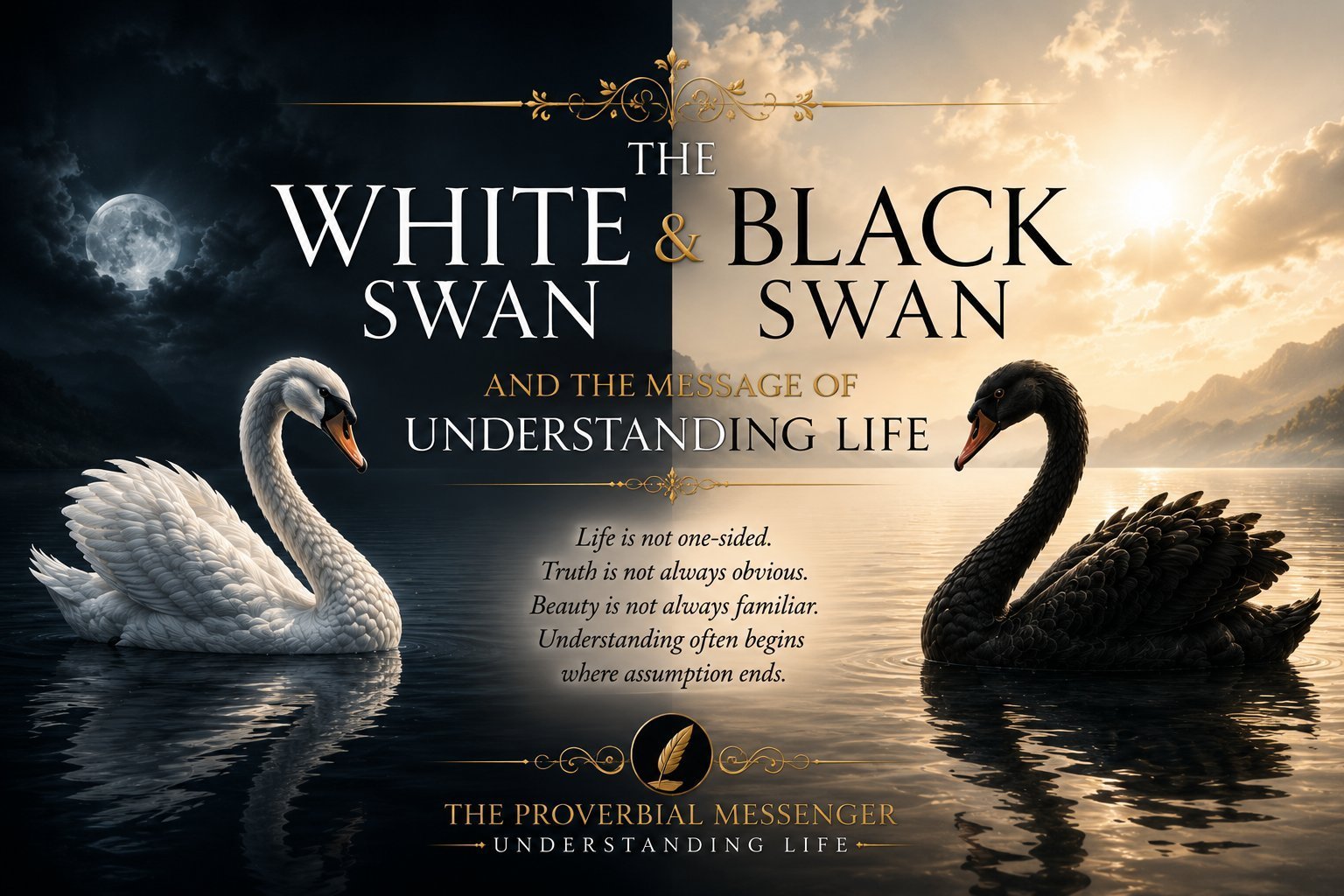
On the cover of The Proverbial Messenger: Understanding Life, the white swan and the black swan sit opposite one another. They are not enemies. They are not merely contrasts. Together, they represent the seen and the unseen, the accepted and the overlooked, the known and the misunderstood. They speak to the central purpose of this work: to look again at life, to question inherited assumptions, and to seek understanding beneath the surface.
The Black Swan: The Thing Thought Impossible
Black swans carry unusual symbolic weight because of history and geography. For many centuries in Europe, the phrase "black swan" was used to describe something thought impossible. Every swan Europeans had seen was white, so the idea of a black swan seemed like a contradiction.
The Roman poet Juvenal famously used the image of a black swan to describe something exceedingly rare — almost impossible. In that world, to speak of a black swan was to speak of something beyond expectation, beyond ordinary experience, and beyond accepted belief.
Then, in 1697, Dutch explorers in Western Australia encountered real black swans, Cygnus atratus, gliding upon the waters. What had once been treated as impossible was suddenly visible. The certainty had not been truth; it had only been limited experience.
No number of white swans can prove that all swans are white. One black swan can overturn the assumption.
This is why the black swan became such a powerful image in philosophy. It reminds us that human understanding is often built on what has been seen, repeated, taught, and accepted. Yet truth is not limited to what people have already observed. Sometimes one overlooked reality is enough to challenge an entire way of thinking.
The Black Swan and Hidden Truth
In modern thought, the term "black swan" is also associated with rare and unexpected events that change everything. These are moments people did not foresee, often because they trusted too much in the familiar.
But beyond philosophy and probability, the black swan has a deeper symbolic meaning. It represents the hidden thing. The rare thing. The truth that was dismissed until it appeared. The beauty that did not fit the expected pattern.
The black swan is not merely darkness. It is mystery, depth, and revelation. It is the part of life that refuses to be simplified.
In this sense, the black swan belongs naturally to Understanding Life. Life is not always plain. It is not always gentle. It contains trial, contradiction, loss, surprise, correction, and awakening. Much of what matters most is not immediately understood. Wisdom often begins when we stop assuming that what we have seen is all there is to know.
The White Swan and the Black Swan Together
The white swan traditionally carries meanings of grace, beauty, purity, peace, and light. It is the image people expect. It is familiar, elegant, and easily admired.
The black swan carries a different kind of beauty. It speaks of mystery, depth, rarity, and the truth that challenges certainty.
Placed together, the white swan and the black swan become more than decoration. They form a visual proverb. They suggest that life contains both light and shadow, clarity and mystery, surface and depth. One cannot understand life fully by looking only at what is easy, bright, familiar, or acceptable. True understanding requires the courage to consider what has been overlooked.
The white swan may represent what is visible. The black swan may represent what has been hidden. Together, they point toward balance.
Swans in Myth, Thought, and Symbolism
Across many cultures, swans have gathered meaning. They are often associated with transformation, fidelity, beauty, dignity, and the passage of the soul. Their calm movement across water has made them symbols of grace, while their strength beneath the surface reminds us that beauty is not always effortless.
There is also the ancient idea of the "swan song" — the belief that a swan, silent through life, sings beautifully before death. Though this is not true of real swans, the image has endured because of its poetic force. It speaks to final utterance, last wisdom, and the beauty of truth spoken at the appointed time.
Swans are also connected with transformation. They move between water, land, and air, and therefore suggest transition from one state to another. They are creatures of reflection, often seen doubled in the water beneath them. That reflection matters. It reminds us that life must be examined, not merely lived.
Why the Swan Belongs to This Website
The message of The Proverbial Messenger is not merely to decorate life with beautiful words. It is to ask what life is, what it means, what it reveals, and what it requires of us.
The swans speak directly to that message. They remind us that life is both visible and hidden. There are things we are taught to accept, and there are things we must examine for ourselves. There are assumptions passed down as certainty, and there are truths waiting quietly outside the borders of common belief.
The black swan especially represents the spirit of inquiry. It is the thing the record said could not exist until someone went and looked. It is the exception that exposes the weakness of careless certainty. It is the rare bird that teaches humility to the human mind.
That is why the swans belong here. They are not simply beautiful. They are philosophical. They are symbolic. They are a reminder that understanding life means looking beyond the surface, beyond assumption, and beyond what others have already named as possible.
A Visual Proverb
The white swan and the black swan together form the heart of the visual message:
Life is not one-sided. Truth is not always obvious. Beauty is not always familiar. Understanding often begins where assumption ends.
In The Proverbial Messenger: Understanding Life, the swans invite the reader to pause, reflect, and look again. They ask us to consider not only what is seen, but what has been missed; not only what is accepted, but what may yet be revealed.
For sometimes the rarest truth is not loud. It simply appears on the water — graceful, unexpected, and impossible to ignore.
The swans on the cover are the heart of this work. Their full meaning unfolds across The Proverbial Messenger: Understanding Life.