Reflections on Understanding Life · Three
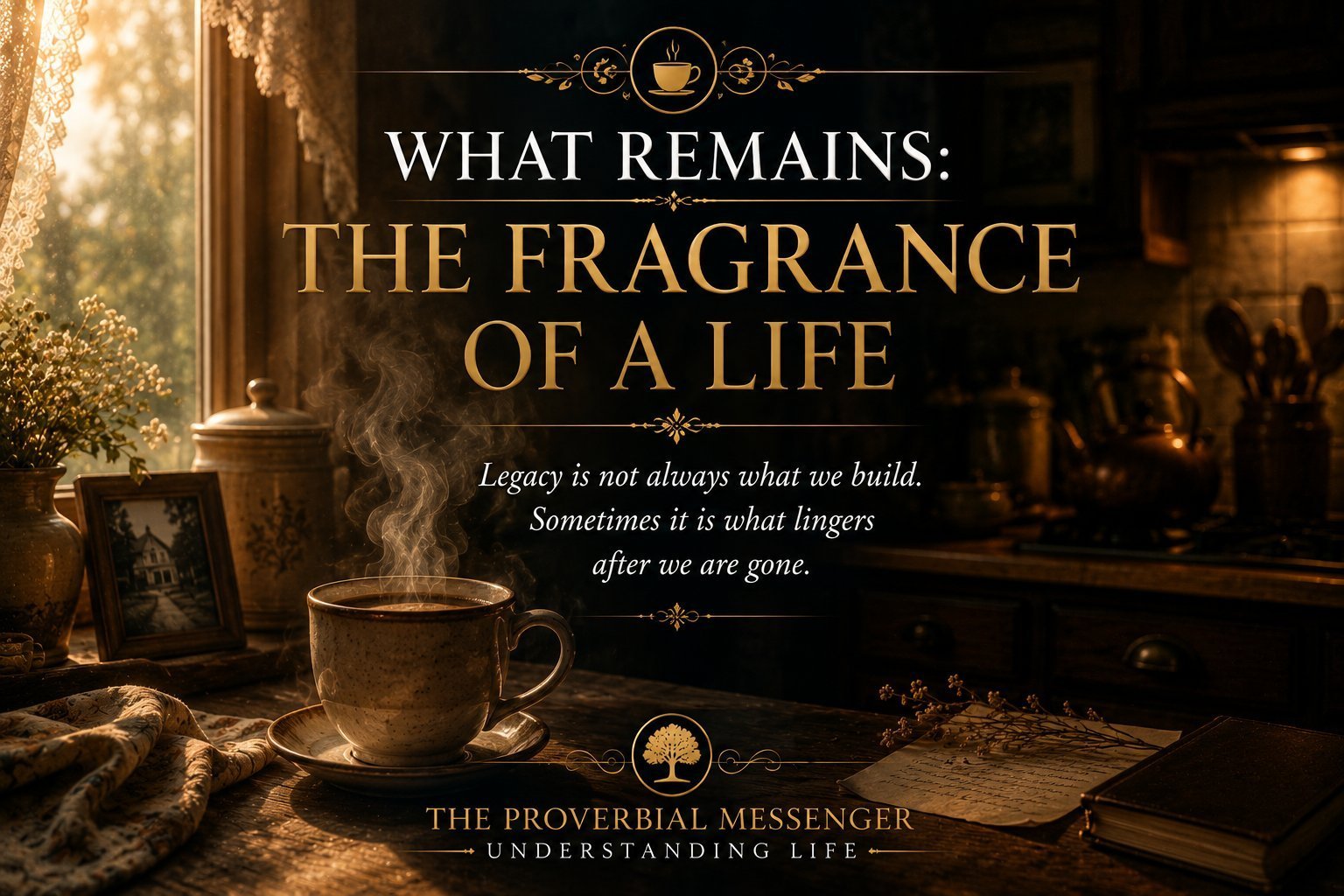
What Remains: The Fragrance of a Life
Legacy is not always what we build. Sometimes it is what lingers after we are gone.
A life does not only leave behind possessions. It leaves traces.
It leaves a tone in a room, a memory in a person, a way of doing things that others carry forward without always knowing where they first learned it. It leaves habits, kindnesses, warnings, corrections, recipes, prayers, sayings, laughter, wounds, comfort, discipline, and sometimes even silence.
When a person has lived long enough in a certain way, their presence settles into the places and people around them. They may not intend to leave a legacy. They may not write it down, arrange it, title it, or place it in anyone's hands. Yet something remains. That remaining thing is often more honest than any monument.
A monument can be commissioned. A speech can be written. A will can be prepared. A name can be engraved. But the true evidence of a life is not always found in what was arranged at the end. Sometimes it is found in what could not help remaining because of what the person consistently was.
The Kitchen That Remembered
In Understanding Life, the question of legacy opens with a woman standing in a kitchen she had not entered for twenty years. She had come to help clear the house after the death of a woman called Miss Lin. She was not family. She had known Miss Lin in an earlier season of life, when she had little money, a child to raise, and an almost unreasonable determination to buy a home.
Miss Lin had helped her when there was every reason not to. She had been patient when patience was not profitable. She had stayed when walking away would have been easier. Years passed. They were not extremely close, and yet at the end, the younger woman's name was on the list of people Miss Lin wanted informed of her passing. She mattered.
When the younger woman stepped into the kitchen, the smell stopped her. It was the same. Some particular combination of cooking, cleaning, habit, warmth, and years of being lived in by one particular person remained in the room. Miss Lin had been dead three days, but the house still held evidence of her. She had not arranged it. She had not tried to be remembered in that way. She had simply been herself, all the way through, for long enough that the place could not help keeping the trace of her.
That is legacy. Not performance. Not self-advertisement. Not a final act of control. Legacy is what remains because a life was real enough to leave an imprint.
Not a Monument, but a Fragrance
We often imagine legacy as something grand. A building. A title. A family name. A book. A business. A public achievement. A carefully prepared statement of how we wish to be remembered. Those things can matter. But they are not the whole of legacy.
There is another kind of legacy — quieter, humbler, and often more powerful. It is not what a person constructs near the end of life. It is what they deposit into others while they are simply living.
In the manuscript, Miss Lin's legacy is not something she authored formally. It is what she was, deposited into a house and into another life. Her patience continued forward into later kindnesses extended by the younger woman to others.
That image is beautiful because it tells the truth. A life does not have to control every outcome in order to matter. A person may plant something they never see mature. They may help someone who later helps someone else. They may speak a sentence that returns to another person years later in a moment of need. They may show mercy once, and that mercy may become part of another person's way of living.
Legacy is not always a statue. Sometimes it is a fragrance. The proof that someone was there. The proof that someone was themselves. The proof that their presence changed the room.
The Coffee Bean and the Water
A carrot is softened by boiling water. An egg is hardened by boiling water. But a coffee bean changes the water.
This familiar image becomes, in Understanding Life, a way of thinking about legacy. When the heat is over, the coffee bean is still recognisably itself. It has not dissolved into nothing. It has not been consumed. Yet the room has changed. The aroma remains as evidence that the bean was present and remained itself under heat.
That is the kind of person who leaves a true legacy. Not the person who is merely changed by every trial. Not the person who hardens until no one can reach them. Not the person who disappears into the pressure. But the person who remains genuinely themselves and changes the atmosphere around them.
Such a person does not need to announce their influence. It becomes evident. Others can feel it. Rooms hold it. Families inherit it. Communities remember it. The fragrance of a consistent life outlasts the moment of its labour.
What Survives a Life
The question of legacy is really the question of what survives. Many traditions have tried to answer that question by speaking of immortality as escape — the soul leaving the body and passing into another realm. But the Israelite Bible gives a more grounded and demanding picture. It speaks of seed, generation, memory, righteousness, and continuation.
Psalm 112 speaks of the upright man whose seed is mighty upon the earth and whose righteousness endures. In this framework, legacy is not merely the survival of an individual consciousness elsewhere. It is the continuation of righteousness, wisdom, and fruit among the living.
A life survives in what it produces. Not only in children, though children matter. Not only in possessions, though inheritance has its place. Not only in public works, though great works can continue long after the worker rests. A life survives in the people it has shaped.
It survives in the one who learned patience from someone patient. It survives in the one who learned courage from someone brave. It survives in the one who learned discipline from someone steady. It survives in the one who learned generosity from someone who gave when giving was inconvenient. This is why a life must be lived carefully. We are always handing something on.
Inheritance and Legacy Are Not the Same
An inheritance can be counted. It can be listed, divided, taxed, disputed, preserved, or spent. It may include a house, money, books, jewellery, land, documents, furniture, or keepsakes. These things may be meaningful, but they are not the whole of what a person leaves.
Legacy is different. Legacy cannot always be assigned to a beneficiary. It cannot be fully contained in an estate. It cannot be controlled by legal language. In Understanding Life, inheritance is distinguished from legacy: inheritance may be spent, but legacy is what a life cannot help leaving because it was genuinely itself.
That distinction matters. It means legacy is not merely what a person wants to leave. It is what their life has already been leaving. Every day. Every choice. Every habit. Every response. Every repeated act. By the time a person reaches the end, legacy has usually already been written — not in ink, but in people.
The Responsibility of Remaining
This makes legacy both comforting and sobering. Comforting, because it means no righteous act is wasted. A kindness may travel farther than the giver ever knows. A correction may protect someone years later. A sacrifice may become part of a future the giver never sees. A word spoken in season may continue working long after the voice that spoke it has gone quiet.
Sobering, because the opposite is also true. Harshness leaves a trace. Neglect leaves a trace. Pride leaves a trace. Bitterness leaves a trace. Cruelty leaves a trace. Confusion leaves a trace. The room remembers more than we think. The people around us carry more than we realise.
This is why the question is not only, "What will I leave when I die?" The better question is: what am I leaving while I live?
The Fragrance of a Just Life
A blessed memory is not manufactured at the end. It is cultivated over time. It comes from being consistent enough, sincere enough, corrected enough, and rooted enough that others receive something real from our presence. It comes from becoming the kind of person whose life does not merely occupy space but improves it.
The just do not need to chase remembrance. Their memory is blessed because their life deposited something worth keeping. Miss Lin's kitchen remembered her because she had been there truly. Not loudly. Not perfectly. Not famously. But truly.
And perhaps that is the most beautiful kind of legacy: not the kind that demands attention, but the kind that remains quietly, like fragrance in a room, reminding the living that someone passed through this world with enough substance to leave it changed.
What Remains
When the seasons are over, when the cycles have turned, when the last work is done and the silver cord is loosed, what remains? The answer may not be found first in the official record. It may be found in a kitchen. In a child's memory. In a sentence repeated years later. In a kindness copied without thought. In a garden someone else continues to tend. In the fragrance of a life that was genuinely itself.
A person does not always choose their legacy at the end. They grow it while they live. And when they are gone, the truth of what they were will remain somewhere — in a room, in a people, in a work, in a memory, in a seed still growing.
For legacy is not merely what is left behind. Legacy is what continues.
The question of what a life leaves behind runs through The Proverbial Messenger: Understanding Life — a meditation on meaning, memory, and what remains when the seasons are over.