Reflections · The Forgotten Spinoza, Part I
The Philosopher They Tried to Forget
Universities teach his ideas and forget his face. When the testimony of those who knew him is gathered, another picture appears.
History has a curious way of remembering certain people while quietly forgetting everything that made them remarkable.
Sometimes it forgets their words. Sometimes it forgets their nation. Sometimes it forgets their appearance.
Baruch Spinoza is one such man.
Today he is celebrated as one of Europe’s greatest philosophers. Universities teach his ideas. Scholars praise his influence upon the Enlightenment. His books continue to shape discussions concerning religion, liberty and reason more than three centuries after his death.
Yet remarkably little attention is given to the man himself.
Open almost any modern textbook, encyclopaedia or website and the reader is presented with the same familiar image: a pale European philosopher, neatly dressed, with soft features and flowing dark hair. It has become so common that few stop to ask an obvious historical question.
Is that actually what the people who knew Spinoza remembered?
The answer is surprisingly different. When the testimony of his contemporaries is gathered together, another picture begins to emerge — one preserved not by modern imagination but by those who either met him personally or interviewed those who had. It is a picture that deserves to be examined on its own merits.
An Israelite Family in Amsterdam
Baruch Spinoza was born in Amsterdam in 1632. His family belonged to the Portuguese Israelite community — descendants of Iberian Israelites whose lives had been forever altered by the persecutions of Spain and Portugal.
For generations these families had lived under immense pressure. The Spanish Inquisition forced many Israelites either to leave their homeland or to conceal their faith while publicly professing Christianity. Some fled first to Portugal, only to meet the same persecution there. Others eventually found refuge in more tolerant cities such as Amsterdam, where they openly returned to the faith of their fathers.
Spinoza was born into this world. He learned the Scriptures. He studied Hebrew, Portuguese, Spanish and Latin. He received the education expected of a promising young member of the Portuguese Israelite congregation. No one imagined that he would one day become one of the most controversial philosophers Europe had ever known.
Yet before considering his philosophy, we should first consider something much simpler.
What did he look like?
Listening to the Witnesses
History is often reconstructed through eyewitness testimony. When historians wish to know what Julius Caesar looked like, they consult ancient descriptions. When they wish to know how Abraham Lincoln appeared, they consult photographs and contemporary accounts. The same principle should apply to Baruch Spinoza.
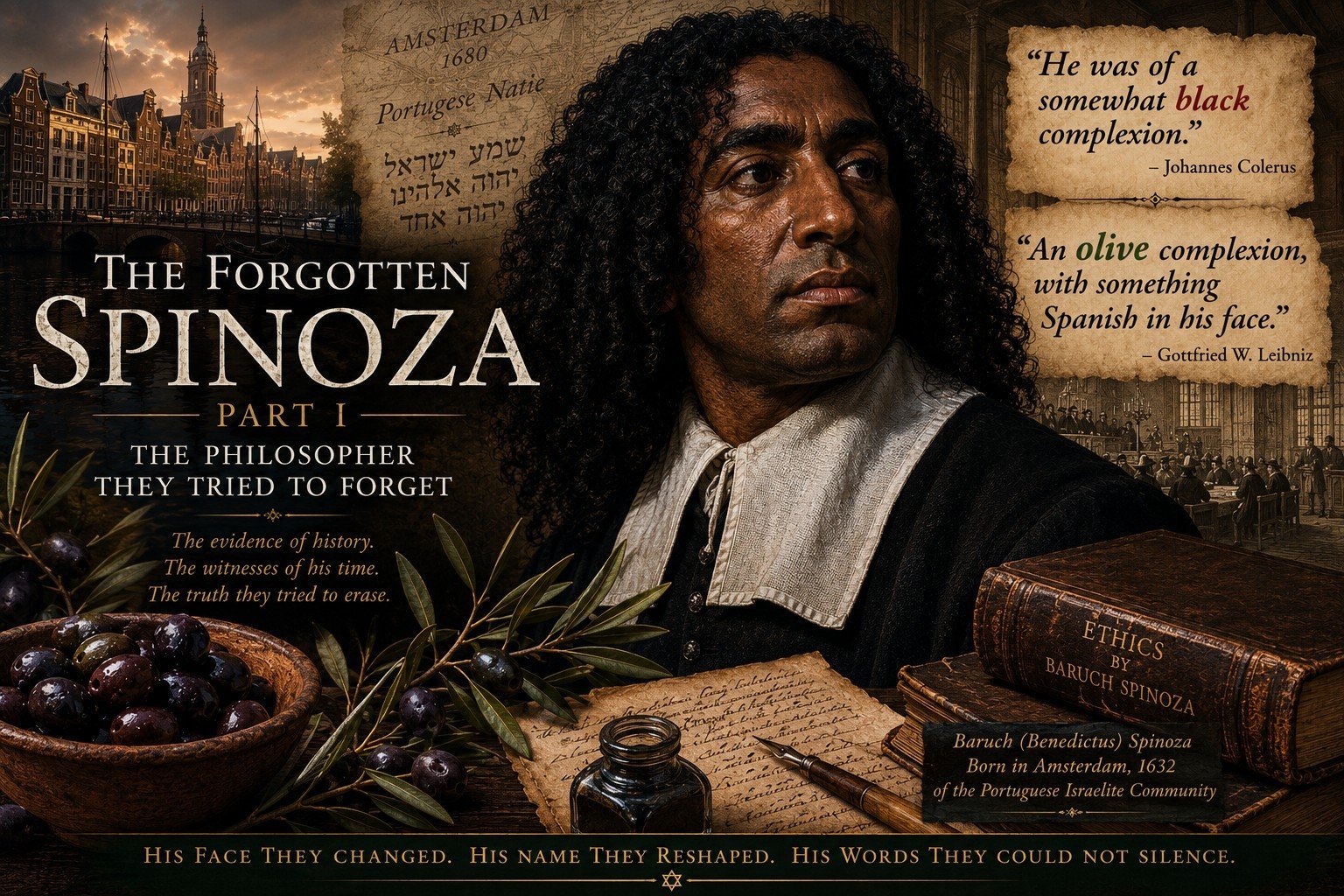
The first and most important witness is Johannes Colerus. Colerus became a minister at The Hague within a generation of Spinoza’s death — about sixteen years after — while many who had known the philosopher were still living. Determined to preserve his memory, he interviewed those who had known Spinoza personally, collected documents and examined his surviving possessions before publishing the earliest substantial biography.
Describing Spinoza’s appearance, Colerus records that he was of middle size, with good features, and —
the skin somewhat black, black curled hair, long eye-brows, and of the same colour, so that one might easily know by his looks that he was descended from the Portuguese Jews.
Johannes Colerus · The Life of Spinoza, 1705
This statement deserves careful attention. Colerus was not describing an imaginary figure. He was preserving the recollections of those who had known Spinoza while the memories were still fresh. His is the earliest surviving account of the philosopher’s appearance — and it does not stand alone.
Leibniz Meets Spinoza
Among the greatest intellectuals ever to meet Spinoza was the German philosopher Gottfried Wilhelm Leibniz. Unlike later artists, Leibniz required no imagination. He sat with Spinoza. He spoke with him. He observed him.
Years later he remembered the philosopher as possessing an olive complexion, with something distinctly Spanish in his face.
Modern readers frequently interpret the word olive according to present-day assumptions. Yet language changes. Historically, olive described a broad range of darker Mediterranean complexions. More importantly, the ripe olive itself is not pale green. It is commonly deep brown or black.
So the evidence lies not in a modern colour chart but in the testimony itself.
Colerus remembered a complexion somewhat black. Leibniz remembered a complexion olive, and a face something Spanish. Neither resembles the pale portraits that dominate modern publications.
These are independent observations, made by men who either knew Spinoza or interviewed those who did.
The Early Record, and How the Image Drifted
The earliest writers preserved Spinoza’s memory with care. Colerus wrote his life; Pierre Bayle gave him a long entry in his celebrated Dictionary a few decades after his death; others gathered what they could while the memory was still fresh. But of his face, it is Colerus and Leibniz who speak most directly — and both describe a dark man.
Only later did uncertainty appear. As the eyewitnesses died, portraits replaced memories. Engravings were copied from earlier engravings. Painters borrowed from other painters. Each generation inherited an image slightly further removed from the living man.
Portraits Are Not Photographs
One of the great mistakes made by modern readers is to assume that every historical portrait accurately represents its subject. Portraits are interpretations. Some are painted decades after death. Others rest on sketches of uncertain origin. Still others are imaginative reconstructions produced long after every eyewitness had died.
Spinoza suffered particularly from this. As his philosophy grew respected across Europe, artists produced portraits suited to the expectations of their own day. The philosopher grew gradually more refined. More European. More familiar to the audiences viewing him.
By the nineteenth century the transformation was largely complete. The dark-complexioned philosopher remembered by his contemporaries had become the pale philosopher reproduced in countless books.
It is, in the end, a simple thing to say:
He has been changed, in the popular eye, from black into nearly anything but.
Whether every modern portrait intended such a transformation is beside the point. The cumulative effect is unmistakable. The image remembered by eyewitnesses gave way, slowly, to the image preferred by later generations.
Why It Matters
Some will ask whether any of this is important. Does complexion really matter?
The answer is yes — not because philosophy depends upon the colour of a man’s skin, but because history depends upon truth. If eyewitnesses consistently describe a man one way, and later generations depict him another, the historian has a duty to ask why.
This is not identity politics, nor an attempt to enlist Spinoza in modern quarrels. It is fidelity to evidence. History belongs first to the witnesses. Paintings, however beautiful, cannot overturn the testimony of those who saw. Popular imagination cannot replace documented recollection. When the evidence survives, it deserves to be heard.
The Greater Transformation
Yet perhaps the greatest transformation was not Spinoza’s face. It was his philosophy.
Today he is celebrated as a champion of liberty, free thought and the Enlightenment. These descriptions are not wrong. But they are incomplete.
The same philosopher whose appearance was softened in the popular imagination also wrote some of the strongest criticisms ever directed against institutional Christianity. He accused churches of trading charity for hatred. He condemned ministers who sought power instead of truth. He rejected religion used as an instrument of political control. He warned against mistaking ceremony for righteousness.
And he wrote not as an outsider mocking religion, but as a man who believed that genuine obedience to God had been buried beneath superstition, ambition and ecclesiastical authority.
Those words have survived far better than the memory of the man who wrote them. That is where our story continues.
Part II turns from the face to the voice — Spinoza’s own indictment of the Christianity of his day, in his own words.