Reflections · The Forgotten Spinoza, Part II
Spinoza’s Indictment of Christendom
History remembers him as a champion of reason, and forgets the target of his sharpest words: the Christianity of his own day.
History remembers Baruch Spinoza as one of the fathers of modern philosophy. It remembers him as a champion of reason. It remembers him as an advocate of liberty.
What history rarely remembers is the object of his fiercest criticism.
Contrary to popular imagination, Spinoza did not spend most of his energy attacking the existence of God, nor did he devote himself simply to dismantling religion. His greatest concern was something far more immediate. He believed that institutional Christianity had drifted so far from its own profession that its conduct had become a contradiction of its message.
This was not the complaint of a modern sceptic looking back. It was the observation of a seventeenth-century philosopher watching Europe tear itself apart through religious conflict. Catholics and Protestants condemned one another. Reformed churches divided repeatedly. Governments persecuted dissenters. Theological disputes filled the universities while wars were fought in the name of Christ.
Against this background Spinoza wrote one of the most penetrating observations in religious history.
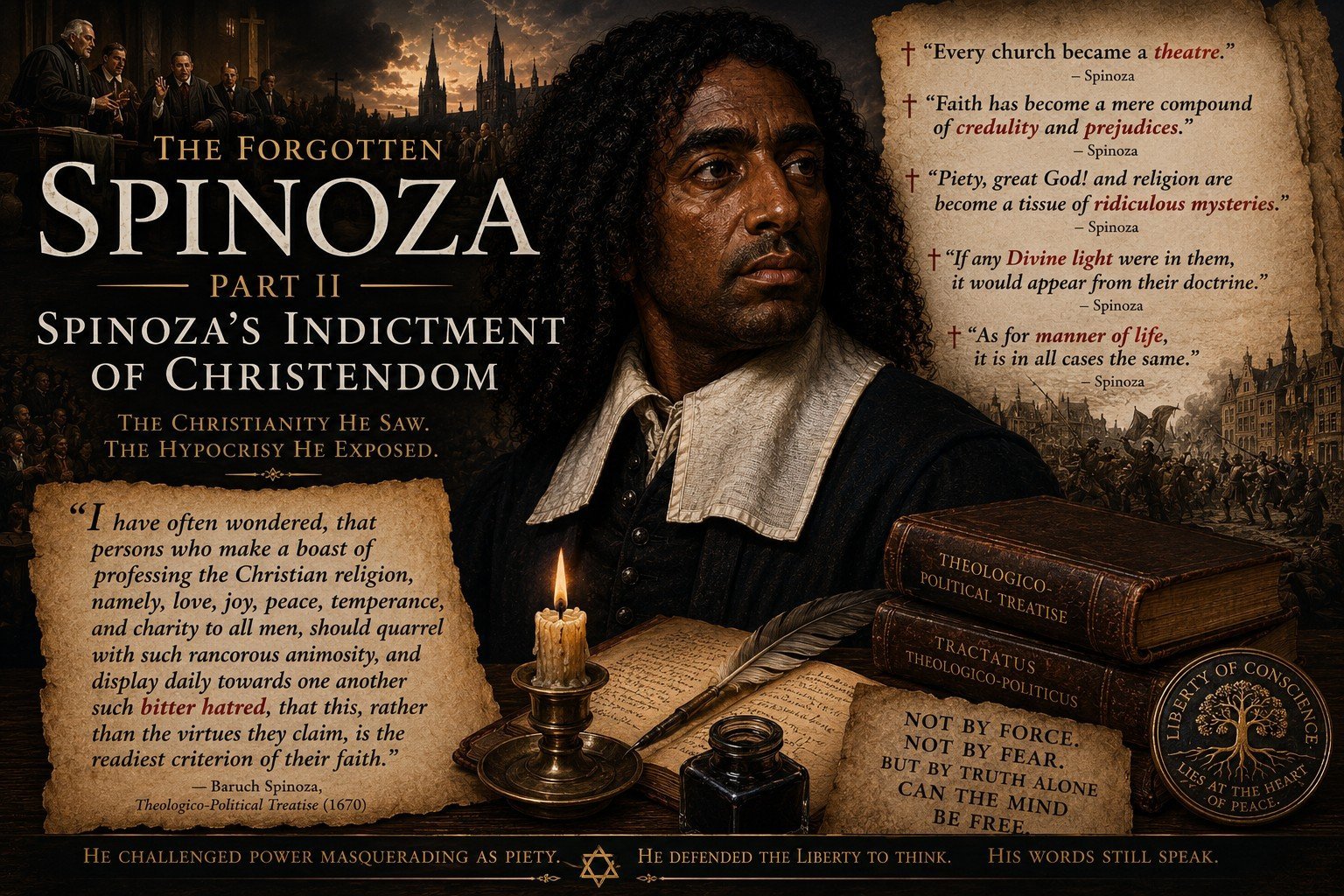
I have often wondered, that persons who make a boast of professing the Christian religion, namely, love, joy, peace, temperance, and charity to all men, should quarrel with such rancorous animosity, and display daily towards one another such bitter hatred, that this, rather than the virtues they claim, is the readiest criterion of their faith.
Baruch Spinoza · Theologico-Political Treatise, 1670
Few opening sentences in philosophy possess such force.
Notice what Spinoza does not say. He does not accuse Christians of holding the wrong doctrines. He does not begin by debating miracles. He does not question the existence of God. Instead, he points to behaviour.
If Christianity professed love, why was hatred so common among its followers? If charity was its defining virtue, why did bitterness become its distinguishing mark? According to Spinoza, one no longer recognised professing Christians by mercy, patience or compassion. One recognised them by the hostility they showed toward one another.
Religion Had Become Identity
Spinoza believed that religion had gradually been reduced to outward labels. People belonged to particular churches. They repeated familiar phrases. They observed particular ceremonies. They wore distinctive clothing. Yet beneath these external differences he found remarkably little variation.
As for manner of life, it is in all cases the same.
Baruch Spinoza
His criticism remains strikingly modern. Religious identity had become something one inherited rather than something one lived. To profess righteousness was easier than to practise it.
The Churches Became Theatres
One of Spinoza’s most memorable observations concerns the ministry itself. He lamented that —
Every church became a theatre.
Baruch Spinoza
The image is unforgettable. Instead of feeding the flock, preachers competed for applause. Instead of patiently explaining Scripture, they pursued originality. Instead of cultivating humility, they cultivated admiration. The pulpit became a stage. Congregations became audiences. Truth became performance.
The result was predictable.
This state of things necessarily stirred up an amount of controversy, envy, and hatred, which no lapse of time could appease.
Baruch Spinoza
For Spinoza, ambition had entered religion. Where ambition flourishes, peace rarely survives.
Faith or Credulity?
Spinoza believed that many religious leaders discouraged thoughtful inquiry.
Faith has become a mere compound of credulity and prejudices.
Baruch Spinoza
His concern was not with faith itself. It was with a faith that demanded submission without understanding. He feared that unquestioning acceptance could easily become an instrument of manipulation; the more extraordinary the claim, the less willing many became to examine it. For Spinoza, genuine faith and honest reason were never enemies. Truth had nothing to fear from investigation.
Religion Buried Beneath Mysteries
Spinoza’s frustration becomes unmistakable.
Piety, great God! and religion are become a tissue of ridiculous mysteries.
Baruch Spinoza
His complaint was not against reverence. It was against unnecessary obscurity. Religion had become increasingly occupied with speculative doctrines, philosophical systems and incomprehensible language, while neglecting justice, mercy and obedience. The simpler the teaching of Scripture, the more complicated the theologians seemed determined to make it.
The Measure of Godly Light
Perhaps Spinoza’s most profound observation is also one of his simplest.
If any Divine light were in them, it would appear from their doctrine.
Baruch Spinoza
He refused to judge religious leaders merely by their claims. He judged them by the fruit of their teaching. Did their doctrine produce charity? Did it produce humility? Did it produce compassion? Or did it produce anger, division and persecution?
If hatred continually followed their preaching, Spinoza questioned whether the light of God was in them at all.
Greek Philosophy and Scripture
Another of Spinoza’s enduring criticisms concerned biblical interpretation. He believed many theologians had approached Scripture through the philosophy of Plato and Aristotle, instead of allowing Scripture to explain itself. The prophets became philosophers. The apostles became metaphysicians. Simple biblical language was wrapped in centuries of speculation.
According to Spinoza, Scripture was increasingly interpreted through philosophy, rather than philosophy being judged by Scripture. Whether one agrees with him entirely or not, the warning deserves consideration. Every generation faces the temptation to make Scripture conform to inherited systems rather than allowing Scripture to challenge them.
Ceremonies and Righteousness
Spinoza also questioned the tendency to confuse ceremonies with holiness. Baptism. Communion. Festivals. Public prayers. These, he argued, could preserve the unity of a religious community, but they possessed no power in themselves to make a man righteous before God.
Ceremony without obedience remained ceremony. No outward act could substitute for justice. No ritual could replace charity. No institution could guarantee righteousness.
Religion and Power
Perhaps nowhere does Spinoza’s analysis feel more contemporary than in his treatment of power. He believed many religious controversies persisted not because truth was difficult to discover, but because influence was difficult to surrender.
Theological systems became institutions. Institutions accumulated wealth. Wealth produced authority. Authority defended itself. In such an environment, disagreement became dangerous. Questions became threats. Independent thought became rebellion. Religion, instead of liberating the conscience, began to govern it.
Liberty to Think
Spinoza’s solution was remarkable for his age. He argued that governments should not attempt to control thought, and that churches should not possess civil authority to compel belief.
Truth, he believed, required no violence. If an idea depended upon persecution for its survival, perhaps the idea itself deserved to be questioned. This conviction became one of the foundations of the modern understanding of liberty of conscience.
The Forgotten Warning
Many today admire Spinoza because they imagine him standing against religion. The record suggests something more careful.
He stood against hypocrisy. He stood against persecution. He stood against ambition dressed in piety. He stood against ministers who loved authority more than truth. He stood against ceremonies mistaken for righteousness. He stood against traditions that silenced honest inquiry.
Whether one accepts all of his conclusions is another matter; he challenged many doctrines that faithful readers of Scripture would continue to affirm. Yet his observations concerning religious hypocrisy still deserve careful reflection.
For whenever religion values power above truth — whenever institutions prize conformity above righteousness — whenever hatred becomes more visible than charity — whenever tradition becomes immune to examination — whenever men honour God with their lips while their conduct contradicts their profession — the warning of Baruch Spinoza still speaks.
Not only to Christianity, but to every religious institution that claims to represent the God of Abraham while forgetting the justice, mercy and truth that ought to distinguish His people.
Part III turns to the deepest loss of all — not his face, and not his voice, but the name of the God of his fathers.