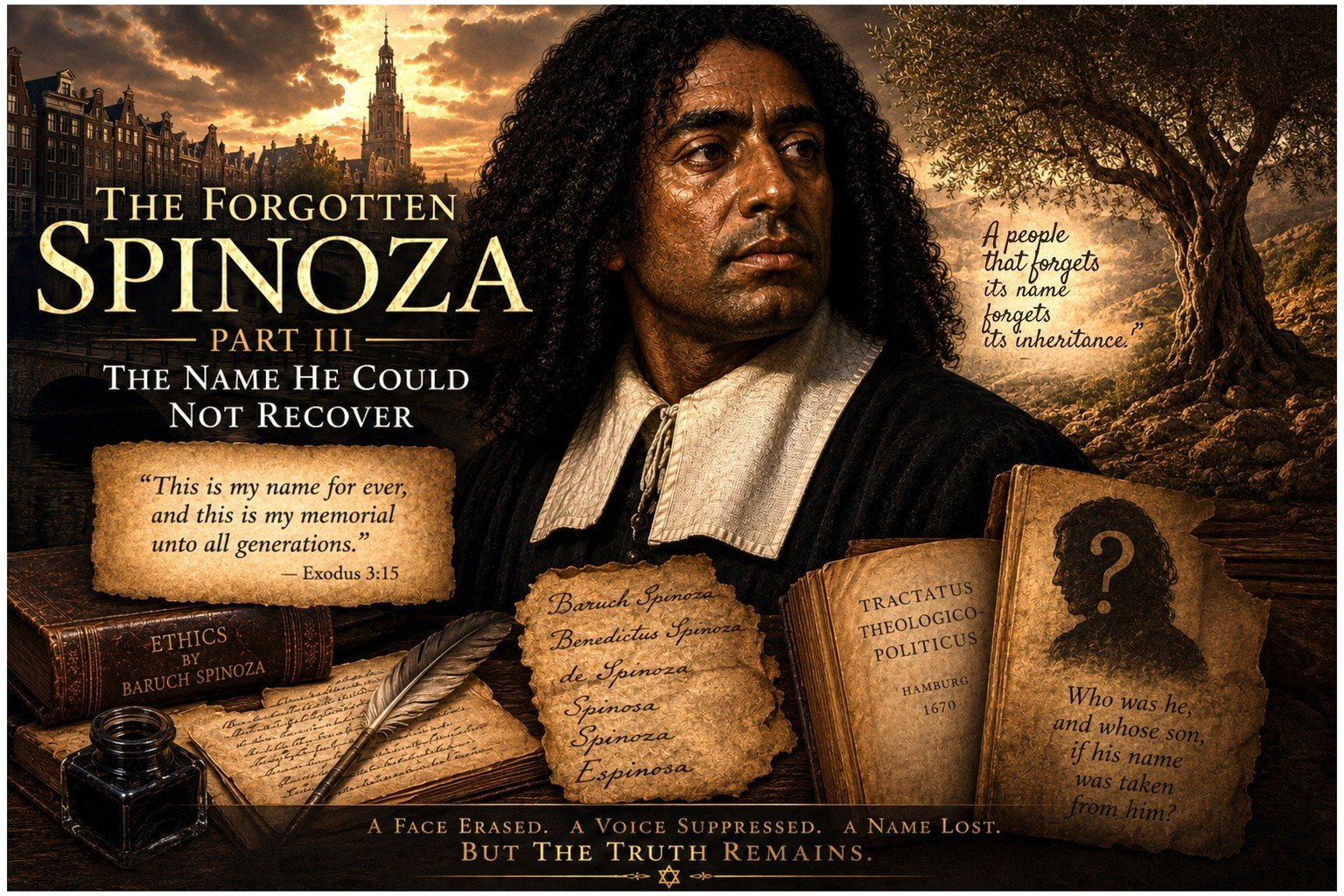
Reflections · The Forgotten Spinoza, Part III
The Name He Could Not Recover
His face was changed and his words were softened. But the deepest loss was the name of the God of his fathers.
In the first part of this study, we saw how the face of Baruch Spinoza was changed — how a man his own contemporaries remembered as dark was slowly repainted, generation by generation, until he had been changed, in the popular eye, from black into nearly anything but.
In the second, we heard the words they tried to forget — his indictment of a Christianity that had traded charity for hatred and truth for power.
Two losses. His appearance. His voice.
But there is a third loss, and it is deeper than the other two.
A face can be repainted, and the true one recovered from the testimony of those who saw it. Words can be softened, and the original found again upon the page. Those losses can be undone, because the evidence survives.
The third loss went to the root.
For the same Spinoza who could take Christendom apart with a single sentence came at last to the name of God. And there, for all his brilliance, something failed in him.
Two Answers at the Bush
When Moses stood before the burning bush and asked by what name he should make God known, he did not receive one answer. He received two.
The first:
And God said unto Moses, I AM THAT I AM: and he said, Thus shalt thou say unto the children of Israel, I AM hath sent me unto you.
Exodus 3:14
This is a declaration of being. It speaks of One who simply is — self-existent, answerable to no one, needing nothing outside Himself in order to be. It is a statement of sovereignty. I am who I am; why do you question Me? It is not, in itself, a personal name. It tells us that God is. It does not yet tell us who He is.
Then God speaks again:
And God said moreover unto Moses, Thus shalt thou say unto the children of Israel, The LORD God of your fathers, the God of Abraham, the God of Isaac, and the God of Jacob, hath sent me unto you: this is my name for ever, and this is my memorial unto all generations.
Exodus 3:15
Here is the name. Here is the memorial. And notice how different it is from the verse before it. The first answer declares that God is. The second tells us whose God He is — the God of the fathers, bound by covenant to Abraham, to Isaac and to Jacob, and given to be remembered for all generations.
The being and the memorial are not the same thing. The chapter sets them side by side, yet it keeps them apart. One is a truth about God’s existence. The other is the name of a relationship.
The Reader Who Chose the Being
Which of the two did Spinoza take up?
The answer is written in his own Theologico-Political Treatise, in its thirteenth chapter. Following the Israelite sage Maimonides, Spinoza argued that the four-letter name — the name printed in our Bibles as “the LORD” — was the only true name of God: the one name that expressed God’s absolute essence, without any relation to created things. Every other name, he said, described God only in His dealings with us.
Notice what has happened. Of the two answers given at the bush, Spinoza reached for the first. He reached for the being — the “I am,” the self-existence — and made it the highest and only true name of God.
And it suited him perfectly. His entire philosophy was built upon a single, self-existent substance that simply, necessarily, is. “I AM THAT I AM” fell into his system as though it had been made for it.
The memorial — the God of Abraham, of Isaac and of Jacob, the name to be kept for all generations — he treated as the lesser thing.
The Fathers Who “Did Not Know”
Then Spinoza came to another verse, and from it he drew a startling conclusion:
And I appeared unto Abraham, unto Isaac, and unto Jacob, by the name of God Almighty, but by my name JEHOVAH was I not known to them.
Exodus 6:3
Spinoza read these words to mean that the patriarchs had never known the name of God’s essence at all. They had known Him by His works, His promises and His power — but not, he concluded, in His essence.
Read that slowly. The fathers — Abraham, Isaac and Jacob — the very men whom Scripture binds together as the memorial “unto all generations” — become, in Spinoza’s reading, the ones who did not truly know God.
He kept the being. He let go of the covenant.
To be fair to him, this reading of Exodus 6:3 was not his own invention. It came down to him from Maimonides, and others before him had said much the same. But what Spinoza did with it was his own. He took the essence and set it above the covenant. He set the God who can be reasoned out above the God of the fathers who must be received.
The Philosopher’s God and the God of the Fathers
There is a difference between the God a man arrives at by thinking and the God a man inherits from his fathers.
The God of Exodus 3:14 — the pure “I am,” the self-existent being — can be reasoned to. A mind brilliant enough, working alone, can climb to the idea of a single necessary substance. Spinoza climbed there. He is among the few who ever did.
But the God of Exodus 3:15 — the God of Abraham, of Isaac and of Jacob — cannot be reasoned to. He must be handed down. He is not the conclusion of an argument. He is an inheritance, passed from father to son, generation to generation, as a memorial that was never meant to be worked out afresh by each man on his own.
Spinoza reasoned his way to the being. He had no one to hand him the memorial.
Why the Inheritance Was Broken
And here is the sorrow of it — the reason this third loss is the heaviest of the three.
Remember who Spinoza was. He was a son of the Portuguese Israelite community of Amsterdam — the descendants of those whom the Inquisition had driven into hiding. For generations his people had survived by concealment: professing one faith in the open street while remembering another behind a closed door.
A people who survive by hiding what they are do not pass down everything intact. Something is always spent in the hiding. The chain that carries a name from father to son — the memorial meant for all generations — had been strained, across his family’s history, almost to breaking.
So when Spinoza reached back for the God of his fathers, he could not lay hold of the whole of Him. He found the being — the part a great mind can reach on its own. He could not recover the covenant — the part that can only be received.
His blindness was not a simple refusal to believe. It was the measure of how much had already been taken from his people before ever he was born.
The Witness to the Loss
So the three transformations are, in the end, one.
His face was changed — from black into nearly anything but. His voice was softened — his indictment of Christendom reduced to a slogan about liberty. And his grasp of the name of God was narrowed to the being, with the covenant memorial left behind.
The face. The voice. The name. Each one a form of the same forgetting.
Spinoza is not the villain of this story, and he is not its hero. He is its witness. He saw the corruption of the churches with a clearness his age could not equal — and he could not name the covenant he had lost, because the covenant was the very thing that had been taken from him. His brilliance and his blindness, set side by side, are the measure of what was lost.
Yet the memorial was given “unto all generations.” That is not a small phrase. It means the name was never meant to end with any one man, nor to die with any one generation. The God of Abraham, the God of Isaac and the God of Jacob did not cease to be the God of the fathers because a son could no longer find his way back to Him. The name still stands. The memorial still waits.
What Spinoza reached for and could not hold is not lost forever. It was only lost to him.
And perhaps that is the truest reason to remember the forgotten Spinoza — not only the face they changed and the words they softened, but the name he reached for in the dark and could not recover.
For what he could not recover, we are still able to seek.
The book at the centre of this series — Spinoza’s Theologico-Political Treatise — is where his critique of Christianity and his reading of the name of God sit on the same pages. Read it with your King James Bible open beside it.